Our Cyber Monday Deal:
Through December 31, 2025, we’re opening up free access to The Exchange Daily and The Exchange Weekly for IT and business leaders who want signal, not noise.
Activate this year-end offer and you’ll get, at no cost through 12/31/2025:
Full access to The Exchange Daily – a concise, C-suite-ready briefing on AI, cyber, cloud, and federal IT.
Full access to The Exchange Weekly – a deeper, strategic newsletter that connects headlines to budgets, risk, and long-term planning.
An executive-focused view built for CIOs, CTOs, CISOs (Sissos), VPs of IT, and senior architects.
This is designed for leaders who:
Are tired of chasing tech headlines and want one trusted briefing that’s already filtered for impact.
Need ready-to-forward summaries for their direct reports, PMOs, and security teams.
Want to benchmark 2026 plans against what’s actually changing in AI, cyber, and cloud right now.
Sign up now, enjoy free access through December 31, 2025, and then decide if you want to continue at the standard subscription rate going into 2026.
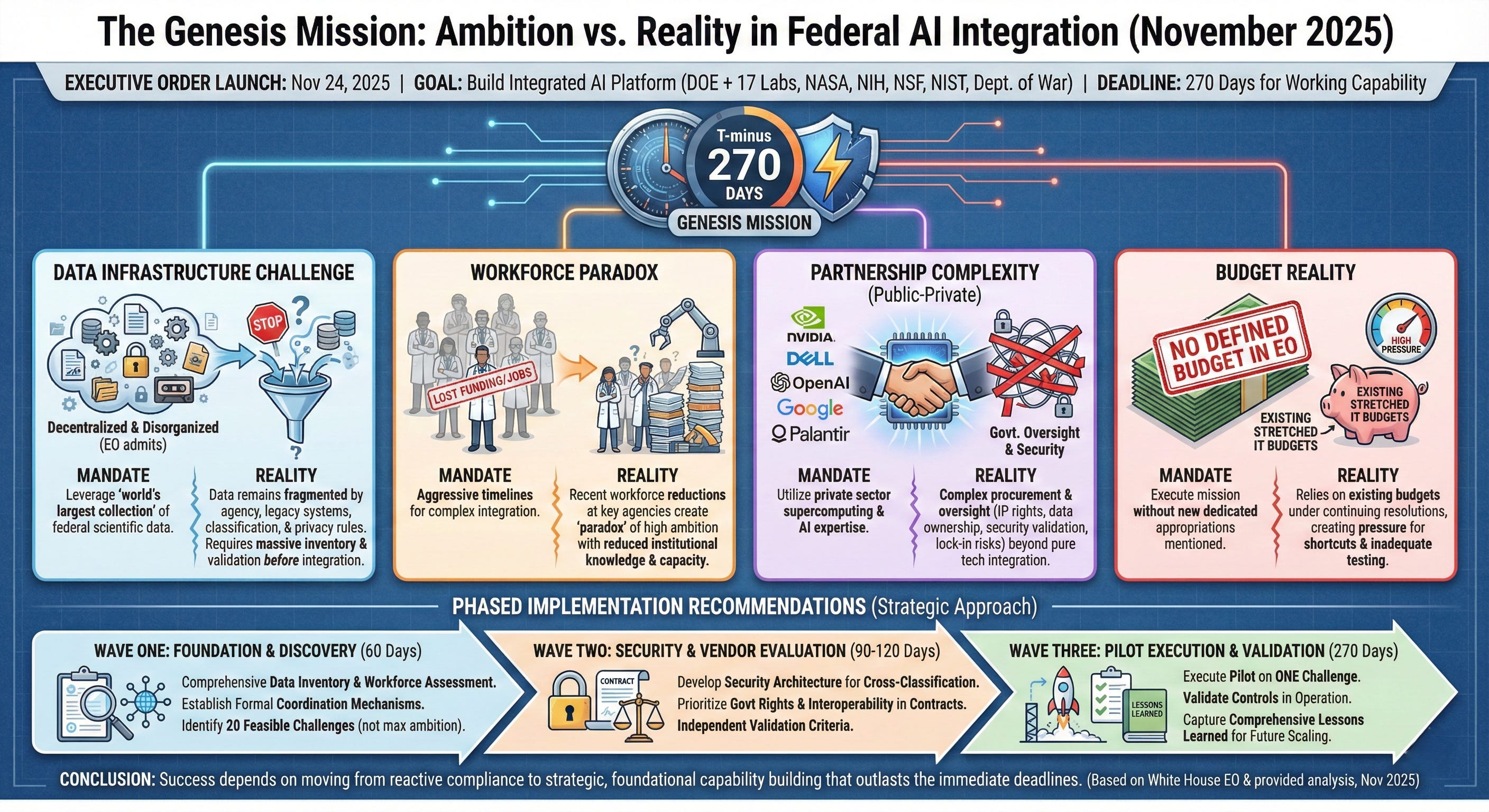
On November 24, 2025, President Trump signed an Executive Order launching what the White House bills as the largest mobilization of federal scientific resources since the Apollo Program. The Genesis Mission directs the Department of Energy to build an integrated AI platform on top of scientific data from 17 National Laboratories plus NASA, the National Institutes of Health, the National Science Foundation, the National Institute of Standards and Technology, and the Department of War. Agencies have 270 days to demonstrate working capability.
The ambition is undeniable. The scale is unprecedented. The timeline is aggressive.
But beneath the headlines sits a harder reality: Genesis layers Apollo-scale expectations onto fragmented data infrastructure, agencies that have just shed thousands of scientists and engineers, complex public-private partnerships with unresolved questions about data rights and security controls, and IT budgets already dominated by simply keeping legacy systems alive.
For Exchange Weekly readers, the real story isn’t whether Genesis is “big.” It’s whether federal science leaders treat it as a rushed compliance exercise or as a once-in-a-decade catalyst to fix foundational problems they already know they have.
The short version: Four tensions that will define Genesis
If you’re skimming, here are the core tensions that will drive outcomes:
Tension 1: A centralized AI vision sitting on top of decentralized, poorly cataloged data.
Tension 2: Platform ambition launched just after major cuts to the scientists and engineers who understand the data.
Tension 3: Heavy reliance on commercial AI providers without fully resolved questions about data rights, security validation, and long-term vendor dependence.
Tension 4: Comparisons to Apollo and the Manhattan Project without Apollo-style dedicated funding or wartime budget flexibility.
How leaders navigate these tensions over the next 270 days will matter far more than the rhetoric in the press release.
Tension 1: Centralized AI vs decentralized, poorly cataloged data
The Executive Order itself highlights both the opportunity and the problem. It describes federal scientific data as one of the world’s largest collections of research datasets, representing decades of public investment. At the same time, public reporting has characterized this trove as “decentralized and disorganized,” a gold mine that remains largely untapped by modern AI systems.
That’s not consultant hyperbole or vendor marketing. It is the government and its own overseers acknowledging that the data foundation for Genesis is fragmented, hard to inventory, and unevenly documented.
Bringing 17 National Labs and multiple science agencies into a single AI platform is not as simple as streaming a few tables into a foundation model. Consider only three of the players:
Department of Energy. Nuclear weapons research and other highly classified datasets tied to security protocols built over decades of Cold War compartmentalization.
NASA. Decades of telemetry, Earth observation, and international mission data, with export-control and technology-transfer constraints woven through.
NIH. Medical and bioscience research governed by HIPAA, the Common Rule, a patchwork of international agreements, and ethics regimes that assume humans—not AI agents—are the primary downstream consumer.
Each organization operates under different classification rules, retention policies, and data management cultures. They were never designed to feed a single cross-agency AI layer.
The Executive Order gives agencies 60 days to identify 20 scientific challenges of national importance. That deadline implicitly assumes agencies already know:
What data they have.
Where it lives across legacy and modern systems.
How it is classified today—and whether those labels are still accurate.
What standards and formats are in use or were quietly bypassed.
How dependencies thread across systems and organizations.
Yet the same documents and reporting that celebrate Genesis also concede that the underlying data remains fragmented. Before anyone can safely integrate or share across classification and agency lines, they must do unglamorous work:
Inventorying datasets across decades of systems.
Reconciling classification decisions that may have drifted.
Filling documentation gaps where institutional memory has been doing the work of metadata.
None of this happens automatically because a President signs an order. It happens only if agencies invest scarce time in groundwork that will not make any press release.
Tension 2: Platform ambition vs shrinking institutional memory
The workforce picture compounds the data challenge. Reporting in late November noted that thousands of scientists and staff at the very agencies now central to Genesis—DOE, NASA, NIH, and others—had recently lost jobs and funding.
This creates a paradox no amount of compute can solve: Genesis assumes a deep reservoir of institutional knowledge at the exact moment when that knowledge base has been thinned.
Scientific datasets are not just numbers stored in object buckets. They are:
Instruments, calibrations, and site selections.
Quality-control routines developed and revised over years.
Assumptions and caveats that may live only in a lab notebook or a senior scientist’s head.
Informal cross-walks between datasets that were never fully documented but are essential for correct interpretation.
When a researcher who spent twenty years on a specific instrument or campaign walks out the door, they often take unique context with them:
Why certain data periods should never be used in trend analysis.
Which calibration runs were suspect.
Which file naming quirks encode critical meaning and which are historical accidents.
The same is true at the systems level. Integration planning requires staff who understand not just current architecture diagrams, but also the budget decisions, technology constraints, and crisis-driven workarounds that shaped them. That history determines where fragile dependencies sit and where integration might introduce subtle failures.
So when Genesis arrives immediately after large workforce reductions, agencies don’t just lose bodies. They lose:
The people who know where the data really lives.
The people who can explain hidden coupling between systems.
The people who have seen previous modernization attempts and know why they failed.
The Executive Order’s timelines implicitly assume workforce stability and knowledge continuity. Reality looks very different. That mismatch is a core execution risk.
Tension 3: Commercial capacity vs public-interest guardrails
The Executive Order explicitly calls out companies like Nvidia, Dell, OpenAI, Google, and Palantir as partners who will provide supercomputing capacity and AI platforms, with the government pledging to maintain “controls to respect protected information.”
From a technical standpoint, this is rational. These firms have:
Specialized processors and accelerators at scale.
Optimized AI frameworks and orchestration layers.
Staff who run large AI clusters in production every day.
Building that capacity from scratch inside government would take years.
But reliance on commercial AI infrastructure for national science raises thorny questions that live at the intersection of procurement, security, and intellectual property—not just at the level of GPUs and tokens per second:
Who owns the models and derivative artifacts trained or tuned on federal datasets.
What rights vendors gain to reuse or learn from workloads that flow through their platforms.
How security controls are specified and validated when national security or sensitive data runs on third-party systems.
What happens when a vendor relationship changes—commercially or geopolitically.
The EO’s language about “maintaining controls” only matters if those controls are:
Written into contracts up front in sufficient detail.
Independently validated before platforms are declared operational.
Continuously monitored with real consequences for non-compliance.
Agencies have 120 days to develop plans for data integration and computing resources. Within that window they must:
Evaluate vendors on criteria that prioritize federal data rights, portability, and independent security validation.
Negotiate contract terms that avoid lock-in and protect against overly broad license rights to derivative works.
Build in requirements for external testing of security controls and clear government visibility into architectures.
Stand up pilot environments that test security assumptions under real workloads.
Commercial firms will, quite rationally, push for terms that favor their business models—broad reuse rights, minimal external scrutiny of proprietary security designs, pricing that creates switching costs. It will be up to program leadership, contracting officers, and counsel to hold the line where public interests and long-term flexibility are at stake.
Palantir is the most visible example, with a long track record of federal work and well-defined preferences for how its platforms are deployed and licensed. But similar tradeoffs will exist with every named partner. Technical capability does not automatically mean alignment with government’s long-term governance and competition goals.
Tension 4: Manhattan-scale rhetoric vs incremental funding reality
Commentary has already framed Genesis as the most ambitious mobilization of federal science resources since the Apollo Program or, in some respects, the Manhattan Project.
There are important differences.
The Manhattan Project operated under wartime conditions with extraordinary secrecy and essentially unconstrained funding justified by existential threat.
Apollo benefited from dedicated Congressional appropriations on the order of tens of billions of 1960s dollars, allocated specifically for lunar landing and associated capabilities over a relatively compressed period.
By contrast, the Genesis Mission launches:
Without a clearly defined, ring-fenced budget line.
Under continuing resolutions and tight discretionary caps.
Into IT environments where most spending is already spoken for.
Recent budget data illustrates the constraint. For FY 2024, major federal agencies planned to spend roughly 95 billion dollars on information technology. About 74 billion of that goes to operating and maintaining existing systems. Only around 21 billion is allocated to development, modernization, and enhancements.
Genesis does not arrive on top of an unused pool of “AI money.” Agencies must:
Maintain aging, mission-critical systems.
Respond to evolving cybersecurity requirements.
Advance other modernization efforts that were already underway.
All while somehow:
Mobilizing 17 National Labs.
Building cross-agency data integration.
Negotiating, procuring, and overseeing new AI partnerships.
Designing and validating new security architectures.
In this context, the risk is not lack of enthusiasm. It is the temptation to:
Cut corners on validation and testing.
Accept vendor-friendly contract language to move faster.
Treat the 270-day deadline as a go-live date rather than a structured pilot milestone.
The pressure is real. The budget constraint is real. They will shape behavior.
Three waves for executing Genesis without breaking the system
For Exchange Weekly readers inside government—or advising it—the most constructive response is not to debate the EO’s existence but to shape how it is implemented. A pragmatic approach is to treat Genesis as three waves, each building on the last:
Wave One – Foundation and Discovery (0–60 days)
The instinct will be to race toward AI use cases. Resist it. Within the first 60 days, agencies should focus on:
Data asset inventory. Not just what exists in theory, but where it actually resides, how it is classified, how it is accessed today, and where documentation is missing.
Workforce capacity map. Identify surviving pockets of institutional knowledge and critical gaps created by recent departures. Understand where external support will be mandatory because internal expertise has been lost.
Formal interagency coordination. Move beyond informal relationships. Establish documented decision-making forums, escalation paths, and information-sharing procedures, especially across classification boundaries.
Realistic selection of 20 challenges. Choose scientific challenges based on feasibility under current constraints, with clear success criteria, not on maximum rhetorical impact.
Wave One is where you either build a foundation or set the stage for compounded risk. Work skipped here reappears later as security incidents, integration failures, and governance surprises.
Wave Two – Security Architecture and Vendor Evaluation (60–120 days)
With baseline inventories and governance in place, the next phase should focus on designing security and selecting partners.
Key activities:
Security architecture design. Define how data at different classification levels will flow, where controls will be enforced, how access will be monitored, and how incidents will be detected and contained. Align with existing NIST and sector-specific frameworks, but be explicit about AI-specific risks such as training-data exposure and model-inference leakage.
Vendor evaluation criteria. Go beyond performance benchmarks. Require concrete commitments on data rights, derivative works, portability, interface openness, and third-party security validation.
Contract structures that preserve leverage. Avoid single-vendor architectures that make it practically impossible to switch later. Build in performance metrics, termination rights, and security obligations that are enforceable in practice.
Pilot security validation. Before any large-scale integration, run meaningful pilots that test controls, logging, monitoring, and incident response with real (but carefully scoped) data.
Wave Two is where federal leaders decide whether Genesis will be an open, governable architecture—or an assemblage of opaque vendor silos tied together with PowerPoint and hope.
Wave Three – Pilot Execution and Validation (120–270 days)
The 270-day deadline should be treated as a proof-of-concept milestone, not a hard “go-live” date for full production systems.
Within this window:
Select 1–3 pilot challenges from the original list of 20 that have the clearest data quality, most engaged stakeholders, and least sensitive risk profile.
Exercise security and governance under real workloads. Monitor access patterns, validate that controls function as designed, and test incident response.
Capture lessons learned aggressively. Document unexpected dependencies, performance bottlenecks, governance friction points, and gaps in training or documentation.
Adjust architectures and practices based on pilot outcomes before attempting broader scale.
The goal is not to win a race against an arbitrary clock. It is to demonstrate that AI-enabled science platforms can be built in ways that are secure, governable, and repeatable.
Genesis as burden vs catalyst
Federal executives can experience Genesis in two very different ways.
Option 1: Compliance burden.
Treat the EO as a checklist:
Stand up a steering committee.
Collect some use cases.
Run a pilot with a vendor willing to produce a nice dashboard in time for a briefing.
Declare partial victory and move on.
This path minimizes short-term disruption and budget fights. It also produces brittle, narrow solutions that will atrophy as soon as leadership attention shifts.
Option 2: Modernization catalyst.
Use Genesis to justify and accelerate work that many CIOs, CISOs, and chief data officers already know is overdue:
Cleaning up data catalogs and metadata.
Rationalizing overlapping systems and shadow pipelines.
Modernizing security architectures for AI-inflected workflows.
Rebuilding workforce capacity around data engineering, MLOps, and AI governance.
Genesis deadlines can create political cover and urgency for investments in data infrastructure and workforce development that have historically been hard to prioritize against daily operational fires.
The difference between these paths is not primarily technical. It is about how leaders frame Genesis inside their organizations:
As a short-term mandate to be minimized.
Or as a forcing function to systematically address foundations that will determine the next decade of federal science and technology capability.
The strategic choice facing federal science leaders
December 2025 marks the start of the 60-day clock for Genesis’ first milestone: identifying 20 scientific challenges. The work—or the avoidance—begins now.
Agencies that use the next few months to inventory data, map workforce realities, and put serious governance around security and vendor choices will not just “comply” with Genesis. They will emerge with:
Better visibility into their own scientific assets.
Stronger security and data-sharing architectures.
A clearer view of where they must rebuild institutional capacity.
Agencies that wait for more guidance, more budget clarity, or the next political signal will find themselves cramming at the end of each deadline window, with predictable outcomes.
Genesis is both a significant challenge and a genuine opportunity. Its success or failure will tell us less about AI than about the ability of large public institutions to align ambition, infrastructure, workforce, and governance under pressure.
The question is not whether Genesis is hard. It plainly is.
The question is whether your organization will experience it as a rushed, one-off compliance exercise—or as the moment you finally used a political mandate to fix the foundations of your data, security, and science platforms.
Sources
Executive Order – Launching the Genesis Mission – The White House – November 24, 2025 – https://www.whitehouse.gov/presidential-actions/2025/11/launching-the-genesis-mission/
Fact Sheet: President Donald J. Trump Unveils the Genesis Mission to Accelerate AI for Scientific Discovery – The White House – November 24, 2025 – https://www.whitehouse.gov/fact-sheets/2025/11/fact-sheet-president-donald-j-trump-unveils-the-genesis-missionto-accelerate-ai-for-scientific-discovery/
Trump signs executive order for AI project called Genesis Mission to boost scientific discoveries – Federal News Network – November 25, 2025 – https://federalnewsnetwork.com/technology-news/2025/11/trump-signs-executive-order-for-ai-project-called-genesis-mission-to-boost-scientific-discoveries/
Trump Orders Genesis Mission to Advance AI Breakthroughs – Scientific American – November 25, 2025 – https://www.scientificamerican.com/article/trump-orders-genesis-mission-to-advance-ai-breakthroughs/
Trump signs executive order launching Genesis Mission AI project – NBC News – November 24, 2025 – https://www.nbcnews.com/tech/tech-news/trump-signs-executive-order-launching-genesis-mission-ai-project-rcna245600
Energy Department Launches “Genesis Mission” to Transform American Science and Innovation Through the AI Computing Revolution – U.S. Department of Energy – November 24, 2025 – https://www.energy.gov/articles/energy-department-launches-genesis-mission-transform-american-science-and-innovation
Trump announces AI “Genesis Mission.” Here’s what it means for energy costs – Axios – November 25, 2025 – https://www.axios.com/2025/11/24/trump-ai-genesis-mission-doe-chris-wright
Trump signs executive order launching “Genesis” mission to expedite scientific discovery using AI – CBS News – November 24, 2025 – https://www.cbsnews.com/news/trump-executive-order-genesis-mission-ai-scientific-discovery-super-computer/
This update was assembled using a mix of human editorial judgment, public records, and reputable national and sector-specific news sources, with help from artificial intelligence tools to summarize and organize information. All information is drawn from publicly available sources listed above. Every effort is made to keep details accurate as of publication time, but readers should always confirm time-sensitive items such as policy changes, budget figures, and timelines with official documents and briefings.
All original content, formatting, and presentation are copyright 2025 Metora Solutions LLC, all rights reserved. For more information about our work and other projects, drop us a note at info@metorasolutions.com.