
Executive Summary
This week marked a structural inflection point in federal IT contracting. On February 20, the General Services Administration announced Phase 1 awards for the Alliant 3 Governmentwide Acquisition Contract (GWAC), selecting 43 vendors from 133 proposals for an uncapped, 10-year vehicle covering systems engineering, cloud services, cybersecurity, data solutions, software development, and emerging technologies (Source: GSA.gov, February 20, 2026; SAM.gov award notice, February 20, 2026). Simultaneously, the Department of State finalized 48 awards across its EVOLVE IDIQ functional areas. The Office of Management and Budget advanced efforts to restore agency CIO authority over IT acquisitions. A proposed FAR rule on covered semiconductors moved forward with comments due April 20. These events converged with the Department of Homeland Security’s $1 billion Blanket Purchase Agreement to Palantir Technologies (awarded February 12, reported February 19) and continued operationalization of OMB Memorandum M-26-04, tightening AI procurement guardrails.
Want to see the whole article, including the infographics and details? Subscribe today.
Already subscribed? Thank you! Your contributions help to make this newsletter continue.
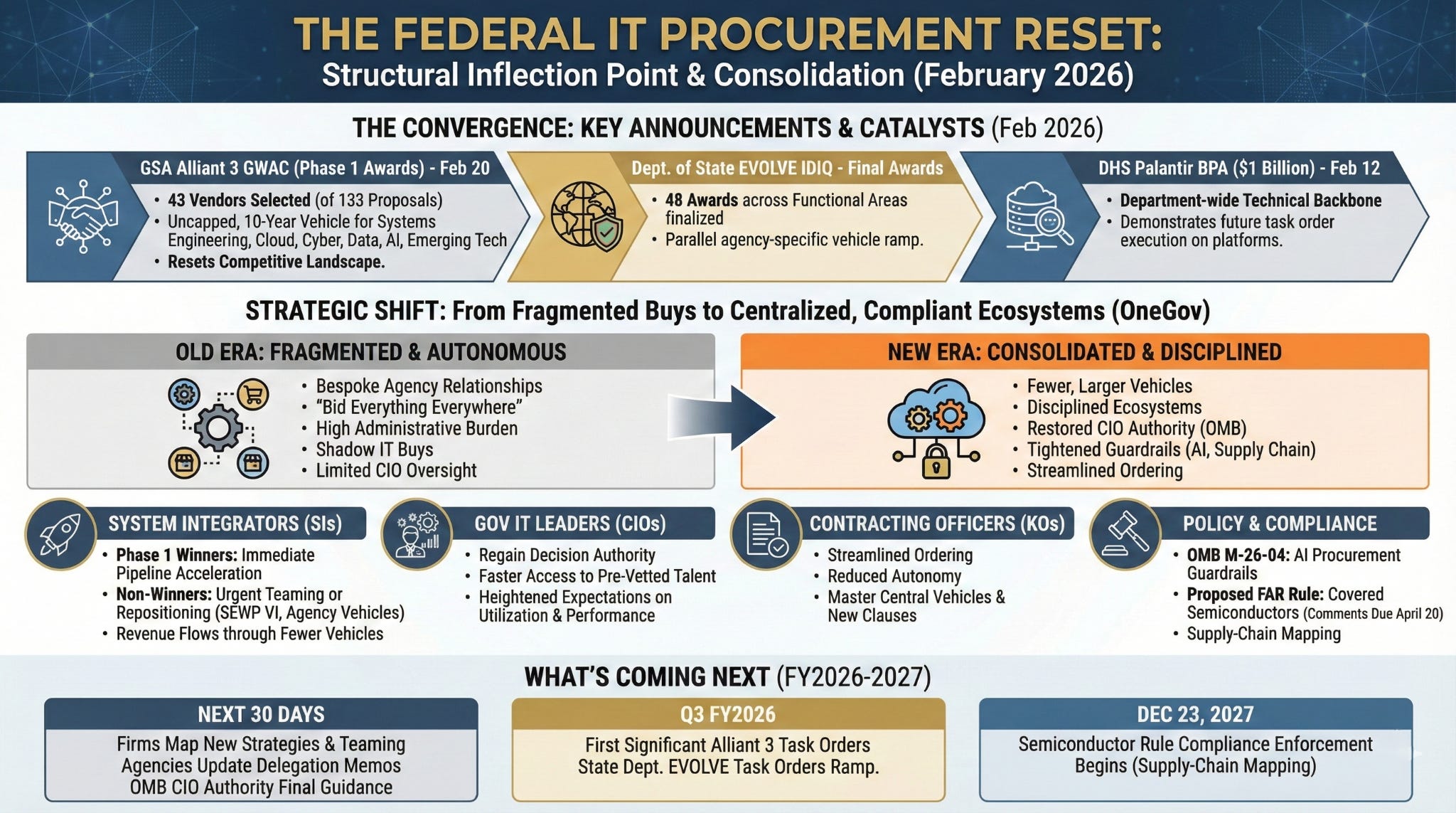
The Alliant 3 Phase 1 outcome is not routine recompete news. It resets the competitive landscape for the next decade by determining prime access to task-order flow under a vehicle designed with no dollar ceiling, explicit support for OneGov centralization, and a broad scope that includes the very AI and data platforms now being consolidated elsewhere. System integrators on the Phase 1 list gain immediate pipeline acceleration. Those outside it face urgent teaming decisions or repositioning toward SEWP VI, agency-specific vehicles, or later Alliant phases (up to 76 total awards planned). Non-bidders must now map alternative routes.
This reset arrives at the precise moment when agency CIOs are regaining decision authority, supply-chain compliance is tightening, and platform plays like the DHS-Palantir BPA demonstrate how task orders will be executed. For service providers, the week clarified that revenue in 2026 and beyond will flow through fewer, larger, more disciplined vehicles rather than fragmented agency buys. Government IT leaders see faster access to pre-vetted talent pools, but with heightened expectations around utilization rates and performance data. Contracting officers gain streamlined ordering but lose some autonomy as CIOs reassert oversight.
Secondary developments reinforced the theme. The DHS-Palantir BPA creates a department-wide technical backbone that future Alliant 3 task orders will almost certainly support. Operationalization of OMB M-26-04 adds compliance layers that winners must price and document immediately. The semiconductor rule preview (effective December 23, 2027) forces supply-chain mapping for any hardware-adjacent work under these vehicles.
The net result is a procurement architecture reset that favors firms ready to operate inside centralized, compliant ecosystems. Firms that treat this week as isolated announcements will lose ground to those who see the convergence. The next 30 days will separate those mapping new capture strategies from those waiting for the next RFP. This newsletter prioritizes the Alliant 3 story for its unmatched revenue and positioning impact on system integrators while weaving in the supporting shifts that define execution realities.
Top News: Procurement Architecture Reset – Alliant 3 Phase 1 Awards and the Consolidation of Federal IT Access
What Happened This Week
On Friday, February 20, GSA posted the Phase 1 award notice for Alliant 3 (Solicitation 47QTCB24R0009). After evaluating 133 proposals, GSA made awards to 43 offerors. The vehicle carries no maximum dollar ceiling and a 10-year ordering period. GSA has signaled that it will continue phased awards until approximately 76 recipients (plus ties) are reached. No offeror is eliminated; debriefings come only after all phases close (Source: SAM.gov, February 20, 2026; GSA.gov news release, February 20, 2026).
The same week, the Department of State finalized 48 awards under its EVOLVE IDIQ across five functional areas, following protests. OMB reiterated the need to finalize guidance restoring CIO authority to review all agency IT acquisitions, demand utilization and pricing data, and enforce performance clauses. On February 17, the FAR Council published a proposed FAR rule implementing FY2023 NDAA restrictions on covered semiconductor products and services, with a compliance date of December 23, 2027.
These procurement events coincided with the DHS $1 billion, five-year BPA to Palantir (awarded February 12, reported February 19 by Wired, non-competed, department-wide for Gotham, Foundry, and related implementation services) and continued operationalization of OMB Memorandum M-26-04, reinforcing risk-tiered AI governance in procurements (Source: White House, December 11, 2025).
Why It Matters (Prioritized by Audience)
1. System Integrators and Service Providers
Alliant 3 Phase 1 winners secure preferred access to what is expected to exceed the $82.5 billion ceiling of Alliant 2. Task orders will cover the full spectrum of federal IT modernization, including the exact capabilities agencies are now consolidating onto platforms like Palantir. Winners can accelerate capture pipelines immediately; non-winners must identify teaming partners among the 43 (or await later phases) or redirect resources to SEWP VI and agency vehicles. The revenue implications are direct: firms on the vehicle can price more competitively on large orders because overhead is spread across guaranteed access rather than through repeated full-and-open competitions. Firms that relied on bespoke agency relationships now compete inside a smaller, more disciplined ecosystem where utilization metrics and past performance on the vehicle will dominate evaluations.
2. Government IT Workers and Leaders
Agency CIOs regain practical control. The restored authority means IT leaders can require contractors to submit utilization reports and pricing benchmarks before task-order award. This reduces “shadow” buys outside approved vehicles and accelerates delivery of modernization programs. Leaders now have a clearer, pre-vetted pool of 43-plus providers for complex work, but must build internal processes to leverage the vehicle without creating new bottlenecks. The convergence with AI guardrails and semiconductor rules means CIOs must update acquisition strategies now to avoid funding delays later in FY2026.
3. Government Contracting Officers
KOs gain speed through pre-competed terms but operate under stronger CIO oversight. Task orders under Alliant 3 require less source selection time yet must incorporate new clauses on utilization rates, semiconductor compliance, and AI risk tiers. The shift favors KOs who master the new central vehicles rather than agency-unique vehicles that may face consolidation pressure.
4. All Others
Policy analysts and industry observers see confirmation of the administration’s OneGov centralization agenda. Procurement volume consolidates into fewer vehicles, administrative burden for agencies decreases, and taxpayer value improves through competition at the IDIQ level rather than the task-order level. The semiconductor rule adds national security supply chain discipline that will ripple through the entire federal IT hardware ecosystem.
Strategic Context
Alliant 3 embodies the deliberate move from fragmented agency buying to centralized, scalable access. Alliant 2 started with a $50 billion ceiling in 2018 and grew through ceiling increases; Alliant 3 removes the ceiling entirely because demand for enterprise IT services, cloud migration, cybersecurity, and emerging technology integration continues to outpace prior forecasts. The simultaneous State EVOLVE awards and OMB CIO authority push reinforce the same pattern: reduce duplication, enforce data-driven decisions, and channel spending through disciplined vehicles.
The DHS-Palantir BPA illustrates exactly how these vehicles will be used. Rather than dozens of separate data-analytics contracts, DHS now has a single backbone. Future Alliant 3 task orders will fund mission-specific extensions, integrations, and custom workflows on top of that backbone. OMB M-26-04 adds the compliance overlay: any task order involving high-impact AI must demonstrate model transparency, bias mitigation, and risk-tier documentation. The semiconductor rule layers supply-chain requirements that affect even software-dominant task orders if hardware components are involved.
Taken together, the week signals the end of the “bid everything everywhere” era and the start of an ecosystem where positioning on the right vehicles, compliance readiness, and teaming discipline determine revenue share. Defense contractors already aligning to the six Critical Technology Areas under the War Department will use Alliant 3 as a cross-agency feeder for non-core IT support.
What’s Coming Next
Phase 2 and subsequent Alliant 3 awards will continue through 2026 until the full complement is reached. Expect the first significant task orders for the new vehicle in Q3 FY2026 as agencies complete their internal mapping to it. State Department EVOLVE task orders will ramp in parallel. The semiconductor rule’s comment period closes April 20, with finalization expected later in 2026 and enforcement beginning December 23, 2027; agencies will begin flowing compliance requirements into solicitations immediately. OMB’s CIO authority guidance will be issued in final form within weeks, prompting agencies to update internal delegation memos by late March.
Recommendations
For System Integrators and Service Providers:
Wave 1 (immediate): Audit your proposal pipeline against the 43 Phase 1 awardees. Identify every opportunity where teaming or subcontracting is viable. Update capture plans to reflect Alliant 3 as the primary vehicle for cross-agency work.
Wave 2 (next 30-60 days): Map your capabilities and past performance to Alliant 3 scope areas. Prepare teaming agreements with awardees that complement your strengths (especially in emerging tech or niche cybersecurity). Begin pricing models that assume higher utilization under the vehicle.
Wave 3 (60+ days): Develop modular offerings that layer compliance artifacts (AI risk tiers, semiconductor mapping, utilization reporting) as standard deliverables. Position these as differentiators when pursuing task orders.
For Government IT Workers and Leaders:
Wave 1: Inventory current IT contracts and map them to Alliant 3 or EVOLVE where possible. Establish internal working groups with contracting staff to prepare for the first task orders.
Wave 2: Update governance processes to incorporate CIO review of all IT acquisitions and required performance data clauses.
Wave 3: Pilot one high-visibility modernization effort on the new vehicle to demonstrate speed and value to oversight bodies.
For Government Contracting Officers:
Wave 1: Complete training on Alliant 3 ordering procedures and new compliance clauses.
Wave 2: Review existing IDIQs for consolidation opportunities into the new vehicles.
Wave 3: Prepare standardized templates that embed utilization metrics, AI risk reporting, and semiconductor compliance language.
Top News Sources
“Alliant 3: GSA’s New Governmentwide Acquisition Contract Supports Procurement Consolidation and Federal IT Modernization,” GSA.gov, February 20, 2026. https://www.gsa.gov/about-us/newsroom/news-releases/gsas-new-alliant-3-gwac-awards-02202026
Alliant 3 GWAC Phase One Award Notice, SAM.gov, February 20, 2026. https://sam.gov/workspace/contract/opp/5c3cf630096e4f168e164e8c091a2442/view
“GSA reveals first round of awards for Alliant 3 contract,” FedScoop, February 20, 2026. https://fedscoop.com/general-services-administration-alliant-3-contract-award-gwac-governmentwide-acquisition/
“GSA, State award spots on sought-after IT contracts,” Federal News Network, February 20, 2026. https://federalnewsnetwork.com/contractsawards/2026/02/gsa-state-award-spots-on-sought-after-it-contracts/
“DHS Opens a Billion-Dollar Tab With Palantir,” Wired, February 19, 2026. https://www.wired.com/story/department-homeland-security-ice-billion-dollar-agreement-palantir/
Other Major News
1. DHS $1 Billion Palantir BPA: Platform Backbone for the New Vehicles
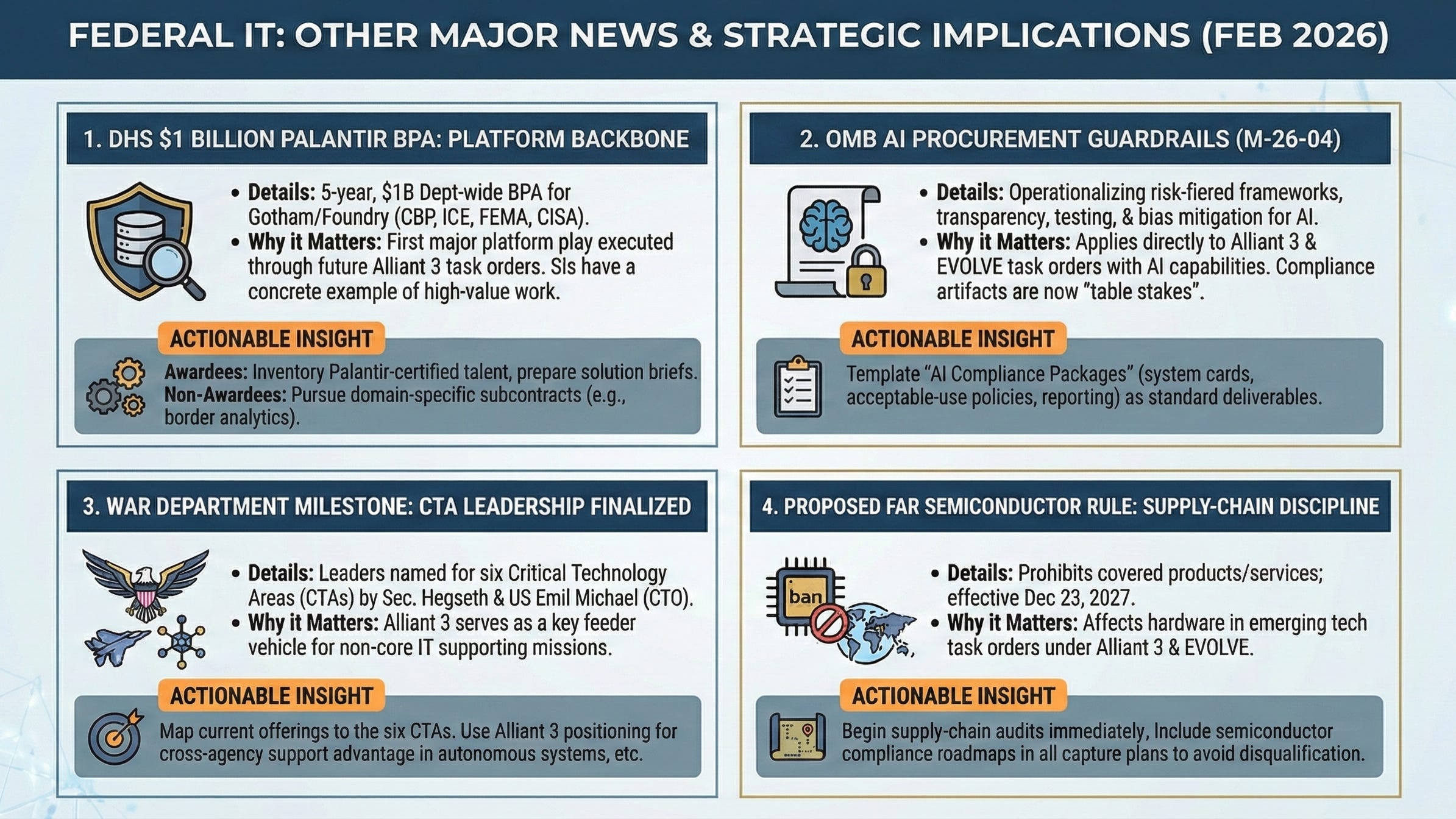
On February 12, DHS awarded a five-year, $1 billion BPA to Palantir for department-wide licenses, maintenance, and implementation of Gotham and Foundry platforms (details reported February 19 by Wired). The vehicle covers CBP, ICE, FEMA, and CISA, allowing task orders without separate competitions (Source: Wired, February 19, 2026).
Why it matters: This is the first major platform play that will be executed through Alliant 3 task orders. SIs on Alliant 3 now have a concrete example of high-value work: building mission-specific extensions on a shared data layer. Actionable insight: Awardees should immediately inventory Palantir-certified talent and prepare solution briefs showing integration pathways. Non-awardees should pursue subcontracts focused on domain-specific workflows (border analytics, disaster modeling, cyber correlation).
2. OMB AI Procurement Guardrails Solidify Compliance Requirements
This week agencies continued operationalizing OMB Memorandum M-26-04 (“Increasing Public Trust in Artificial Intelligence Through Unbiased AI Principles,” issued December 11, 2025). The memo requires risk-tiered frameworks, model transparency, testing, and bias mitigation for AI procurements tied to funding eligibility (Source: OMB M-26-04, December 11, 2025).
Why it matters: These rules apply directly to task orders under Alliant 3 and EVOLVE when AI capabilities are involved. Integrators must now include these artifacts in every proposal technical volume. Actionable insight: Begin templating “AI compliance packages” (system cards, acceptable-use policies, reporting mechanisms) as standard deliverables. This becomes table stakes for winning work on the new vehicles.
3. War Department Milestone Approaches: CTA Leadership Finalized
As the War Department completes its major March 1 systems and branding milestone, Secretary Pete Hegseth and Under Secretary for Research and Engineering Emil Michael (who also serves as CTO) have named leaders for the six Critical Technology Areas. Defense SIs must align R&D and offerings to these consolidated buckets (Source: CTO.mil, January 29, 2026).
Why it matters: Alliant 3 will serve as a key feeder vehicle for non-core IT supporting War Department missions. Actionable insight: Map your current offerings to the six CTAs now. Firms with strong Alliant 3 positioning gain an advantage in cross-agency support for autonomous systems, battle management, and related technologies.
4. Proposed FAR Semiconductor Rule Advances Supply-Chain Discipline
The February 17 proposed rule prohibits procurement of covered semiconductor products/services, effective December 23, 2027 (Source: Federal Register notice via SAM.gov and related coverage).
Why it matters: Affects hardware components in emerging technology task orders under Alliant 3 and EVOLVE. Actionable insight: Begin supply-chain audits immediately. Include semiconductor compliance roadmaps in all Alliant 3 capture plans to avoid future disqualification.
Other Major News Sources
DHS Palantir BPA coverage: Wired, February 19, 2026. https://www.wired.com/story/department-homeland-security-ice-billion-dollar-agreement-palantir/
War Department CTAs: CTO.mil, January 29, 2026.
Semiconductor FAR rule: SAM.gov and Federal Register notices referenced in industry summaries, February 17, 2026.
The Week Ahead
February 24-27 will see continued fallout from the Alliant 3 announcements, including debrief requests, teaming discussions, and internal agency briefings on leveraging the vehicle. February 28 marks the final full week of “Department of Defense” branding in many systems. March 1 marks a major systems and branding milestone for the War Department, with an anticipated policy memorandum from Secretary Hegseth that will accelerate autonomous systems and reduce bureaucratic layers. Expect the first formal task-order solicitations under Alliant 3 to appear in March or April as agencies finalize their FY2026 execution plans. The semiconductor rule comment period remains open through April 20; industry associations will host webinars and submit coordinated responses. OMB is expected to release final CIO authority guidance before the month-end, triggering agency-level policy updates.
Closing Perspective
The Alliant 3 Phase 1 awards represent more than a contract vehicle launch. They codify a new reality in which federal IT spending flows through fewer, larger, more transparent gateways. System integrators who positioned themselves inside these gateways this week secured decade-long optionality. Those who did not know face a compressed decision window: team aggressively, demonstrate compliance at every layer, or accept a smaller addressable market. The convergence with platform consolidations like DHS-Palantir, restored CIO authority, AI guardrails, and supply-chain rules means the winners will be those who treat procurement architecture itself as a core capability. In the AI-driven, centralized federal enterprise, speed belongs to the prepared, and access belongs to the positioned. The playing field has been redrawn. The firms that move fastest to occupy the new high ground will define the next decade of government IT delivery.
This update was assembled using a mix of human editorial judgment, public records, and reputable national and sector-specific news sources, with help from artificial intelligence tools to summarize and organize information. All information is drawn from publicly available sources listed above. Every effort is made to keep details accurate as of publication time, but readers should always confirm time-sensitive items such as policy changes, budget figures, and timelines with official documents and briefings.
All original content, formatting, and presentation are copyright 2026 Metora Solutions LLC, all rights reserved. For more information about our work and other projects, drop us a note at info@metorasolutions.com