
Executive Summary
The General Services Administration released a draft contract clause on March 6, 2026, that will reshape how every federal agency buys and uses artificial intelligence capabilities through the Multiple Award Schedule program. Titled GSAR 552.239-7001 Basic Safeguarding of Artificial Intelligence Systems, the clause imposes detailed requirements on data ownership, intellectual property rights, service provider accountability, sourcing preferences, output neutrality, and operational safeguards.
GSA initially planned to insert the clause into MAS Refresh 31 with an original public comment deadline of March 20. In response to industry requests, officials extended the public comment period to April 3, 2026, and deferred the clause to Refresh 32. The comment window has now closed. GSA is reviewing the substantial feedback received before finalizing language for the next refresh cycle.
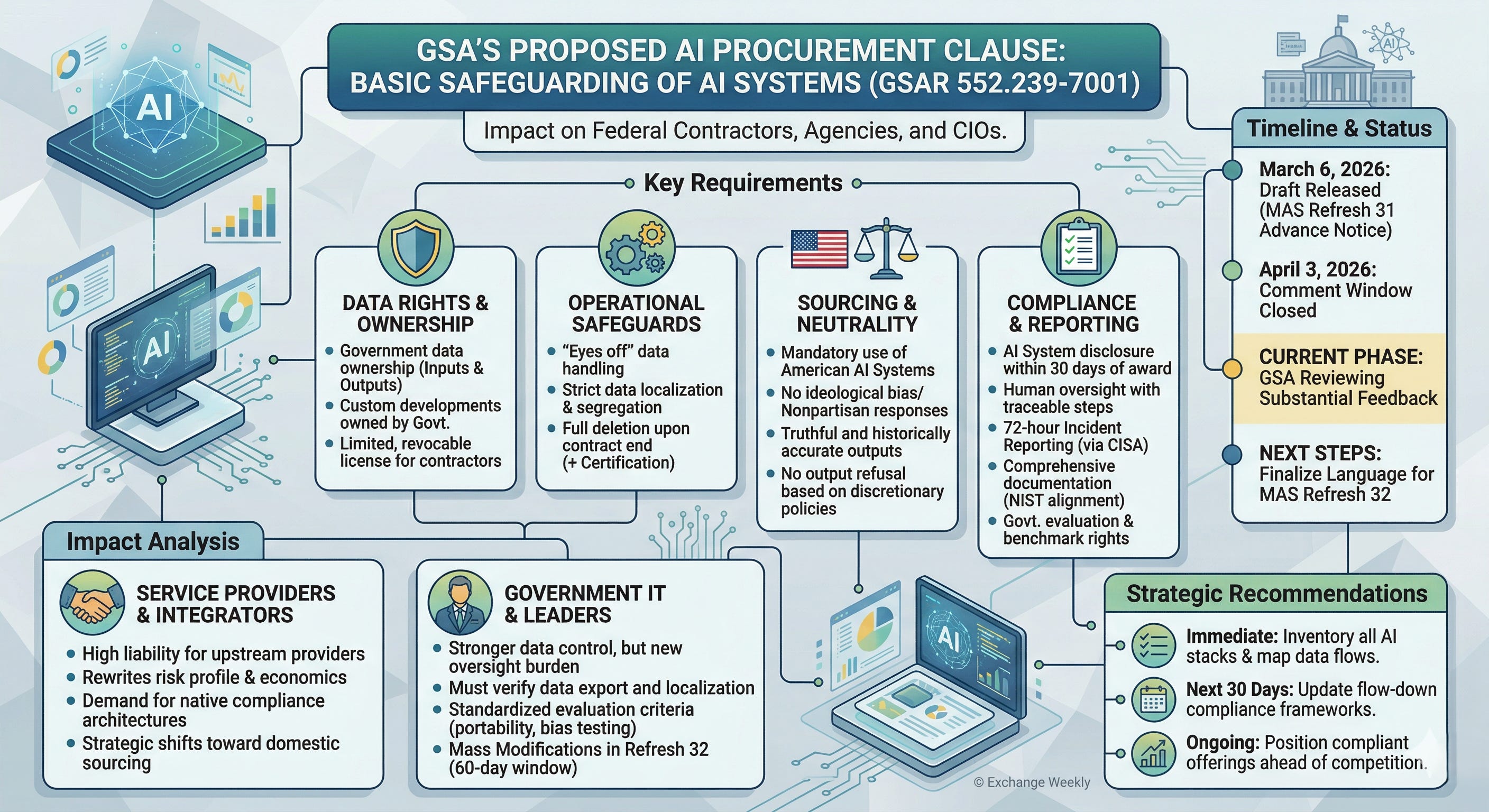
For system integrators and service providers, the stakes could not be higher. The clause reaches beyond prime contractors to any service provider that supplies, operates, or licenses an AI system used in contract performance. It overrides conflicting commercial terms of service. It demands government ownership of all data inputs and outputs, as well as any custom developments. It requires strict “eyes off” data handling, localization, segregation, deletion upon contract end, and certification. It also mandates that American AI systems produce truthful, nonpartisan outputs, provide human oversight, report incidents within 72 hours, and allow government evaluation rights with potential remediation or termination.
Government IT leaders face immediate operational changes. Agencies must prepare to enforce new license terms, data export capabilities, change management notices, and documentation requests aligned with NIST AI Risk Management Framework guidelines. Contracting officers will see new evaluation criteria, flow-down obligations, and compliance verification steps in every AI-related solicitation.
This single clause addresses multiple priorities from OMB Memorandum M-25-22 on efficient AI acquisition: protecting government data rights, reducing vendor lock-in, promoting domestic sourcing, and ensuring systems remain neutral tools rather than ideological platforms. The timing aligns with accelerating federal AI spending and growing scrutiny of commercial AI providers.
The week ahead will test how GSA incorporates feedback and timelines for Refresh 32. Agencies and contractors must begin inventorying their AI stacks now. The clause, once finalized, will apply to new solicitations and trigger mass modifications on existing schedules. Preparation today prevents compliance gaps tomorrow.
GSA’s Proposed AI Procurement Clause – What the New ‘Basic Safeguarding of Artificial Intelligence Systems’ Rules Mean for Federal Contractors, Agencies, and CIOs
What Happened This Week
On March 6, 2026, GSA posted the draft clause as part of the advance notice for MAS Refresh 31. The nine-page document defines key terms, including American AI Systems, Government Data (inputs and outputs), Custom Development, Service Provider, and Large Language Model. It establishes the clause’s precedence over any commercial terms in the order of precedence under GSAR 552.212-4.
GSA required contractors to take responsibility for service provider compliance, even when those providers sit outside the direct contract. The draft grants the government full ownership of all Government Data and Custom Developments while giving contractors only a limited, revocable license for contract performance. The government receives an irrevocable royalty-free license to operate the AI system for any lawful purpose, and the system must not refuse outputs based on the contractor’s or provider’s discretionary policies.
Prohibited uses of Government Data include training or fine-tuning models for other customers, informing business decisions, or retaining data beyond contract needs. Contractors must implement “eyes off” procedures that limit human review, maintain detailed processing logs, enforce data localization, segregate government data, and delete everything upon contract completion with written certification.
Additional requirements cover disclosure of AI systems within 30 days of award, exclusive use of American AI Systems, human oversight with traceable intermediate steps, 72-hour incident reporting via the CISA form, feedback mechanisms, comprehensive documentation (including system cards and bias disclosures), open-format data portability to prevent lock-in, advance notice for model changes, and adherence to unbiased AI principles that prioritize truthfulness, historical accuracy, and nonpartisan responses.
The clause also reserves broad government evaluation rights using independent benchmarks and allows remediation or suspension for noncompliance.
GSA originally set a comment deadline of March 20, 2026. On March 19, 2026, GSA announced the extension to April 3, 2026, and confirmed the clause would move to Refresh 32. The comment window closed on Friday, April 3. Multiple industry stakeholders, including trade associations and technology policy groups, submitted detailed feedback by the deadline. GSA will now review submissions before finalizing language for the next refresh cycle.
Why It Matters
1. System Integrators and Service Providers
This clause directly rewrites the economics and risk profile of every AI-related line item on GSA Schedules. Prime contractors become liable for upstream service providers, including commercial model hosts that never sign the contract. Failure to flow down requirements or verify compliance could trigger termination, suspension, or False Claims Act exposure.
Revenue implications are immediate. Firms that rely on proprietary data practices, model fine-tuning across customers, or non-U.S. components must redesign offerings or lose schedule eligibility. The data ownership and deletion rules eliminate many current monetization paths for government-derived insights. The “no refusal” and unbiased principles provisions require AI systems to produce outputs and conduct analyses for lawful government purposes without refusal based on the contractor’s or service provider’s discretionary policies.
Competitive positioning is shifting toward integrators that can demonstrate native compliance architectures, American-sourced models, open APIs, and auditable “eyes off” pipelines. Those who wait for the final language risk mass-modification surprises in Refresh 32. Early movers can capture market share by offering pre-certified modular compliance layers that smaller providers cannot match.
A key compliance consideration for system integrators is the potential tension between the clause’s “American AI Systems” requirement and existing Trade Agreements Act obligations that apply to most GSA Schedule contracts. The clause references OMB M-25-22 policy but provides limited additional guidance on what qualifies as compliant, creating uncertainty for models with global supply chains, open-source components, or international development elements. Contractors should evaluate their AI supply chains against both the new clause and established TAA rules to avoid unexpected eligibility issues.
2. Government IT Workers and Leaders
CIOs and program managers gain stronger control over data and outputs but inherit new oversight burdens. Agencies must now negotiate or enforce detailed data export tools, localization commitments, and successor-model evaluation periods. The clause supports mission needs by guaranteeing system availability for lawful purposes and traceable decision logs that aid IV&V and audit readiness.
Budget impacts appear in two places. First, agencies may pay premiums for compliant American AI systems and enhanced documentation. Second, they avoid long-term lock-in costs through mandated portability. Workforce considerations include training contracting officer representatives on new compliance verification and preparing technical teams to exercise evaluation rights with independent benchmarks.
The clause aligns with the broader federal AI strategy under OMB M-25-22 and the Advancing American AI Act. It reduces supply-chain risk and ideological distortion risks while preserving innovation through commercial solutions.
3. Government Contracting Officers
Acquisition professionals receive a standardized clause that simplifies AI procurements while raising evaluation complexity. Officers must insert the clause in every solicitation involving AI capabilities. They gain clear authority to demand disclosures, verify American AI sourcing, review documentation packages, and enforce flow-downs.
Evaluation criteria will expand to include compliance demonstrations, portability proofs, and bias-mitigation testing plans. Mass modifications in Refresh 32 will require 60-day acceptance windows, creating an administrative workload. Officers should begin drafting implementation guidance and updating source selection plans now to avoid delays when the clause activates.
4. All Others
Policy makers and analysts see the clause as a concrete step toward operationalizing executive AI priorities. It balances innovation with safeguards in ways that influence state and local procurement. Industry analysts will track adoption rates and compliance costs as leading indicators of federal AI market maturity.
Strategic Context
The clause operationalizes OMB Memorandum M-25-22 (April 2025), which directed agencies to strengthen data rights, promote competition, and favor domestic AI in acquisitions. It builds on the Advancing American AI Act definition of AI systems and NIST risk management guidance.
Unlike prior FAR or agency-specific AI language, this clause applies government-wide through the largest commercial buying channel. It addresses real-world issues that surfaced in early federal AI deployments: data leakage through commercial training pipelines, vendor lock-in via proprietary formats, inconsistent safety guardrails, and outputs shaped by non-government policy preferences.
The timing reflects accelerating federal AI investment and heightened congressional and OMB scrutiny of commercial providers. By moving through the MAS refresh process rather than traditional rulemaking, GSA achieved speed while still inviting industry input. The extension to April 3 demonstrates responsiveness to legitimate compliance concerns.
What’s Coming Next
GSA will analyze comments received by April 3 and finalize the clause for MAS Refresh 32. As of April 6, 2026, no revised timeline for Refresh 32 has been announced. Agencies will begin incorporating the clause into new solicitations immediately upon finalization. Existing schedule holders will receive mass mods that require acceptance or risk schedule deactivation for AI line items.
Longer term, other agencies may adopt similar language outside GSA Schedules, and Congress may codify elements in future authorization bills.
Recommendations
For System Integrators and Service Providers
Wave 1 (immediate, next 14 days): Inventory every AI system used or offered on GSA Schedules. Map data flows, service providers, and current commercial terms against the draft clause. Identify gaps in ownership, portability, sourcing, and “eyes off” controls.
Wave 2 (next 30 days): Develop or update modular compliance frameworks that can be flowed down to service providers. Prepare standardized disclosure packages, data export tools, and audit-ready documentation aligned with NIST guidelines.
Wave 3 (pre-Refresh 32): Test successor-model evaluation processes and unbiased-output verification pipelines. Position compliant offerings in client proposals before competitors finalize their roadmaps.
For Government IT Workers and Leaders
Wave 1: Direct program teams to catalog current AI usage and flag any reliance on non-American systems or proprietary data practices.
Wave 2: Prepare technical evaluation plans and independent benchmark suites to exercise the new government rights once the clause activates.
Wave 3: Update acquisition strategies and budget forecasts to reflect potential premium costs for compliant solutions and reduced long-term lock-in expenses.
For Government Contracting Officers
Wave 1: Review upcoming AI solicitations and insert placeholder language referencing the forthcoming clause.
Wave 2: Develop compliance verification checklists and flow-down templates.
Wave 3: Schedule training for CORs on new documentation and reporting requirements.
Primary Topic Sources
GSA Federal Acquisition Service, “GSA_Federal_Acquisition Service Proposed Government AI System Terms and Conditions.pdf,” March 6, 2026.
GSA Interact, “Advanced Notice for MAS Refresh 31 and Upcoming Mass Modification,” updated March 19, 2026.
OMB Memorandum M-25-22, “Driving Efficient Acquisition of Artificial Intelligence in Government,” April 2025.
The Week Ahead
GSA’s review of comments submitted by April 3 will determine whether the clause undergoes significant revisions before Refresh 32. Contractors should watch the MAS Interact page for any follow-on guidance or additional feedback windows.
Agencies continue to align internal AI governance with OMB directives. Expect increased focus on supply-chain risk assessments and documentation requirements that mirror the draft clause.
Forward-looking guidance centers on preparation rather than reaction. The clause’s data-portability and change-management provisions reward architectural foresight. Organizations that treat the draft as a preview rather than a surprise will maintain momentum through the refresh cycle.
Closing Perspective
This proposed clause marks a maturing phase in federal AI procurement. After years of broad policy guidance, agencies now deploy concrete contract language that translates principles into enforceable obligations. The result strengthens government control over data and outcomes while preserving access to commercial innovation.
System integrators and service providers who view the requirements as strategic design constraints rather than obstacles will emerge stronger. The clause rewards transparency, domestic capability, and technical openness. Those attributes align with long-term federal needs and position compliant firms for sustained revenue growth across multiple contract vehicles.
The next several weeks will clarify final language. Yet the core direction is set: federal AI acquisitions will demand stronger safeguards, clearer rights, and verifiable neutrality. Organizations that act now on the draft language will lead the transition rather than scramble to catch up.
The Exchange Daily™ Newscasts and Exchange Weekly™ Newsletters are productions of Metora Solutions LLC, a Service Disabled Veteran Owned Small Business. While every effort is made to keep details accurate as of publication time, readers and listeners should always confirm time-sensitive items, such as policy changes, budget figures, and timelines, directly from official documents and briefings.
The Exchange is for informational purposes only and does not constitute legal, investment, procurement, security, compliance, technical, or any other form of professional advice. No attorney-client, advisor-client, or other professional relationship is created or presumed by listening to or reading this content. Always consult qualified professionals and validate with primary sources before taking any action.
All information is from publicly available sources. All rights reserved. Copyright Metora Solutions LLC 2026.