
Executive Summary
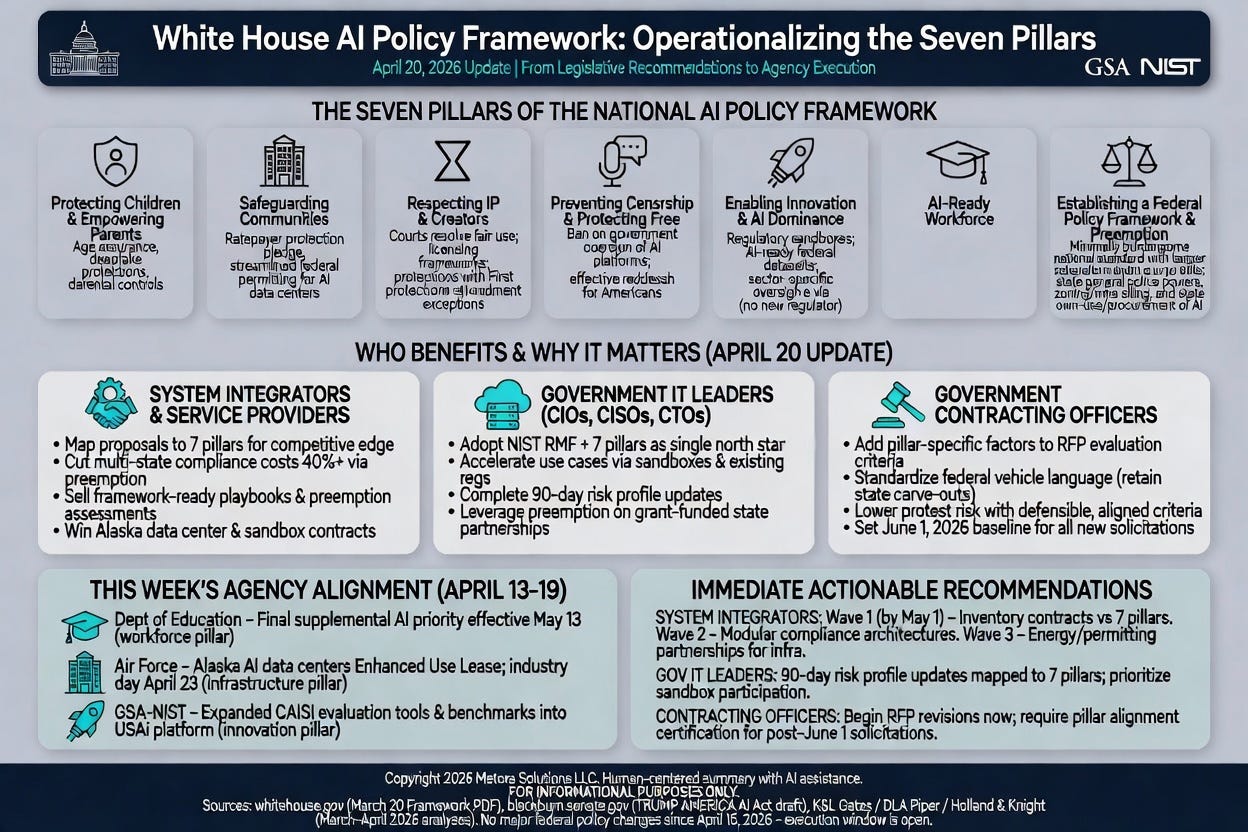
The White House released its National Policy Framework for Artificial Intelligence: Legislative Recommendations on March 20, 2026. This four-page document provides Congress with a unified set of legislative proposals across seven pillars to establish a minimally burdensome national AI standard while preempting cumbersome state AI laws. The pillars address protecting children and empowering parents, safeguarding American communities, respecting intellectual property and creators, preventing censorship and protecting free speech, enabling innovation and American AI dominance, educating Americans and building an AI-ready workforce, and establishing the federal framework with targeted preemption.
As of April 20, 2026, no new executive orders, enacted legislation, or major agency directives have emerged since mid-April. The framework and the related December 11, 2025 Executive Order on ensuring a national policy framework remain the central reference points. Senator Marsha Blackburn’s TRUMP AMERICA AI Act discussion draft, released March 18, 2026, continues as the most prominent congressional vehicle, though it has not advanced to formal introduction or committee markup in the past five days. Legal analyses published in early April by major firms underscore the framework’s emphasis on preemption to eliminate the 50-state patchwork, regulatory sandboxes, AI-ready federal datasets, and sector-specific oversight through existing agencies rather than a new federal AI regulator.
This stability creates a predictable environment for system integrators and service providers. Contracts can now standardize around a single national baseline for most development and deployment activities, while agencies gain clear direction to align governance, procurement, and infrastructure decisions with the seven pillars. Government IT leaders can accelerate high-impact use cases through existing regulatory channels, and contracting officers can incorporate framework-aligned evaluation criteria without awaiting further rulemaking. The week of April 13-19, 2026 showed continued agency momentum consistent with the innovation and infrastructure pillars, including the Department of Education’s final supplemental AI priority for grants, the Department of the Air Force’s Enhanced Use Lease plans for Alaska AI data centers, and expanded GSA-NIST collaboration on AI evaluation science for the USAi platform.
This edition equips CIOs, CISOs, and CTOs with practical, phased playbooks for governance, procurement, preemption navigation, and infrastructure alignment. It avoids overlap with prior coverage of agency accelerators, GAO procurement notes, or workforce and permitting details, focusing instead on the operational steps that deliver immediate value to system integrators, government IT leaders, and acquisition professionals.
Operationalizing the White House National AI Policy Framework: Practical Steps for Federal Agencies in 2026
What Happened This Week
The March 20, 2026 framework builds directly on the December 11, 2025 Executive Order “Ensuring a National Policy Framework for Artificial Intelligence,” which directed development of legislative recommendations to preempt state AI laws that conflict with national policy. The framework itself is non-binding legislative guidance rather than new regulation. It explicitly rejects creation of a new federal AI rulemaking body and instead directs sector-specific application through existing agencies and industry-led standards.
Agency actions observed the week of April 13-19, 2026 align with the framework’s innovation, community safeguard, and workforce pillars without requiring new legislation. The Department of Education finalized its supplemental AI priority for discretionary grant programs, effective May 13, 2026, advancing AI literacy and professional development consistent with the education and workforce pillar. The Department of the Air Force detailed plans for large-scale AI data centers on up to 4,700 acres across three Alaska installations (Joint Base Elmendorf-Richardson, Eielson Air Force Base, and Clear Space Force Station) under its Enhanced Use Lease program, supporting the infrastructure streamlining and ratepayer-protection elements of the community safeguard pillar. GSA and NIST deepened their partnership on AI evaluation science to strengthen the USAi procurement platform, directly supporting the innovation pillar’s call for rigorous, standards-based assessment. These steps demonstrate that agencies are already translating the framework into operational reality even before Congress acts.
Why It Matters
1. System Integrators and Service Providers
The framework delivers the clearest contract signal since the 2023 executive order era. Preemption of undue state burdens allows firms to replace 50-state compliance matrices with a single national standard for most AI development and deployment activities. This reduces proposal costs and delivery timelines on multi-jurisdictional vehicles. Agencies will increasingly award points in solicitations for demonstrated participation in regulatory sandboxes, provision of AI-ready datasets, and alignment with the seven pillars, particularly child-safety technical controls, IP licensing verification, free-speech safeguards, and energy-efficient infrastructure. Service providers that package framework-aligned governance playbooks, preemption impact assessments, and modular compliance architectures as reusable offerings will capture first-mover advantage on Fiscal Year 2027 modernization task orders.
2. Government IT Workers and Leaders
CIOs, CISOs, and CTOs now have a single, authoritative reference for updating agency AI risk-management profiles. The framework endorses the NIST AI Risk Management Framework with explicit mappings to child protection, free-speech safeguards, and IP verification. Leaders can accelerate deployment of high-impact use cases through existing regulatory channels and regulatory sandboxes without waiting for new interagency councils. The preemption language gives agencies leverage to condition grants and cooperative agreements on state alignment with the national standard, reducing operational friction in cross-jurisdictional data-sharing and shared services initiatives.
3. Government Contracting Officers
Acquisition professionals can immediately revise solicitation templates to include framework-specific evaluation factors. Vendors can be required to certify alignment with the seven pillars, demonstrate commercially reasonable age-assurance and child-safety controls, verify IP licensing processes, and provide evidence of free-speech safeguard architectures. The framework’s carve-outs preserve state authority over general police powers, zoning and infrastructure siting, and each state’s own procurement and use of AI, so contracting officers must still accommodate those requirements when supporting state or local partners. Federal-only vehicles, however, gain uniformity and defensibility.
4. All Others
Policy makers and analysts see the emergence of a coherent national AI strategy that balances innovation with targeted safeguards while offering a clear alternative to the European Union’s prescriptive model and China’s state-centric approach. The framework’s rejection of a new central regulator in favor of sector-specific oversight through existing agencies preserves the agility that has allowed the United States to maintain technological leadership.
Strategic Context
The framework arrives after more than 1,200 state AI bills were introduced in 2025 alone (MultiState AI Legislation Tracker, 2026). Without federal preemption, system integrators faced parallel compliance stacks that would have increased proposal costs and delayed delivery by 12 to 18 months on average. The March 20 document calls for Congress to “preempt state AI laws that impose undue burdens to ensure a minimally burdensome national standard consistent with these recommendations, not fifty discordant ones.” Preemption is carefully bounded to respect federalism: it does not preempt state general police powers (including child protection, fraud prevention, and consumer protection laws of general applicability), state zoning and infrastructure siting authority, or requirements governing a state’s own use or procurement of AI. This carve-out prevents the framework from being viewed as federal overreach while still delivering the national uniformity industry has sought.
The innovation pillar reinforces existing OMB and NIST guidance and explicitly endorses regulatory sandboxes and the release of federal datasets in AI-ready formats. These elements connect directly to the Department of the Air Force Alaska data-center initiative and the GSA-NIST evaluation partnership observed this week.
What’s Coming Next
As of April 20, 2026, Congress has not introduced comprehensive legislation implementing the framework, and Senator Blackburn’s TRUMP AMERICA AI Act discussion draft (released March 18) remains in early dialogue stage with no reported committee action since mid-April. Agencies are expected to continue aligning internal policies and procurement practices with the seven pillars in the absence of new statutory direction. OMB is anticipated to issue updated guidance in the third quarter incorporating the framework into the annual budget process. State legislatures will monitor the preemption language closely; those with existing restrictive AI laws may face pressure to amend provisions that conflict with the national standard or risk loss of federal interoperability on grant-funded initiatives.
Recommendations
System integrators and service providers should treat the framework as the new baseline for all proposals submitted after June 1, 2026.
Wave 1: Inventory all current and pipeline contracts against the seven pillars. Identify immediate opportunities to offer framework-aligned add-on services such as governance playbook development, preemption impact assessments for multi-state deployments, and AI-ready data transformation services.
Wave 2: Develop modular compliance architectures that default to the federal standard while allowing configuration for the preserved state carve-outs (general police powers, zoning, and state own-use procurement). Package these as reusable intellectual property licensable across vehicles.
Wave 3: Position for infrastructure opportunities by partnering with energy providers and permitting specialists who understand the framework’s ratepayer-protection and federal permitting streamlining mandates under the community safeguard pillar.
Government IT leaders should direct their teams to update agency AI risk-management profiles as a Wave 1 priority, using the NIST AI RMF as the foundation and mapping explicitly to each of the seven pillars. Prioritize high-impact use cases that demonstrate regulatory sandbox participation and contribution of AI-ready datasets.
Contracting officers should begin revising solicitation templates to include framework-specific evaluation factors. Require vendors to provide evidence of child-protection technical controls, IP licensing verification processes, free-speech safeguard architectures, and energy-efficiency metrics for data-center proposals.
Sources
The White House, “National Policy Framework for Artificial Intelligence: Legislative Recommendations,” March 20, 2026. https://www.whitehouse.gov/wp-content/uploads/2026/03/03.20.26-National-Policy-Framework-for-Artificial-Intelligence-Legislative-Recommendations.pdf
The White House, “Ensuring a National Policy Framework for Artificial Intelligence,” Executive Order 14365, December 11, 2025. https://www.whitehouse.gov/presidential-actions/2025/12/eliminating-state-law-obstruction-of-national-artificial-intelligence-policy/
U.S. Senator Marsha Blackburn, “Blackburn Releases Discussion Draft of National Policy Framework for Artificial Intelligence,” March 18, 2026. https://www.blackburn.senate.gov/2026/3/technology/blackburn-releases-discussion-draft-of-national-policy-framework-for-artificial-intelligence/3b3b6458-b6c7-478b-9859-374949586765
K&L Gates, “White House Releases National AI Policy Framework,” March 24, 2026. https://www.klgates.com/White-House-Releases-National-AI-Policy-Framework-3-24-2026
DLA Piper, “White House releases the National Policy Framework for Artificial Intelligence: Key points,” March 23, 2026. https://www.dlapiper.com/en-us/insights/publications/2026/03/white-house-releases-the-national-policy-framework-for-ai-key-points
Holland & Knight, “White House Releases a National Policy Framework for Artificial Intelligence,” March 27, 2026. https://www.hklaw.com/en/insights/publications/2026/03/white-house-releases-a-national-policy-framework-for-artificial
WilmerHale, “White House Releases National Policy Framework for Artificial Intelligence,” March 23, 2026. https://www.wilmerhale.com/en/insights/blogs/wilmerhale-privacy-and-cybersecurity-law/20260323-white-house-releases-national-policy-framework-for-artificial-intelligence
U.S. Department of Education, “Final Supplemental Priorities for Discretionary Grant Programs,” 91 Fed. Reg. 18774 (April 13, 2026), Docket ID ED-2025-OS-0118, effective May 13, 2026.
Department of the Air Force, “Request for Lease Proposals – Enhanced Use Lease for AI Data Centers, Alaska Installations,” SAM.gov, April 10, 2026. Industry day April 23, 2026.
NIST, “CAISI Signs MOU with GSA to Boost AI Evaluation Science in Federal Procurement Through USAi,” March 18, 2026. https://www.nist.gov/news-events/news/2026/03/caisi-signs-mou-gsa-boost-ai-evaluation-science-federal-procurement-through
The Week Ahead
The week of April 20-26, 2026 will feature continued agency alignment with the framework rather than new announcements. Expect OMB to circulate internal draft guidance on incorporating the seven pillars into Fiscal Year 2027 budget submissions. The Department of the Air Force is scheduled to host an industry day on April 23 for the Alaska AI data-center program, offering system integrators a direct view into framework-aligned infrastructure and energy requirements. NIST will likely release an updated concept paper on critical-infrastructure AI profiles referencing the innovation pillar’s sandbox and standards approach.
State responses will continue to surface. California and New York are expected to issue statements clarifying how their existing AI laws interact with the proposed federal preemption language. Procurement offices at GSA and the Department of Veterans Affairs will likely publish updated AI clauses reflecting the framework’s evaluation criteria. Forward-looking agencies and their industry partners should use this week to complete Wave 1 gap analyses before May 1 so they can influence rather than react to upcoming solicitations.
Closing Perspective
The March 20, 2026 framework marks the transition of federal AI policy from experimentation to structured execution. By providing a clear legislative roadmap that prioritizes a single national standard without discarding targeted state roles in general police powers, zoning, and state own-use procurement, the White House has given system integrators, government IT leaders, and contracting officers the predictability they need to move at mission speed. The agency actions observed this week in education, defense infrastructure, and procurement standards demonstrate that operationalization is already underway.
The organizations that treat this framework as the new operating system for federal AI, rather than another compliance checkbox, will capture the greatest value in the contracts and capabilities that define the next decade. The window is open. The guidance is clear. Execution now separates leaders from laggards.
This update was assembled using a mix of human editorial judgment, public records, and reputable national and sector-specific news sources, with help from artificial intelligence tools to summarize and organize information. All information is drawn from publicly available sources listed above. Every effort is made to keep details accurate as of publication time, but readers should always confirm time-sensitive items such as policy changes, budget figures, and timelines with official documents and briefings.
All original content, formatting, and presentation are copyright 2026 Metora Solutions LLC, all rights reserved. For more information about our work and other projects, drop us a note at info@metorasolutions.com