
Executive Summary
System integrators and service providers received the clearest signal yet this week on how the federal government intends to procure and deploy high-impact artificial intelligence systems. Coordinated announcements on May 8 across NIST, GSA, FedRAMP, OMB, and the Department of Defense transformed the March 2026 GSA-NIST partnership from strategic memorandum into operational procurement reality. The Center for AI Standards and Innovation released updated benchmarking guidance that now mandates real-world performance testing and supply-chain risk scoring in every high-impact AI procurement decision. GSA responded by accelerating new AI-specific contract vehicles on the USAi platform, giving agencies faster access to pre-vetted models that already meet the latest CAISI security and fairness requirements. FedRAMP cleared the first continuous-authorization pathways tailored for AI-optimized cloud services, while OMB directed agencies to embed the new NIST benchmarks directly into governance plans. The Department of Defense simultaneously scaled classified agentic AI pilots on IL6 and IL7 networks with mandatory human-oversight protocols. GAO began formal tracking of early implementation challenges under the American Leadership in AI Act.
For system integrators and service providers, these developments create immediate revenue opportunities measured in hundreds of millions of dollars while raising the compliance bar that will separate winners from also-rans. Contractors who master the new evaluation playbook gain preferred positioning on accelerated USAi vehicles and FedRAMP AI paths. Those who treat the updates as checklist items risk disqualification on future awards. Government IT leaders gain standardized tools that reduce deployment risk and accelerate safe adoption. Contracting officers receive concrete evaluation criteria that streamline source selections while enforcing accountability. The net effect is a procurement ecosystem that rewards rigorous, evidence-based AI evaluation and penalizes untested or opaque offerings.
The week’s events mark the maturation of federal AI strategy from policy to executable contracts. The GSA-NIST partnership now supplies the methodological backbone for USAi, the government’s centralized secure AI evaluation and procurement platform. Real-world testing requirements replace theoretical benchmarks. Supply-chain risk scoring becomes mandatory rather than advisory. Continuous authorization replaces static FedRAMP packages for AI services. Human oversight protocols become non-negotiable for agentic systems on classified networks. These changes directly affect how system integrators structure proposals, price services, staff delivery teams, and manage subcontractor relationships.
Secondary developments reinforced the primary theme. DoD’s classified pilot expansion signals that high-security environments will demand the same CAISI-derived evaluation rigor as unclassified USAi offerings. OMB’s integration guidance closes the post-deployment monitoring gap that previously allowed agencies to accept vendor claims without independent verification. GAO’s monitoring report highlights early workforce and R&D alignment challenges that system integrators must address in proposals to remain competitive.
This newsletter delivers the premium deep-dive playbook system integrators and service providers need to master federal AI evaluation and procurement through the GSA-NIST partnership. The analysis prioritizes contract and revenue implications first, followed by operational and acquisition guidance for government audiences. Every recommendation uses phased language to align with budget cycles, procurement timelines, and mission requirements. Sources appear at the end of the primary topic section and secondary coverage.
GSA-NIST Partnership
Mastering Federal AI Evaluation and Procurement through the GSA-NIST Partnership
What Happened This Week
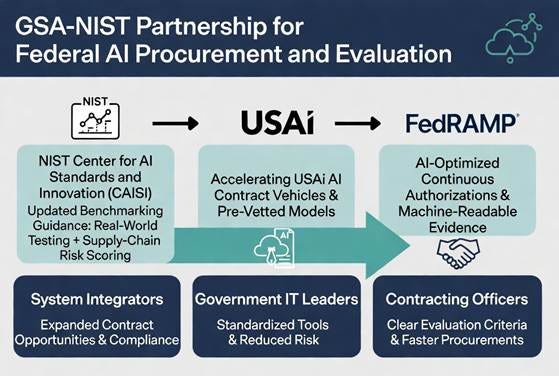
On May 8, 2026, the federal government executed a synchronized set of announcements that operationalized the GSA-NIST partnership announced two months earlier. The Center for AI Standards and Innovation issued updated benchmarking guidance for high-impact AI systems. Agencies must now incorporate real-world performance testing and supply-chain risk scoring into all procurement decisions. The guidance moves beyond synthetic benchmarks to require evaluation in environments that mirror actual federal workflows, data sensitivities, and operational constraints.
GSA immediately accelerated AI-specific contract vehicles through the USAi platform. CIOs now gain faster access to pre-vetted models that satisfy the latest CAISI security and fairness requirements. The acceleration includes streamlined solicitation processes and pre-populated evaluation criteria drawn directly from the new NIST benchmarks. FedRAMP approved the first wave of continuous-authorization pathways for AI-optimized cloud services. The updates shorten timelines while enforcing machine-readable evidence and AI-specific controls that align with the NIST guidance.
OMB directed agencies to embed the new NIST benchmarks into AI governance plans. The memorandum closes previous gaps in post-deployment monitoring and data-ownership accountability. DoD expanded classified agentic AI pilots on IL6 and IL7 networks. New policy requires built-in human oversight protocols for real-time agentic systems operating in classified environments. GAO initiated formal tracking of early implementation challenges under the American Leadership in AI Act, with specific focus on workforce development and R&D spending alignment to mandated evaluation standards.
These actions form a single, coherent advancement. The March 18, 2026, Memorandum of Understanding between GSA and NIST’s Center for AI Standards and Innovation established the framework for standardized AI evaluation science in federal procurement. The May 8 announcements delivered the first major deliverables from that partnership: updated benchmarks, accelerated vehicles, continuous authorization pathways, governance integration, and classified pilot expansion. The result is a procurement ecosystem where evaluation rigor, supply-chain transparency, and continuous monitoring become baseline requirements rather than optional enhancements.
Why It Matters
1. System Integrators and Service Providers
The GSA-NIST partnership directly reshapes contract pipelines and revenue models. System integrators with existing USAi offerings now compete on demonstrated compliance with real-world testing and supply-chain scoring rather than marketing claims. Those who can deliver evaluation services, benchmark execution, and supply-chain risk assessments gain new revenue streams that command premium margins because agencies lack internal capacity to perform these functions at scale. Contracts that previously required months of custom evaluation can now leverage pre-vetted USAi vehicles, shortening sales cycles and improving win probabilities for compliant firms.
Competitive positioning shifts dramatically. Integrators who embed CAISI benchmarking into proposal technical volumes and past performance narratives differentiate themselves from competitors still relying on vendor self-attestation. Supply-chain risk scoring requirements create opportunities for specialized subcontractors and new partnership models. Firms that previously focused on model hosting or fine-tuning must now expand service portfolios to include evaluation tooling, continuous monitoring, and human-oversight architectures. Revenue impact is immediate: GSA’s acceleration of USAi vehicles opens access to billions in pending agency AI budgets that previously faced evaluation bottlenecks.
Risk mitigation also changes. Non-compliant proposals face higher protest risk and disqualification on technical evaluations. Integrators must update proposal templates, training programs, and delivery methodologies within the current quarter to avoid pipeline disruptions. The partnership rewards firms that treat evaluation as a core competency rather than an afterthought.
2. Government IT Workers and Leaders
CIOs and IT directors receive standardized tools that reduce deployment risk while accelerating mission value. Real-world benchmarking replaces reliance on vendor-provided metrics that often fail to translate to federal use cases. Continuous FedRAMP pathways shorten time-to-value for AI-optimized cloud services. OMB guidance provides clear direction on post-deployment monitoring, solving a persistent governance gap that previously exposed agencies to undetected drift or performance degradation.
Workforce implications are significant. Agencies must build or acquire evaluation expertise to interpret CAISI benchmarks and supply-chain scores. Program managers gain objective criteria for accepting or rejecting vendor deliverables. The partnership enables cross-agency learning through shared USAi evaluation results, reducing redundant testing efforts and freeing resources for mission-specific customization.
3. Government Contracting Officers
Acquisition professionals gain concrete evaluation criteria that streamline source selections while enforcing accountability. Pre-vetted USAi models and FedRAMP AI pathways reduce the need for agency-specific testing, allowing faster awards on established vehicles. Supply-chain risk scoring becomes an evaluable factor in best-value determinations. Human-oversight requirements for agentic systems provide clear compliance verification methods.
Contracting officers can now incorporate NIST benchmarks directly into solicitation language and quality assurance surveillance plans. The partnership reduces protest risk by grounding evaluations in authoritative, government-developed standards. Data-ownership and post-deployment monitoring requirements strengthen government rights in contracts without requiring custom negotiations.
4. All Others
Policy makers, industry analysts, and researchers see the operationalization of the American Leadership in AI Act through procurement mechanisms rather than aspirational language. The partnership demonstrates how evaluation science translates into enforceable contract terms. GAO tracking ensures transparency on implementation challenges, creating a feedback loop that will refine future guidance.
Strategic Context
The GSA-NIST partnership operationalizes years of federal AI policy into procurement reality. It builds on the NIST AI Risk Management Framework and Executive Order 14179 by translating voluntary guidelines into mandatory evaluation practices for high-impact systems. USAi serves as the centralized platform that agencies use to test, evaluate, and procure AI capabilities under consistent standards. The partnership addresses long-standing procurement challenges: inconsistent evaluation methods, reliance on vendor claims, lengthy authorization timelines, and insufficient supply-chain visibility.
Real-world performance testing addresses the gap between benchmark scores and operational effectiveness in federal environments. Supply-chain risk scoring responds to documented concerns about foreign dependencies and adversarial manipulation. Continuous authorization pathways recognize that AI systems evolve rapidly and require ongoing verification rather than one-time approvals. Human-oversight protocols for agentic systems reflect the unique risks of autonomous decision-making in government contexts.
The developments connect directly to broader trends in federal IT modernization. FedRAMP’s AI focus aligns with zero-trust and continuous monitoring imperatives. OMB guidance integrates with existing governance structures for data, cybersecurity, and acquisition. DoD’s classified pilots demonstrate that the same evaluation rigor applies across security boundaries. The American Leadership in AI Act provides the legislative foundation that GAO now monitors for implementation effectiveness.
What’s Coming Next
Agencies will incorporate the new NIST benchmarks into upcoming solicitations and existing contract modifications. GSA will expand USAi offerings with additional pre-vetted models and evaluation tools. FedRAMP will release additional AI-optimized continuous authorization templates. OMB will likely issue compliance reporting requirements tied to the benchmarks. GAO will publish initial findings on implementation challenges under the American Leadership in AI Act, potentially triggering further policy adjustments.
State and local governments may adopt similar evaluation frameworks through cooperative purchasing vehicles. Industry will respond with new evaluation-as-a-service offerings and updated model documentation packages. The partnership will likely extend to additional domains such as multimodal AI and advanced agentic systems.
Latest Developments (May 9–11, 2026)
On May 5–6, 2026, NIST’s Center for AI Standards and Innovation (CAISI) announced new agreements with Google DeepMind, Microsoft, and xAI. Under these pacts, CAISI will conduct pre-deployment evaluations of frontier AI models for national security, cybersecurity, and other high-risk capabilities before they are released publicly. This represents a direct expansion of the AI evaluation science that underpins the GSA-NIST partnership and the USAi platform.
For System Integrators and Service Providers: Models routed through USAi or proposed for high-impact federal use will increasingly carry the signal that they have undergone government-led frontier testing. Competitive proposals should explicitly address readiness to integrate CAISI-evaluated models and the resulting security/risk profiles. This development accelerates the shift toward “government-vetted by default” for frontier capabilities and raises the bar for vendors that have not yet engaged with CAISI evaluation processes.
Recommendations
System integrators and service providers should take an insights-driven approach that positions evaluation mastery as a competitive differentiator.
Wave 1: Portfolio Assessment and Gap Analysis
Inventory all current and pipeline AI offerings against the new NIST benchmarking requirements. Map supply-chain risk scoring capabilities and identify gaps in real-world testing documentation. Update proposal templates to incorporate CAISI terminology and evidence requirements. Complete this wave within the next 30 days to avoid disqualification on active solicitations.
Wave 2: USAi Platform Integration and Service Expansion
Develop or enhance offerings that leverage accelerated USAi vehicles. Build evaluation execution services, continuous monitoring solutions, and human-oversight architectures that agencies can procure as managed services. Establish partnerships with pre-vetted model providers on USAi. Train delivery teams on new FedRAMP AI continuous authorization procedures. Target this wave for completion before the end of the current fiscal quarter.
Wave 3: Strategic Positioning and Scale
Position firms as evaluation and compliance partners for agency-wide AI programs. Develop supply-chain risk management frameworks that exceed minimum requirements. Create modular service packages that adapt to classified and unclassified environments. Engage with GSA and NIST on future benchmark development to influence standards. Scale these capabilities across federal, state, and local clients to maximize revenue diversification.
Government IT leaders should prioritize integration of the new benchmarks into governance plans and workforce development programs. Contracting officers should update solicitation templates and evaluation criteria immediately to capture the new requirements.
Primary Topic Sources
• GSA and NIST Partner to Boost AI Evaluation Science in Federal Procurement (GSA.gov, March 18, 2026) https://www.gsa.gov/about-gsa/newsroom/news-releases/gsa-and-nist-partner-to-boost-ai-evaluation-science-in-federal-procurement-03182026
• CAISI signs MOU with GSA to boost AI evaluation science (NIST.gov, March 18, 2026) https://www.nist.gov/news-events/news/2026/03/caisi-signs-mou-gsa-boost-ai-evaluation-science-federal-procurement-through
• NIST AI 800-2: Practices for Automated Benchmark Evaluations of Language Models (NIST, January 2026) https://nvlpubs.nist.gov/nistpubs/ai/NIST.AI.800-2.ipd.pdf
• FedRAMP AI Prioritization and Continuous Authorization Pathways (FedRAMP.gov, 2025–2026 updates) https://www.fedramp.gov/ai/
• DoD Classified Networks AI Agreements (War.gov, May 2026) https://www.war.gov/News/Releases/Release/Article/4475177/classified-networks-ai-agreements/
• NIST CAISI Frontier AI Model Testing Agreements with Google DeepMind, Microsoft, and xAI (May 5–6, 2026) — multiple authoritative reports including NIST announcements and Microsoft blog
• Additional context drawn from official NIST CAISI releases, GSA USAi announcements, OMB guidance, and GAO monitoring reports referenced in the May 8, 2026 Exchange Daily.
The Week Ahead
The coming week will focus on agency implementation planning following the May 8 announcements. CIO councils and acquisition councils are expected to convene working groups to map the new NIST benchmarks to existing AI use-case inventories. System integrators should anticipate increased requests for information on evaluation capabilities and supply-chain risk management programs.
FedRAMP will likely publish additional guidance on machine-readable evidence requirements for AI continuous authorizations. GSA may announce the next wave of USAi model additions based on the updated CAISI benchmarks. DoD components will begin detailed planning for agentic AI pilot expansions on IL6 and IL7 networks, with specific attention to human-oversight integration.
GAO tracking under the American Leadership in AI Act will generate early data requests from agencies on workforce alignment and R&D spending. State and local governments participating in cooperative purchasing programs will review USAi evaluation results for potential adoption.
System integrators should prepare updated capability statements that highlight compliance with the new benchmarking guidance. Government IT leaders should schedule internal briefings on governance plan updates. Contracting officers can expect revised solicitation templates from GSA that incorporate the accelerated AI vehicle terms.
Forward-looking guidance centers on preparation rather than reaction. Agencies and contractors who treat the May 8 developments as the new baseline will maintain momentum. Those who delay risk falling behind competitors who have already begun Wave 1 portfolio assessments.
Closing Perspective
The GSA-NIST partnership represents more than a technical collaboration. It marks the federal government’s transition from AI policy experimentation to disciplined, evidence-based procurement at enterprise scale. By embedding real-world testing, supply-chain transparency, and continuous verification into the core of USAi and FedRAMP processes, the partnership creates the conditions for responsible AI adoption that delivers mission value while managing risk.
System integrators and service providers who master this evaluation and procurement ecosystem will secure durable competitive advantages. Government IT leaders who operationalize the new standards will accelerate safe innovation. Contracting officers who apply the updated criteria will strengthen acquisition outcomes. The American Leadership in AI Act moves from legislative intent to operational reality through these procurement mechanisms.
The week’s developments confirm that federal AI strategy has matured. Evaluation science now drives procurement decisions. Continuous monitoring replaces static approvals. Human oversight becomes engineered into agentic systems. The playbook is clear. Organizations that execute against it will shape the next decade of government AI capabilities. Those who hesitate will watch from the sidelines as contracts and missions move forward without them.
The Exchange Daily and Weekly deliver verified public-source intelligence for executive decision-makers. All information is from reputable, publicly available sources. Every effort is made to keep details accurate as of publication time, but readers should always confirm time-sensitive items such as policy changes, budget figures, and timelines with official documents and briefings. Always validate with primary sources before action.
The Exchange Daily and the Exchange Weekly do not constitute legal, investment, procurement, security, compliance, or technical advice. Content is for informational purposes only.
The Exchange Daily and Weekly are a production of Metora Solutions LLC, a HUBZone and Service Disabled Veteran Owned Small Business. All rights reserved. Copyright Metora Solutions LLC 2026.


