Our Cyber Monday Deal:
Through December 31, 2025, we’re opening up free access to The Exchange Daily and The Exchange Weekly for IT and business leaders who want signal, not noise.
Activate this year-end offer and you’ll get, at no cost through 12/31/2025:
Full access to The Exchange Daily – a concise, C-suite-ready briefing on AI, cyber, cloud, and federal IT.
Full access to The Exchange Weekly – a deeper, strategic newsletter that connects headlines to budgets, risk, and long-term planning.
An executive-focused view built for CIOs, CTOs, CISOs (Sissos), VPs of IT, and senior architects.
This is designed for leaders who:
Are tired of chasing tech headlines and want one trusted briefing that’s already filtered for impact.
Need ready-to-forward summaries for their direct reports, PMOs, and security teams.
Want to benchmark 2026 plans against what’s actually changing in AI, cyber, and cloud right now.
Sign up now, enjoy free access through December 31, 2025, and then decide if you want to continue at the standard subscription rate going into 2026.
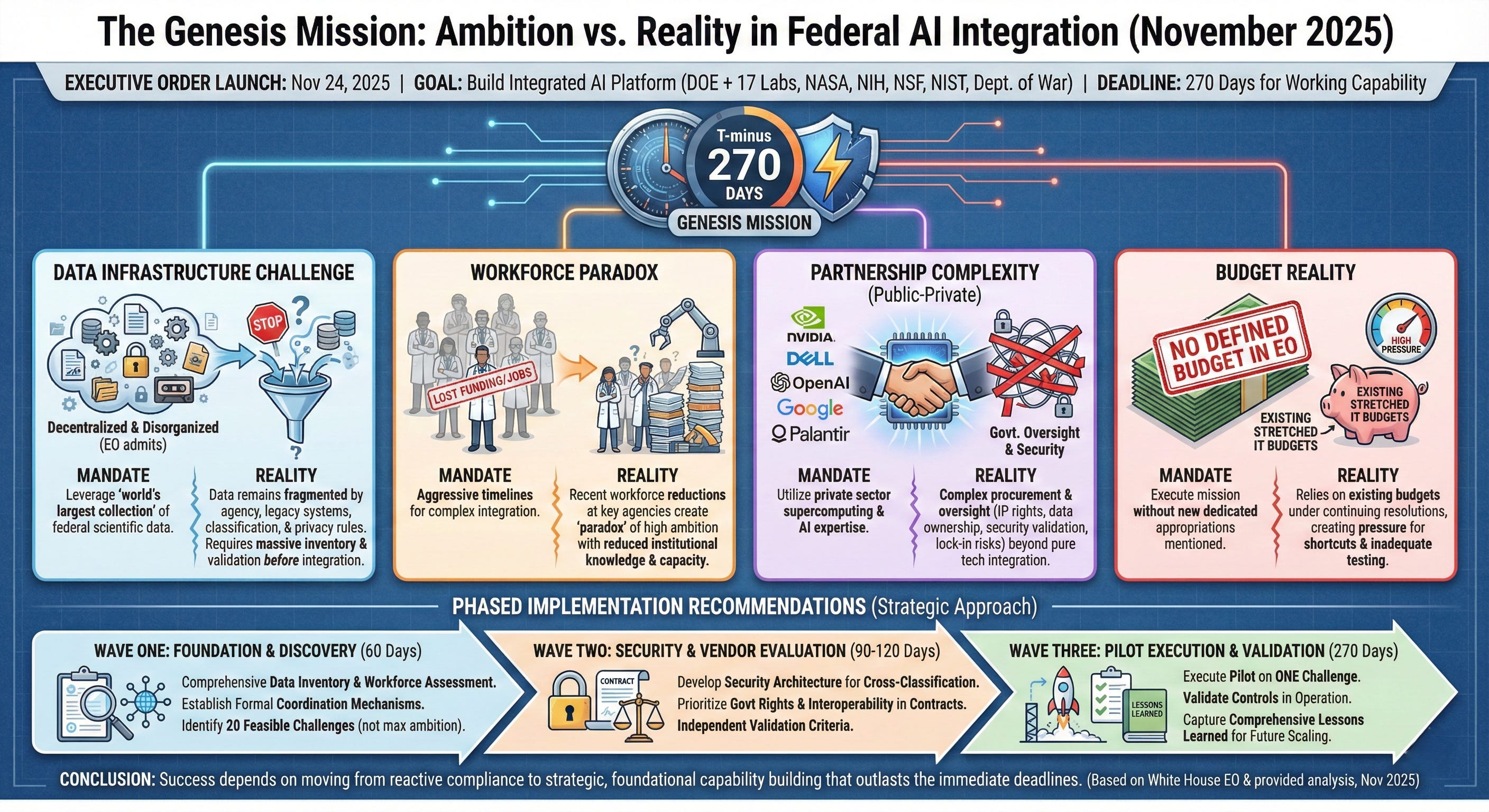
On November 24, 2025, President Trump signed an Executive Order launching what the White House bills as the largest mobilization of federal scientific resources since the Apollo Program. The Genesis Mission directs the Department of Energy to build an integrated AI platform on top of scientific data from 17 National Laboratories plus NASA, the National Institutes of Health, the National Science Foundation, the National Institute of Standards and Technology, and the Department of War. Agencies have 270 days to demonstrate working capability.
The ambition is undeniable. The scale is unprecedented. The timeline is aggressive.
But beneath the headlines sits a harder reality: Genesis layers Apollo-scale expectations onto fragmented data infrastructure, agencies that have just shed thousands of scientists and engineers, complex public-private partnerships with unresolved questions about data rights and security controls, and IT budgets already dominated by simply keeping legacy systems alive.
For Exchange Weekly readers, the real story isn’t whether Genesis is “big.” It’s whether federal science leaders treat it as a rushed compliance exercise or as a once-in-a-decade catalyst to fix foundational problems they already know they have.
The short version: Four tensions that will define Genesis
If you’re skimming, here are the core tensions that will drive outcomes:
Tension 1: A centralized AI vision sitting on top of decentralized, poorly cataloged data.
Tension 2: Platform ambition launched just after major cuts to the scientists and engineers who understand the data.
Tension 3: Heavy reliance on commercial AI providers without fully resolved questions about data rights, security validation, and long-term vendor dependence.
Tension 4: Comparisons to Apollo and the Manhattan Project without Apollo-style dedicated funding or wartime budget flexibility.
How leaders navigate these tensions over the next 270 days will matter far more than the rhetoric in the press release.