
Executive Summary
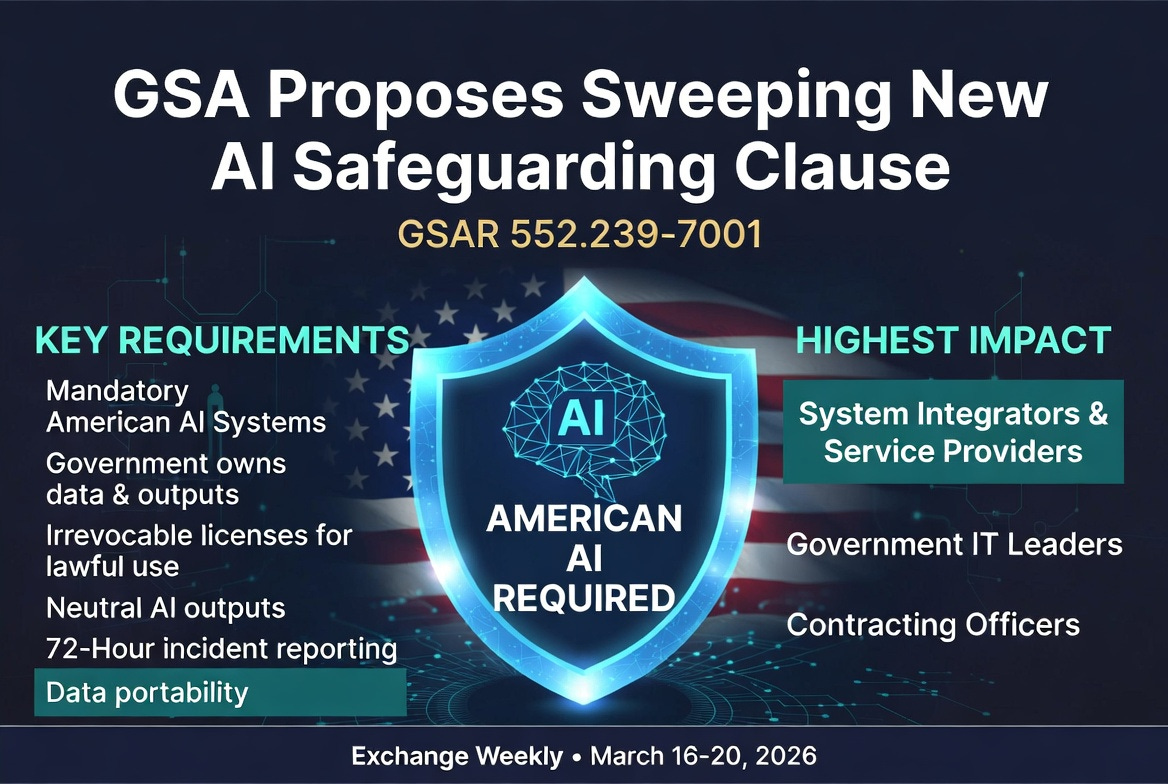
This week solidified procurement as the federal government’s sharpest tool for imposing AI safeguards. GSA’s draft GSAR 552.239-7001 requires exclusive use of “American AI Systems” (developed and produced in the United States per OMB M-25-22), government ownership of Government Data Inputs and Outputs with irrevocable licenses for any lawful purpose (including outputs), prohibitions on contractor use of such data for training, fine-tuning, or business decisions, neutrality principles to ensure objective and truthful outputs without ideological bias or discretionary refusals for lawful requests, comprehensive disclosures of all AI systems used (including third-party service providers), 72-hour incident reporting via CISA, seven-day notifications for material changes, data portability in open machine-readable formats to prevent lock-in, traceability for human oversight, and precedence over conflicting commercial terms. The clause applies to contractors providing AI or using it in performance, with primes responsible for flow-down compliance to subcontractors and service providers.
System integrators and service providers are most affected by the most pressing revenue and contract issues. The “American AI” mandate risks excluding many globally reliant offerings, demanding supply chain audits and pivots that elevate costs for documentation, flow-downs, and neutrality mechanisms, while diminishing proprietary edges through data rights and portability. Compliance burdens could pressure margins in the short term, yet firms certifying domestic stacks and modular architectures position for differentiation and premium share in GSA pipelines. Government IT leaders face accelerated vendor transitions, deployment risks for non-compliant tools, and budget reallocations toward vetted solutions amid mission continuity demands. Contracting officers benefit from new evaluation criteria for sourcing, transparency, and incident accountability, but face verification challenges for claims and flow-downs. A broad cross-agency reach standardizes safeguards through GSA Schedules that support civilian and defense missions.
Secondary elements reinforce the pattern. The White House framework pushes federal preemption of state AI laws, imposes undue burdens, streamlines data center permitting, establishes child safety tools, protects energy costs, and offers small business incentives—establishing long-term tailwinds for compliant domestic AI providers. TMF’s extension maintains access to modernization funding but leaves advocates pressing for multi-year stability. War Department activity sustains demand for sovereign, secure AI in sensitive domains.
The week illustrated procurement’s role in advancing national AI priorities: domestic sovereignty, data control, trustworthy performance, and reduced vendor leverage. System integrators with GSA exposure must accelerate compliance efforts to safeguard and expand revenue opportunities.
Primary Topic: GSA’s Proposed GSAR 552.239-7001 – Basic Safeguarding of Artificial Intelligence Systems
What Happened This Week
GSA’s March 6 draft clause dominated Beltway commentary from March 16-20. Major firms issued alerts breaking down provisions, with analysis shifting from initial scope concerns to implementation feasibility and competitive impacts. The March 20 comment deadline prompted submissions, but GSA extended it to April 3 on March 19 via a blog update, clarifying that it excludes Refresh 31 and may include Refresh 32. Coverage highlighted key elements: “American AI Systems” requirement, irrevocable government licenses extending to outputs, strict data non-use prohibitions, neutrality mandates barring partisan bias or refusals for lawful uses, full disclosure of AI systems (within 30 days post-award), 72-hour incident reporting, change notifications, portability in open formats, human oversight traceability, and precedence over commercial agreements. The extension signaled GSA’s responsiveness to the volume of feedback without immediate revisions.
Why It Matters
1. System Integrators and Service Providers
Highest revenue/contract impact arises from mass modification acceptance (60 days post-issuance) or exclusion risk. “American AI” sourcing prohibits the use of foreign-developed or controlled components, forcing audits that disqualify many current models and compelling domestic substitutions or partnerships. Broad data rights—government ownership of inputs/outputs and Custom Developments, irrevocable licenses, non-use for training or decisions—undermine models reliant on data refinement. Neutrality and refusal bans constrain safety guardrails. Compliance costs escalate for disclosures, incident protocols, flow-down enforcement, and portability. Near-term pipeline pressure contrasts with opportunities for certified, compliant offerings and modular designs that enable quick adaptation.
2. Government IT Workers and Leaders
Operational shifts intensify. Agencies anticipate terms in task orders, driving reevaluations toward compliant vendors and potentially delaying legacy deployments. Budget strains emerge from premium pricing and oversight needs. Technology decisions prioritize interoperable, portable systems. Workforce upskilling targets compliance monitoring and incident handling.
3. Government Contracting Officers
Acquisition strategies incorporate sourcing verification, disclosures, and neutrality as criteria. KO/CORs gain oversight tools but face challenges substantiating “American AI” claims and flow-downs. MAS standardization reduces variability while increasing diligence.
4. All Others
Policy advances sovereign, trustworthy AI. Trends favor domestic investment but risk innovation constraints if overly broad.
Strategic Context
Root causes include foreign supply chain vulnerabilities, data risks, opaque guardrails clashing with needs, and vendor limits on lawful uses. Extends OMB M-25-22 into binding terms, aligns with Advancing American AI Act, and responds to recent GSA dynamics. Parallels FedRAMP/CMMC: resistance yields adaptation. Connects to White House preemption and infrastructure priorities.
What’s Coming Next
GSA processes comments through April 3, likely refining definitions and thresholds. Refresh 32 inclusion could trigger mid-2026 modifications. Agencies may pilot compliant procurements. Indicators: RFIs for attestations, certification growth, and OMB guidance. Scrutiny is possible if overreach concerns arise.
Recommendations
System integrators adopt an Insights-driven approach.
Wave 1: Inventory AI systems across contracts; map to “American AI,” data rules, neutrality; identify gaps.
Wave 2: Develop modular frameworks with flow-downs, incident playbooks, portability, and secure domestic partnerships.
Wave 3: Integrate compliance in proposals; pursue validations for differentiation.
Government IT leaders: Audit uses; prioritize compliant vendors.
Contracting officers: Embed requirements in evaluations; verify via audits.
All: Monitor timelines rigorously.
Primary Topic Sources
GSA draft clause text: https://buy.gsa.gov/interact/system/files/GSA_Federal_Acquisition%20Service%20Proposed%20Government%20AI%20System%20Terms%20and%20Conditions.pdf (GSA, March 2026)
Holland & Knight analysis: https://www.hklaw.com/en/insights/publications/2026/03/gsas-proposed-ai-clause-a-deep-dive (March 19, 2026)
Hogan Lovells update: https://www.hoganlovells.com/en/publications/comments-on-gsas-proposed-ai-clause-due-march-20-2026 (March 19, 2026)
Crowell & Moring alert: https://www.crowell.com/en/insights/client-alerts/ai-for-government-7-days-for-contractor-comments-on-gsa-proposed-contract-clause-for-ai-systems (March 13, 2026)
Lawfare commentary: https://www.lawfaremedia.org/article/the-gsa-s-draft-ai-clause-is-governance-by-sledgehammer (March 18, 2026)
The Week Ahead
Comment reviews continue into April, with refinements expected. Refresh 32 progress critical; watch OMB/War Department alignment on “American AI.” White House framework may drive preemption or infrastructure actions. TMF awards are likely to accelerate. System integrators: Complete inventories, advance partnerships. Government leaders: Map uses for alignment.
Closing Perspective
The GSA clause represents a decisive step in federal AI governance, shifting from advisory guidance to enforceable procurement mandates that prioritize domestic control, data sovereignty, and output trustworthiness. While the breadth invites legitimate concerns about feasibility in layered supply chains and potential innovation drag, it addresses real vulnerabilities in commercial AI adoption—foreign dependencies, opaque decision paths, and conflicting vendor policies—that have long complicated government use. If refined through comments to clarify definitions and thresholds without diluting core protections, this approach could foster a more resilient, accountable federal AI ecosystem. System integrators who treat it as a competitive pivot rather than a mere compliance burden will likely emerge stronger, capturing advantage as agencies demand verifiable alignment with national priorities. The clause underscores procurement’s power to shape technology trajectories, and its evolution will influence how the government balances security, efficiency, and innovation for years ahead.
This update was assembled using a mix of human editorial judgment, public records, and reputable national and sector-specific news sources, with help from artificial intelligence tools to summarize and organize information. All information is drawn from publicly available sources listed above. Every effort is made to keep details accurate as of publication time, but readers should always confirm time-sensitive items such as policy changes, budget figures, and timelines with official documents and briefings.
This publication is for informational purposes only and does not constitute legal, technical, acquisition, financial, or compliance advice. It is not a substitute for professional guidance. Readers should consult qualified legal counsel, technical experts, acquisition professionals, financial advisors, and compliance officers before making any decisions or taking any action based on this content. Always validate with primary sources before proceeding.
All original content, formatting, and presentation are copyright 2026 Metora Solutions LLC, all rights reserved. For more information about our work and other projects, drop us a note at info@metorasolutions.com