
Executive Summary
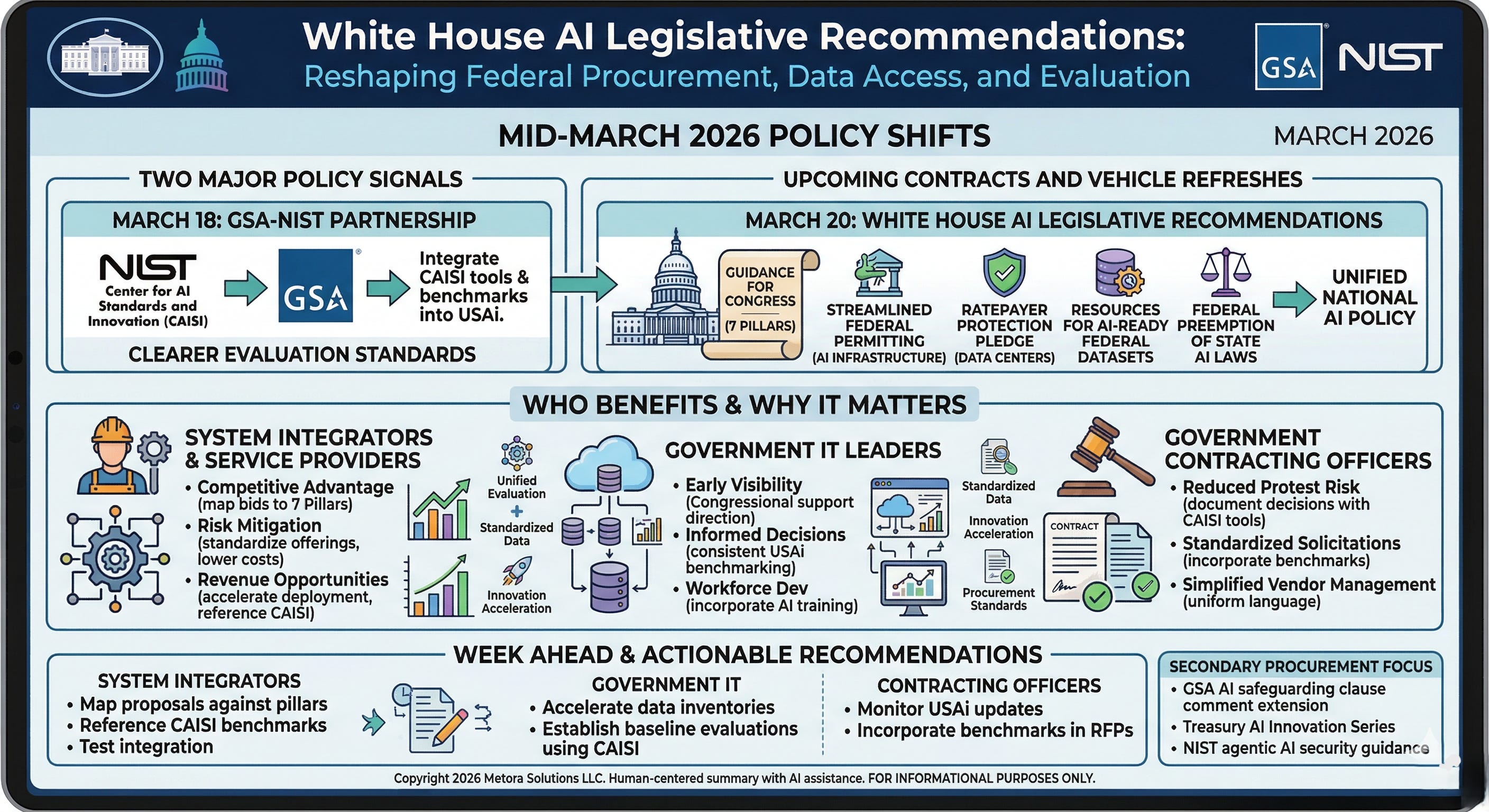
Federal agencies and the contractors that support them received two closely timed policy signals in mid-March that will directly influence how AI-related contracts are structured, evaluated, and awarded for the remainder of 2026 and beyond. On March 18, the General Services Administration and the National Institute of Standards and Technology announced a partnership that brings NIST’s Center for AI Standards and Innovation (CAISI) tools and benchmarks into GSA’s USAi platform. Two days later, on March 20, the White House released its National Policy Framework for Artificial Intelligence: Legislative Recommendations. The document is explicitly framed as a set of recommendations to Congress across seven pillars, not as a direct operational directive to federal agencies.
This edition translates those signals into the practical implications that matter most to system integrators and service providers first. The March 20 framework recommends congressional action on streamlined federal permitting for AI infrastructure, a Ratepayer Protection Pledge to shield residential electricity users from data-center-driven cost spikes, and resources to make federal datasets available in AI-ready formats, as well as federal preemption of state AI laws that impose undue burdens. When paired with the GSA-NIST partnership, these recommendations create clearer evaluation standards for AI models and services in federal acquisitions.
The highest-revenue and contract-impact story this week is the combination of these developments. System integrators now have concrete signals on how Congress may shape AI-related procurement language, data-access requirements, and evaluation criteria. Government IT leaders gain insight into the likely direction of future funding and compliance expectations. Contracting officers receive early indicators of standardized benchmarking tools that can reduce protest risk. All other stakeholders see a continued push toward a unified national AI policy that prioritizes innovation while addressing safety, free speech, and intellectual property.
Secondary developments reinforce the procurement focus. GSA extended the comment period on its proposed AI safeguarding clause to April 3 after industry pushback on multiple high-stakes provisions. Treasury continued its AI Innovation Series. NIST advanced work on agentic AI security guidance.
The strategic context connects the March 20 recommendations to the July 2025 America’s AI Action Plan, the November 2025 Genesis Mission executive order, and the December 11, 2025, Executive Order on Ensuring a National Policy Framework for Artificial Intelligence. The shift emphasizes legislative and standards-based execution rather than new agency mandates.
This newsletter delivers the evidence-based roadmap executives need. System integrators should map current bids against the emerging evaluation and data-access signals. Government IT leaders should begin inventorying datasets for AI readiness. Contracting officers should monitor how USAi benchmarking is incorporated into solicitations. The analysis below prioritizes contract, revenue, and operational impacts for the target audience.
White House AI Legislative Recommendations: Policy Signals Reshaping Federal Procurement, Data Access, and Evaluation Standards for System Integrators in 2026
What Happened This Week
The week of March 18 to March 20 delivered two complementary policy developments with immediate relevance to federal AI acquisitions. On March 18, GSA and NIST announced their partnership to strengthen AI evaluation science in federal procurement. NIST’s Center for AI Standards and Innovation (CAISI) will provide tooling, methodological guidance, benchmarks, and hands-on testing support for GSA’s USAi platform. The goal is to give agencies clearer, more consistent ways to test and measure AI models and services before deployment.
On March 20, the White House released the National Policy Framework for Artificial Intelligence: Legislative Recommendations. Organized around seven pillars, the document is framed as guidance for Congress rather than as binding operational directives to agencies. The pillars address protecting children and empowering parents, safeguarding and strengthening American communities, respecting intellectual property rights, preventing censorship and protecting free speech, enabling innovation and ensuring American AI dominance, educating Americans and developing an AI-ready workforce, and establishing a federal policy framework that includes preemption of certain state AI laws.
Key recommendations pulled directly from the document include congressional action to streamline federal permitting for AI infrastructure construction and operation, implementation of the Ratepayer Protection Pledge to prevent residential electricity cost increases from AI data centers, provision of resources to make federal datasets accessible in AI-ready formats for industry and academia, and preemption of state AI laws that impose undue burdens to create a minimally burdensome national standard. Agency briefings and industry discussions throughout the week highlighted how these signals will influence upcoming solicitations, particularly around data access, evaluation criteria, and nationwide deployment consistency.
Why It Matters
1. System Integrators and Service Providers
This development carries the highest revenue and contract-impact implications for integrators this week. The March 20 recommendations signal to Congress the policy priorities that are likely to appear in future appropriations and authorizing language. Integrators who position their offerings around AI-ready federal data access, standardized evaluation via USAi, and compliance with emerging national standards will gain a competitive advantage in the next round of vehicle refreshes and task orders.
Revenue pipelines stand to benefit from the framework's emphasis on accelerating deployment and removing barriers. Firms already supporting GSA schedules or War Department modernization programs can incorporate references to the recommended data-access provisions and CAISI-supported benchmarks into their capability statements and proposals. The preemption recommendation reduces the risk of maintaining fifty different state-specific compliance regimes, allowing integrators to standardize service offerings and lower delivery costs. Partnership strategies should now include closer alignment with domestic AI providers that meet the “American AI” emphasis referenced in related procurement discussions.
Risk mitigation improves for integrators who begin mapping proposals to the seven pillars. Those who wait risk losing ground to competitors who embed USAi evaluation language and data-readiness references early. Overall, the combined GSA-NIST partnership and legislative recommendations create a clearer playing field for firms that deliver measurable evaluation, data integration, and nationwide consistency.
2. Government IT Workers and Leaders
Agency CIOs, CTOs, and program managers receive early visibility into the likely direction of congressional support for AI modernization. The recommendation to make federal datasets available in AI-ready formats directly addresses a long-standing operational bottleneck in model training and deployment. Leaders can begin prioritizing data-inventory efforts that align with the framework’s emphasis on accessibility for both government and external use.
Technology decisions are better informed because the GSA-NIST partnership provides consistent benchmarking through USAi. IT leaders can reference these tools when justifying architecture choices or pilot expansions. Workforce considerations benefit from the education and AI-ready workforce pillar, which encourages incorporating AI training into existing programs. Budget impacts will depend on how Congress acts on the recommendations, but the signals point toward support for innovation-enabling investments rather than new regulatory burdens. Mission owners gain a unified policy context that connects data access, evaluation standards, and national competitiveness.
3. Government Contracting Officers
Acquisition professionals gain practical reference points for upcoming solicitations. The GSA-NIST partnership provides standardized benchmarks and testing methodologies that can be cited directly in evaluation criteria. Officers can reduce protest risk by documenting decisions in line with the CAISI-supported USAi tools and the legislative recommendations on data access and national standards.
Contract vehicles such as the Multiple Award Schedule will likely incorporate references to these developments in future refreshes. The preemption recommendation supports more uniform contract language across jurisdictions. Vendor management is simplified because the framework enables broad access to federal data while maintaining safety and innovation guardrails. Officers should begin reviewing open opportunities for places where USAi benchmarking language or data-readiness requirements can strengthen the acquisition record.
4. All Others
Policy makers, industry analysts, and researchers observe continued evolution toward a national AI policy that balances innovation with protections. The seven-pillar structure reinforces federal leadership while respecting federalism limits. Cross-agency implications include easier data sharing for research and reduced regulatory fragmentation for state and local partners working with federal programs. The recommendations set expectations for how Congress may address AI in upcoming legislation, including the next NDAA and appropriations cycles.
Strategic Context
The March 20 legislative recommendations build directly on the July 2025 America’s AI Action Plan and the November 2025 Genesis Mission executive order. The December 11, 2025, Executive Order on Ensuring a National Policy Framework for Artificial Intelligence further established the policy of sustaining U.S. AI dominance through a minimally burdensome national approach. The current document shifts the emphasis from executive action to specific congressional recommendations across the seven pillars.
The GSA-NIST partnership supplies the technical evaluation backbone that earlier policies anticipated but did not fully operationalize. By integrating CAISI tools into USAi, the government creates consistent measurement capabilities that support the innovation and deployment goals outlined in the framework. This alignment aligns with the broader government IT strategy on standards-based procurement, data governance, and supply-chain security. The result is a coherent policy thread that treats AI as critical infrastructure requiring both legislative support and standardized evaluation.
What’s Coming Next
Early agency memos are expected to reference the March 20 recommendations when updating AI roadmaps and data strategies. The Multiple Award Schedule Refresh process will continue to incorporate feedback from the recently extended comment period on the AI safeguarding clause. Industry associations will submit additional input on preemption and data-access provisions that could shape final legislative language.
Appropriations committees are likely to consider the framework when marking up defense and civilian spending bills. Targeted provisions supporting AI-ready data initiatives or evaluation infrastructure could appear in both the War Department and civilian budgets. NIST will release additional guidance on AI security that agencies can align with USAi benchmarking. GSA will expand USAi's capabilities by adding additional model categories and metrics from the CAISI partnership.
Recommendations
System integrators and service providers should treat the March recommendations and GSA-NIST partnership as baseline signals for every AI-related federal opportunity. Wave 1: Map current proposals and capabilities against the seven pillars, with specific attention to data-access readiness and USAi evaluation integration. Update compliance matrices and client briefings accordingly. Wave 2: Test integration of CAISI-supported benchmarks into existing service offerings and develop cost models that demonstrate value from standardized evaluation. Wave 3: Prepare flexible contract language for hybrid data environments and track solicitations for references to the legislative recommendations.
Government IT workers and leaders should initiate or accelerate data inventories focused on AI-readiness criteria. Use the GSA-NIST partnership tools to establish baseline evaluation scores for current and planned models. Develop internal roadmaps that reference the framework’s innovation and workforce pillars.
Contracting officers should monitor USAi updates and incorporate CAISI-derived benchmarks into new solicitations where appropriate. Document acquisition decisions against the legislative recommendations to strengthen the record. Review open opportunities to add data-access or evaluation language.
All other stakeholders should track congressional responses to the recommendations and prepare for potential impacts on cross-agency data-sharing agreements and research collaborations.
Primary Topic Sources
https://www.whitehouse.gov/wp-content/uploads/2026/03/03.20.26-National-Policy-Framework-for-Artificial-Intelligence-Legislative-Recommendations.pdf (White House, March 20, 2026)
https://www.gsa.gov/about-us/newsroom/news-releases/gsa-and-nist-partner-to-boost-ai-evaluation-science-in-federal-procurement-03182026 (GSA, March 18, 2026)
https://fedscoop.com/gsa-nist-evaluate-ai-before-agency-deployments-caisi/ (FedScoop, March 19, 2026)
https://www.whitehouse.gov/wp-content/uploads/2025/07/Americas-AI-Action-Plan.pdf (White House, July 2025)
https://www.whitehouse.gov/presidential-actions/2025/12/eliminating-state-law-obstruction-of-national-artificial-intelligence-policy/ (White House, December 11, 2025)
Prior Exchange Daily briefings on AI evaluation and data-access developments (Metora Solutions LLC, March 2026)
Other News Worth Noting
GSA extended the public comment period on its proposed AI safeguarding clause to April 3, 2026, following substantial industry pushback on the draft language for the Multiple Award Schedule Refresh. The nine-page clause includes requirements for “American AI” components, anti-DEI provisions that require systems to be truthful and prioritize historical accuracy without ideological manipulation, contractor liability for reasonable decommissioning costs in cases of non-compliance, and broad government rights to use AI for “any lawful Government purpose.” The latter echoes the Anthropic-Pentagon dispute that previously led to a government-wide ban and supply-chain risk designation. Industry feedback also addressed data licensing, foreign components, and the burden of policing upstream AI providers. The extension gives integrators additional time to analyze the substantive policy shifts that could affect every AI-related MAS task order and set precedents for other vehicles.
Treasury continued its AI Innovation Series with sessions focused on secure financial tools and data-protection standards. The briefings aligned with the broader national policy signals on innovation and evaluation.
NIST advanced its AI Agent Standards Initiative with new draft guidance on agentic AI security expected in the coming weeks. The materials will include recommendations that agencies can reference when using USAi benchmarking tools.
Each secondary item connects directly to the primary theme of standardized, innovation-focused AI procurement and evaluation. They represent incremental but commercially significant steps in the same direction.
The Week Ahead
Agency CIO councils are expected to circulate early guidance referencing the March 20 legislative recommendations when updating AI strategies and data inventories. These memos will clarify how programs can incorporate AI-ready dataset priorities and USAi evaluation standards into ongoing work.
The Multiple Award Schedule Refresh process will reflect outcomes from the just-closed AI clause comment period. Schedule holders should prepare updated capability statements that address the evaluation and data-access signals now visible in the framework.
Industry associations will continue submitting formal comments on preemption provisions and related data-access recommendations. Those inputs could influence congressional consideration of the framework in upcoming legislation.
War Department components will likely issue internal alignment memos connecting their AI programs to the national policy signals on innovation and evaluation. This alignment could open new opportunities for cleared integrators.
NIST’s forthcoming agentic AI guidance will provide technical checklists that agencies can adopt alongside USAi benchmarking. Early adopters will reduce future rework.
Budget planners should reference the framework’s pillars when preparing fiscal-year requests. OMB will view proposals that support AI-ready data and standardized evaluation favorably.
Contracting offices should review active solicitations for opportunities to add USAi or CAISI-derived language. Early movers will establish precedents that others will follow.
The week ahead marks the transition from policy signal to implementation planning. Agencies and contractors that inventory data assets and align with emerging evaluation standards now will capture the largest share of the next wave of AI-related contract opportunities.
Closing Perspective
The March 20 legislative recommendations and the GSA-NIST partnership represent a practical step in translating national AI policy into procurement and standards realities. By focusing congressional attention on data access, innovation barriers, preemption, and evaluation consistency, the framework gives system integrators, IT leaders, and contracting officers a shared reference point for 2026 actions. The real test will come in how quickly agencies and contractors incorporate these signals into data inventories, proposals, and solicitations.
The patterns are consistent with prior executive actions. National policy continues to emphasize leadership by reducing barriers and standardizing tools rather than adding new layers of agency-specific mandates. Integrators who act on the evaluation and data-access signals in the current wave will deliver measurable outcomes across missions. The broader influence of these early alignments will shape how the government approaches subsequent technology waves.
This update was assembled using a mix of human editorial judgment, public records, and reputable national and sector-specific news sources, with help from artificial intelligence tools to summarize and organize information. All information is drawn from publicly available sources listed above. Every effort is made to keep details accurate as of publication time, but readers should always confirm time-sensitive items such as policy changes, budget figures, and timelines with official documents and briefings.
All original content, formatting, and presentation are copyright 2026 Metora Solutions LLC, all rights reserved. For more information about our work and other projects, drop us a note at info@metorasolutions.com
The Exchange Daily and Exchange Weekly are productions of Metora Solutions LLC, a Service Disabled Veteran Owned Small Business. Every effort is made to keep details accurate as of publication time, but readers and listeners should always confirm time-sensitive items such as policy changes, budget figures, and timelines directly with official documents and briefings.
The Exchange Daily and Exchange Weekly are for informational purposes only. They do not constitute legal, investment, procurement, security, compliance, technical, or any other form of professional advice. No attorney-client, advisor-client, or other professional relationship is created by listening to or reading this content. Always consult qualified professionals and validate with primary sources before taking any action.
The Exchange Daily delivers verified public-source intelligence for executive decision-makers. All information is from publicly available sources. No information is derived from classified or proprietary sources.
All rights reserved. Copyright Metora Solutions LLC 2026.