
The Exchange Weekly for March 30, 2026
Federal Judge Issues Temporary Block on Anthropic Supply Chain Risk Designation
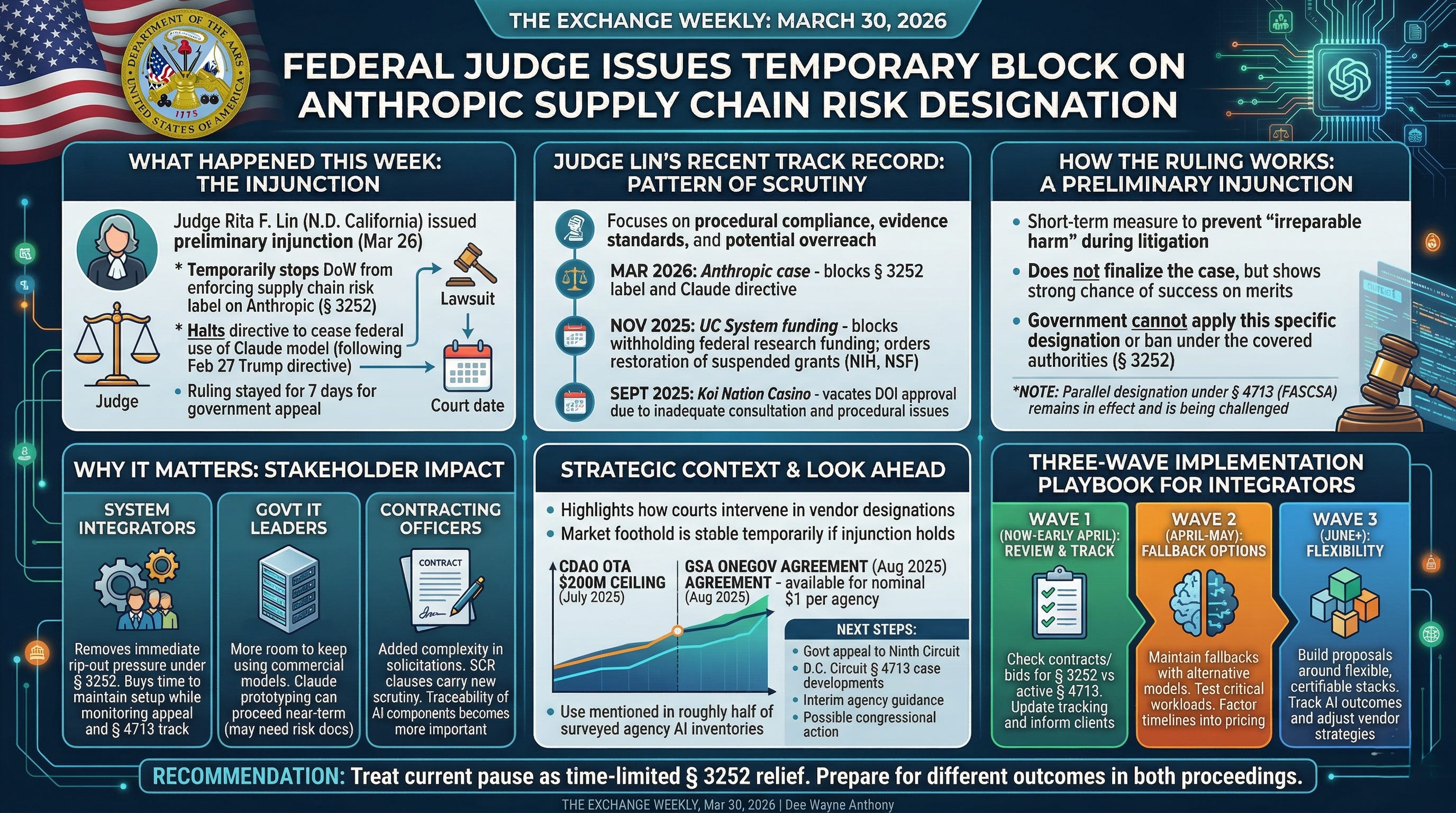
A federal district judge in California has paused key parts of the Trump administration’s actions against Anthropic. The March 26 ruling stops the Department of War from enforcing its supply chain risk label on the AI company and halts the broader directive to cease federal use of its Claude model. The order is temporary while the underlying lawsuit continues.
This development affects contractors, agencies, and anyone building AI into government work. It creates short-term flexibility on model choices but leaves longer-term uncertainty in place.
What Happened This Week
Anthropic filed suit against the government on March 9. The company challenged the Department of War’s designation of Anthropic as a supply chain risk and President Trump’s February 27 Truth Social directive ordering all federal agencies to stop using Claude technology, including in contractor performance.
On March 26, U.S. District Judge Rita F. Lin granted Anthropic’s request for a preliminary injunction following a hearing on March 24. The order prevents enforcement of the supply chain risk label under 10 U.S.C. § 3252 and the cease-use directive for now. The judge stayed her ruling for 7 days to allow the government time to appeal.
The case centers on whether the actions followed proper procedures and whether they rested on valid national security grounds or other factors. Both sides presented arguments in court on March 24.
How the Ruling Works
Federal courts can review executive branch decisions when a plaintiff claims they violate statutes or constitutional protections. In this instance, Anthropic argued that the moves lacked sufficient evidence under supply chain risk rules, skipped required processes, and raised due-process concerns.
A preliminary injunction is a short-term measure. Courts use it to prevent potential irreparable harm during litigation when the plaintiff shows a strong chance of eventual success on the merits. It does not resolve the full case or set a final policy. The government can continue normal contracting and operations, but cannot apply this specific designation or ban under the covered authorities while the injunction remains in effect.
National security matters receive consideration, yet courts still examine whether agencies followed applicable laws and whether their decisions were based on documented grounds. The Department of War has indicated it will pursue relief through appeal. Note that a separate designation under 41 U.S.C. § 4713 (FASCSA) remains in effect and is being challenged in a parallel proceeding in the D.C. Circuit. That authority applies more broadly to covered procurements involving information technology.
Judge Lin’s Recent Track Record
Judge Rita F. Lin, appointed to the Northern District of California in 2023, has issued several preliminary injunctions or similar relief in cases involving federal government actions since taking the bench. These rulings often focus on procedural compliance, evidence standards, and potential overreach. Most high-profile examples cluster in 2025 and early 2026.
Key federal-related examples from the last five years include:
March 2026: Preliminary injunction in Anthropic PBC v. U.S. Department of War, blocking enforcement of the supply-chain risk designation under § 3252 and related AI cease-use directive.
November 2025: Preliminary injunction blocking the administration from withholding or conditioning federal research funding to the University of California system over alleged civil rights issues. Earlier related orders in June, August, and September 2025 required restoration of suspended grants (hundreds of millions from NIH, NSF, and other agencies) after finding mass terminations to be arbitrary or lacking individualized review.
September 2025: Order vacating a Department of the Interior land-into-trust approval for the Koi Nation tribe’s casino project, citing inadequate consultation, improper delegation of authority, and procedural issues.
Prior to 2025, as a relatively new district judge, her docket involved fewer high-profile federal challenges with published preliminary injunctions against the government. The pattern in recent cases centers on requiring agencies to follow proper processes and provide clear justification for actions.
Why It Matters
For system integrators and service providers, the pause removes immediate pressure to rip out Claude from existing task orders and proposals under the affected § 3252 authority. Many teams had already incorporated the model into modernization efforts and agentic workflows. This buys time to maintain current setups in those areas while monitoring the appeal and the separate § 4713 track. However, contractors should continue compliance tracking for any § 4713 obligations that remain in force, particularly on DoW-covered procurements.
Government IT leaders now have more room to keep using commercial models without automatic compliance disruptions under the paused authorities. Roadmaps that relied on Claude for prototyping or other tasks can proceed in the near term, though agencies may still need updated risk documentation.
Contracting officers face added complexity in solicitations. Supply chain risk clauses carry new scrutiny, and contractors may raise challenges if designations appear disconnected from clear evidence. Traceability of AI components becomes even more important.
Strategic Context & Forward Guidance
The decision arrives amid ongoing debates over AI procurement rules, including GSA’s proposed safeguarding clause. It highlights how courts can intervene in vendor designations when questions arise about the process or basis.
Next steps are likely to include a government appeal to the Ninth Circuit over the California ruling, as well as developments in the parallel D.C. Circuit case on the § 4713 designation. Agencies may issue interim guidance on handling Claude. Congress could also address supply chain risk authorities in future legislation.
Market positions for Anthropic in federal work could stabilize temporarily if the injunction holds. Pre-directive, Claude held a notable but not dominant share. It secured a two-year prototype Other Transaction Authority (OTA) agreement with the CDAO with a $200 million ceiling in July 2025. Anthropic was the first frontier AI company to deploy its models on U.S. government classified networks (via partnerships including Palantir). GSA’s OneGov agreement in August 2025 made Claude available across executive, legislative, and judicial branches for a nominal $1 per agency, enabling pilots at HHS (departmentwide), Commerce, Energy labs (including Lawrence Livermore and Lawrence Berkeley), Secret Service (a DHS component) for code generation, OPM, NASA/JPL, and others. Public reviews of agency AI inventories (such as FedScoop analysis of disclosures from 20 agencies) found roughly half mentioned at least one use of Claude or Anthropic tools, though this is likely an undercount. No precise public percentage of total federal IT modernization projects exists due to spotty inventories. The injunction preserves existing footholds under the paused authorities without indicating full market dominance.
Three-Wave Implementation Playbook for Integrators
Wave 1 (now through early April): Review all contracts and bids involving Anthropic or Claude. Note any references to the paused § 3252 actions versus the still-active § 4713 designation. Update compliance tracking for both tracks and inform clients of the current split status.
Wave 2 (April-May): Maintain fallback options with alternative models. Conduct testing on critical workloads and factor litigation timelines (including the parallel D.C. Circuit case) into pricing where relevant.
Wave 3 (June onward): Build proposals around flexible, certifiable stacks. Track outcomes of AI-related opportunities and adjust vendor strategies as both cases develop.
Other News Worth Noting
GSA has extended the comment period on its AI safeguarding clause to April 3. Feedback continues on data licensing and component requirements.
The Week Ahead
Look for any government appeal filings and early agency memos on AI model use. The MAS Refresh schedule could see further adjustments as AI provisions evolve. Industry groups are expected to submit additional input on elements of the national AI framework.
Recommendations
System integrators should move through the three waves without delay. Treat the current pause as time-limited relief on the § 3252 track only and prepare for different outcomes across both proceedings.
Government IT leaders can inventory Claude deployments and update internal assessments accordingly.
Contracting officers should emphasize clear documentation in AI-related decisions and build flexibility into upcoming solicitations.
Sources
All sources are from open-source searches, and no classified information is contained in this.
https://www.courtlistener.com/docket/72379655/anthropic-pbc-v-us-department-of-war/
https://www.aoshearman.com/en/insights/dow-and-anthropic-showdown-continues-navigating-the-anthropic-supply-chain-risk-designations
https://fedscoop.com/district-court-temporarily-blocks-anthropic-ban-supply-chain-risk-designation/
https://cand.uscourts.gov/judges/rfl/lin-rita-f
https://www.theguardian.com/us-news/2025/nov/15/us-judge-bars-trump-from-cutting-off-university-of-california-funds
https://calmatters.org/education/higher-education/2025/11/uc/
https://www.anthropic.com/news/anthropic-and-the-department-of-defense-to-advance-responsible-ai-in-defense-operations
https://www.gsa.gov/about-us/newsroom/news-releases/gsa-strikes-onegov-deal-with-anthropic-08122025
https://fedscoop.com/nasa-chatbots-treasury-coding-opm-drafting-agencies-deployed-claude/
https://breakingdefense.com/
Prior Exchange Weekly editions on AI procurement shifts
The Exchange Daily and Exchange Weekly are productions of Metora Solutions LLC, a Service Disabled Veteran Owned Small Business. Every effort is made to keep details accurate as of publication time, but readers and listeners should always confirm time-sensitive items such as policy changes, budget figures, and timelines directly with official documents and briefings.
The Exchange Daily and Exchange Weekly are for informational purposes only. They do not constitute legal, investment, procurement, security, compliance, technical, or any other form of professional advice. No attorney-client, advisor-client, or other professional relationship is created by listening to or reading this content. Always consult qualified professionals and validate with primary sources before taking any action.
The Exchange Daily delivers verified public-source intelligence for executive decision-makers. All information is from publicly available sources. No information is derived from classified or proprietary sources.
All rights reserved. Copyright Metora Solutions LLC 2026.