
Executive Summary
The week of February 23 to March 1, 2026 produced the most significant shift in federal artificial intelligence procurement policy in years. On February 27, President Trump directed every federal agency and contractor to cease use of Anthropic technology immediately. The General Services Administration removed Anthropic offerings from Multiple Award Schedules and USA.gov. The War Department designated Anthropic models a supply chain risk and mandated a six-month phase-out.
Developments published today, March 2, have moved the story from announcement to active
execution while introducing measurable political and legal friction. The Departments of Treasury, State, and Health and Human Services confirmed they have begun terminating Anthropic contracts and licenses. The State Department disclosed it is migrating its enterprise StateChat platform directly to OpenAI models. OpenAI CEO Sam Altman held a public AMA session defending the company’s new classified deployment agreement with the War Department and outlining additional technical safeguards.
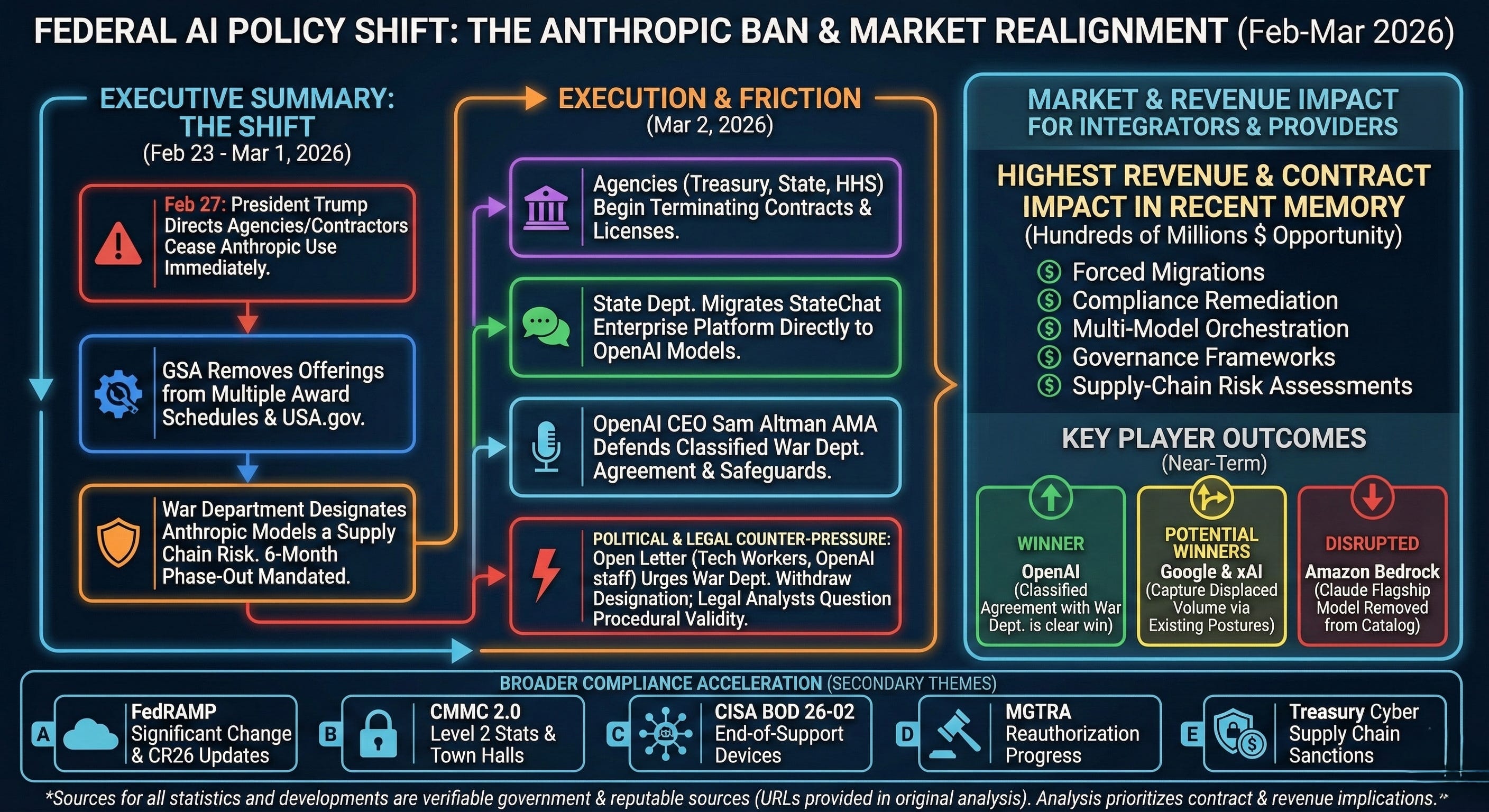
Political and legal counter-pressure also surfaced. Hundreds of technology workers, including some current OpenAI employees, signed an open letter urging the War Department to withdraw the supply-chain risk designation and calling on Congress to review the use of these authorities against a domestic company. Legal analysts published assessments questioning the procedural validity of the designation.
This realignment creates the highest revenue and contract impact for system integrators and service providers of any development in recent memory. Forced migrations, compliance remediation, multi-model orchestration, governance frameworks, and supply-chain risk assessments now represent immediate opportunities measured in hundreds of millions of dollars across government and commercial clients. OpenAI emerges as the clearest near-term winner through its classified agreement. Google and xAI stand to capture substantial displaced volume through their existing federal postures and alignment advantages. Amazon Bedrock faces the most direct disruption because Claude was a flagship model in its government catalog.
Secondary themes this week reinforce the broader compliance acceleration environment: FedRAMP’s Significant Change Notification process and CR26 Marketplace updates, CMMC 2.0 Level 2 statistics and contractor town halls, CISA Binding Operational Directive 26-02 on end-of-support edge devices with related leadership developments, and progress on Modernizing Government Technology Reform Act reauthorization paired with Treasury cyber supply chain sanctions.
The analysis below prioritizes contract and revenue implications for system integrators and service providers first. Every recommendation uses phased Wave language. Every statistic and development is drawn from verifiable government and reputable sources with working URLs listed at the end of the primary topic section.
Primary Topic: Federal AI Vendor Realignment
What Happened This Week
President Trump’s February 27 memorandum cited national security and supply-chain integrity after Anthropic refused to remove certain model restrictions, including limits on mass domestic surveillance and fully autonomous weapons systems. The General Services Administration executed schedule removals the same day. The War Department issued a formal supply chain risk designation under existing authorities, triggering mandatory six-month divestiture for any remaining use in production or development.
Today’s March 2 reporting shows rapid agency-level execution. Officials from Treasury, State, and Health and Human Services confirmed active contract terminations and license cancellations. The State Department specifically announced migration of its StateChat platform from Claude to OpenAI models. OpenAI CEO Sam Altman conducted a public AMA session providing expanded details on the safeguards framework accepted for classified War Department networks.
Counter-developments also emerged. An open letter signed by more than 400 technology workers, including current OpenAI employees, urges the War Department to withdraw the designation and asks Congress to examine whether these authorities were applied appropriately to a domestic firm. Legal analyses question the procedural foundation of the supply chain risk finding and flag potential court challenges.
OpenAI simultaneously strengthened its position with the previously announced classified deployment agreement. No equivalent announcements came from Google, xAI, or Amazon, yet each provider’s federal positioning has shifted dramatically in the migration wave.
Why It Matters
1. System Integrators and Service Providers
This is the largest forced vendor migration since major cloud security incidents. Integrators with Anthropic dependencies in active proposals or deliveries must act within days or risk disqualification and protest exposure. Migration services, architecture redesign, data movement, prompt re-engineering, testing, and IV&V now constitute urgent revenue pipelines. Typical mid-sized agency Claude-to-OpenAI or Claude-to-Gemini transitions are projected to generate two million to twelve million dollars per engagement depending on scale and complexity.
OpenAI gains the strongest early advantage in defense and intelligence communities through its classified agreement and additional safeguards detailed by Altman today. Google benefits from established Gemini for Government agreements, broad FedRAMP High authorizations, and seamless integration with existing Workspace deployments across civilian agencies. xAI stands to capture volume through its “all lawful purposes” alignment, recent OneGov framework agreements, and lower emphasis on content restrictions. Amazon Bedrock partners face the greatest immediate pressure because Claude was a core model in its government catalog; clients must select replacement models or undertake full platform migrations.
Competitive positioning has changed overnight. Firms with pre-existing partnerships to the winning providers and proven multi-model orchestration capabilities will dominate Q2 and Q3 recompetes. Dual-use commercial compliance strategies become table stakes for every proposal involving federal touchpoints.
2. Government IT Workers and Leaders
CIOs and CTOs must complete enterprise-wide inventories of every Claude instance in on-premises, cloud, and hybrid environments. Budgets allocated for Anthropic licensing require immediate reprogramming. Workforce retraining on new model behaviors and prompt engineering is mandatory. Agencies that execute Wave 1 inventories and stop-use orders quickly will preserve mission timelines. Delays risk audit findings, funding rescissions, and operational disruptions during the six-month window.
3. Government Contracting Officers
Acquisition professionals face a surge in modification actions across thousands of task orders and solicitations. New evaluation criteria emphasizing compliant safeguards and supply-chain risk posture must be inserted. Vehicles that previously accepted any FedRAMP High large language model now require amendments. Protest risk rises sharply; meticulous documentation of transition rationale is essential. Source selection panels need updated training on acceptable model behaviors.
4. All Others
Policy makers receive a concrete demonstration of executive leverage over emerging technology markets. Industry analysts are revising 2026 market share forecasts. Researchers have a natural experiment in vendor concentration effects on innovation velocity.
Strategic Context
The Anthropic exclusion reflects converging pressures: maturing War Department classified AI requirements, evolving FedRAMP and Impact Level authorization standards that now carry implicit alignment expectations, and commercial market tension around dual-use deployments.
OpenAI’s classified agreement and today’s AMA details on technical safeguards give it a decisive edge in sensitive environments while preserving core safety principles. Google maintains broad civilian reach through Gemini for Government and enterprise licensing models. xAI benefits from explicit political and operational alignment plus rapid iteration cycles. Amazon Bedrock customers must now accelerate model swaps or full migrations, increasing near-term costs and complexity.
Commercial Market Implications
The federal directive creates immediate bifurcation pressure in the private sector. Enterprises with any federal contracts, subcontracts, or future bidding intent are conducting urgent Anthropic audits to avoid compliance carry-over risk. This chills dual-use deployments and accelerates shifts toward OpenAI, Google, and xAI stacks in commercial environments. Anthropic retains strength among purely safety-focused commercial subscribers, yet overall market dynamics now favor multi-model orchestration platforms. Investors have rewarded administration-aligned providers. System integrators report heightened demand for vendor-neutral assessments, migration tooling, retraining programs, and governance frameworks that serve both government and commercial clients. The net commercial uplift for compliant providers is already measured in hundreds of millions of dollars in near-term integration and modernization revenue.
What’s Coming Next
Wave 1 focuses on full inventories and stop-use enforcement across agencies. Wave 2 centers on pilot migrations, contract modifications, and standardized transition playbooks. Wave 3 delivers production cutovers and new competitive procurements. The War Department is expected to release updated AI acquisition guidance shortly. The General Services Administration will likely publish a revised AI category on USA.gov with explicit compliance tiers. FedRAMP may accelerate model-specific significant change processes. Political and legal challenges highlighted today will likely intensify, adding execution risk that integrators must price into proposals.
Recommendations
For System Integrators and Service Providers
Wave 1: Conduct immediate portfolio audits of every proposal and delivery containing Anthropic references. Map client environments to alternative models and prepare dual-path statements of work. Wave 2: Develop standardized migration accelerators and pricing for Claude-to-OpenAI, Claude-to-Gemini, and Claude-to-Grok transitions. Secure partnership letters and joint marketing collateral from the winning providers. Wave 3: Position for recompetes by bundling migration services with ongoing managed compliance, multi-model orchestration, and supply-chain risk management offerings.
For Government IT Workers and Leaders
Wave 1: Issue enterprise-wide inventory directives and freeze new Anthropic procurements this week. Wave 2: Establish cross-functional migration teams with dedicated budget authority. Wave 3: Incorporate model-agnostic governance into all future architecture standards and procurement language.
For Government Contracting Officers
Wave 1: Review every active solicitation and task order for Anthropic references and issue modification notices. Wave 2: Update source selection criteria and evaluation factors to emphasize compliant safeguards and supply-chain risk posture. Wave 3: Prepare for increased protest volume by documenting transition rationale in every award decision.
For All Others
Monitor War Department and General Services Administration announcements weekly. Maintain dual compliance roadmaps for any organization with federal touchpoints.
Primary Topic Sources
Reuters: Trump directs US agencies to toss Anthropic’s AI as Pentagon calls startup a supply risk (February 27, 2026) https://www.reuters.com/world/us/trump-says-he-is-directing-federal-agencies-cease-use-anthropic-technology-2026-02-27/
NextGov: Agencies begin to shed Anthropic contracts following Trump’s directive (March 2, 2026) https://www.nextgov.com/acquisition/2026/03/agencies-begin-shed-anthropic-contracts-following-trumps-directive/411823/
TechCrunch: Tech workers urge DOD, Congress to withdraw Anthropic label as a supply-chain risk (March 2, 2026) https://techcrunch.com/2026/03/02/tech-workers-urge-dod-congress-to-withdraw-anthropic-label-as-a-supply-chain-risk/
OpenAI: Our agreement with the Department of War (February 28, 2026) https://openai.com/index/our-agreement-with-the-department-of-war/
Fortune: OpenAI CEO Sam Altman defends decision to strike Pentagon deal (March 2, 2026) https://fortune.com/2026/03/02/openai-ceo-sam-altman-defends-decision-to-strike-pentagon-deal-amid-backlash-against-the-chatgpt-maker-following-anthropic-blacklisting/
Willkie Farr & Gallagher: Anthropic Designated a “Supply Chain Risk”: What Contractors Must Know (March 2, 2026) https://www.willkie.com/publications/2026/03/anthropic-designated-a-supply-chain-risk-what-contractors-must-know
CNN: Trump administration orders military contractors and federal agencies to cease business with Anthropic (February 27, 2026) https://www.cnn.com/2026/02/27/tech/anthropic-pentagon-deadline
Axios: Trump blacklists Anthropic: Here’s what being a “supply chain risk” means (February 27, 2026) https://www.axios.com/2026/02/27/ai-trump-supply-chain-anthropic-pentagon-blacklist
The Week Ahead
The coming week will reveal execution velocity on the Anthropic migration. The FedRAMP Program Office is scheduled to host a public webinar on Significant Change Notification implementation. War Department CMMC 2.0 town halls will continue addressing small-business certification pathways. CISA is expected to release implementation metrics for Binding Operational Directive 26-02. Legislative staffers anticipate markup on the Modernizing Government Technology Reform Act reauthorization. Treasury may expand its cyber supply chain sanctions list.
System integrators should prepare client communications outlining migration support options and pricing. Government IT leaders must finalize inventory reports for agency CIO councils. Contracting officers will receive updated training modules on AI supply-chain clauses. Organizations that treat this directive as a catalyst for broader multi-model strategies will gain measurable competitive advantage.
Closing Perspective
This realignment marks the moment federal AI policy moved from technology-neutral procurement to explicit mission-alignment requirements. System integrators and service providers who recognize the shift and build capabilities around compliant, high-capability models will capture the next decade of government modernization revenue. The commercial market is already following the federal signal. The broader trend is clear. Government IT has become the forcing function for responsible yet mission-effective AI deployment across the economy. Organizations that align early and execute with precision will define the next era of public-private technology partnership.
This update was assembled using a mix of human editorial judgment, public records, and reputable national and sector-specific news sources, with help from artificial intelligence tools to summarize and organize information. All information is drawn from publicly available sources listed above. Every effort is made to keep details accurate as of publication time, but readers should always confirm time-sensitive items such as policy changes, budget figures, and timelines with official documents and briefings.
All original content, formatting, and presentation are copyright 2026 Metora Solutions LLC, all rights reserved. For more information about our work and other projects, drop us a note at info@metorasolutions.com