
Executive Summary
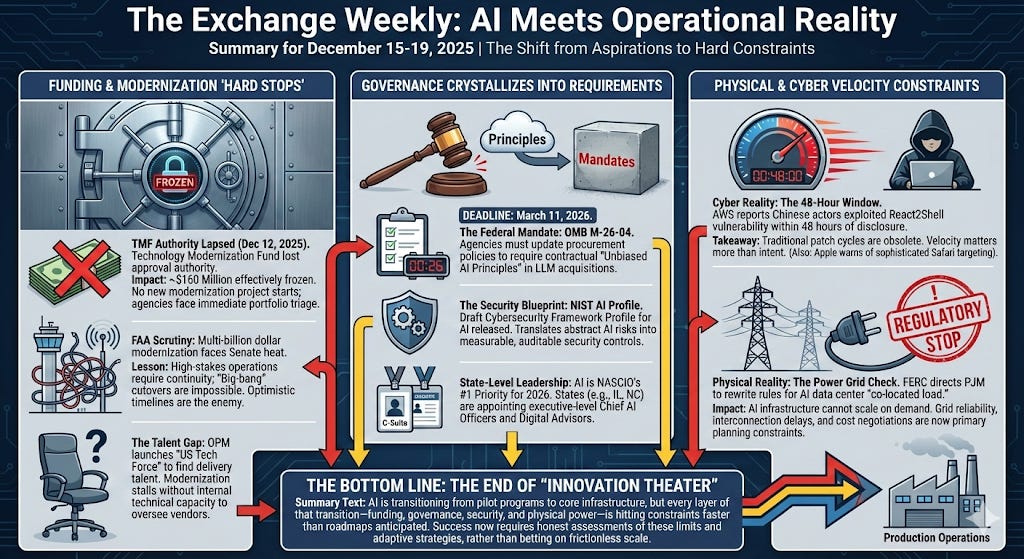
This week marked a shift from AI aspirations to operational constraints. The Technology Modernization Fund lost its authority to approve new investments on December 12, freezing federal modernization funding just as agencies face mounting pressure to deliver AI-enabled services under compressed timelines. Congress pushed reauthorization legislation that would add governance requirements including a federal legacy IT inventory, but the operational impact is immediate: agencies cannot start new modernization projects through TMF, and existing roadmaps must find bridge funding or risk stalling.
At the same time, AI governance moved from principles to procurement requirements. The Office of Management and Budget issued Memorandum M-26-04 requiring agencies to update procurement policies by March 11, 2026 to include contractual requirements for “Unbiased AI Principles” in large language model acquisitions. NIST released its draft Cybersecurity Framework Profile for Artificial Intelligence, giving security teams a control-aligned blueprint for translating AI risk management into measurable outcomes. Illinois recruited a Chief Artificial Intelligence Officer, North Carolina named a Senior Adviser for Digital Experience to rebuild the state’s digital platform, and NASCIO’s 2026 Top Ten priorities list placed AI at number one for the first time. These moves signal that AI is no longer a pilot program managed by innovation teams. It is becoming core infrastructure requiring enterprise governance, procurement discipline, and security controls that can scale.
The cybersecurity picture reinforced that velocity matters more than intent. AWS reported that Chinese threat actors began exploiting the React2Shell vulnerability (CVE-2025-55182) within 48 hours of public disclosure. CISA added multiple vulnerabilities to the Known Exploited Vulnerabilities catalog throughout the week, including flaws in Gladinet CentreStack, Apple WebKit, Cisco networking equipment, ASUS update tools, and Fortinet systems. Apple shipped Safari 26.2 with WebKit fixes and noted the vulnerability “may have been exploited in a sophisticated targeted attack,” language that should trigger accelerated patching for executive devices and high-trust users. The pattern is consistent: adversaries weaponize new vulnerabilities faster than most organizations can execute emergency change control, and the gap between disclosure and exploitation is now measured in hours.
Remember to subscribe. Metora is offering free access to the Exchange Weekly Newsletter through the end of 2025. Don’t miss out starting is 2026.
Physical reality intruded on AI infrastructure plans when the Federal Energy Regulatory Commission directed PJM Interconnection to create new rules for co-located load with explicit consumer protection language. The move acknowledges that AI data centers cannot scale on demand. They require interconnection approvals, cost allocation negotiations, and reliability assessments that can delay or block projects regardless of capital availability. The Department of Energy expanded the Genesis Mission by signing memorandums of understanding with 24 organizations across chips, cloud providers, model builders, and systems integrators, treating AI for science as an ecosystem strategy rather than a collection of agency-specific pilots. New Jersey launched a $20 million AI Hub Fund in partnership with CoreWeave, while OpenAI announced its “OpenAI for Countries” initiative framing AI as national infrastructure requiring localized services, data sovereignty, and workforce development.
Federal acquisition and authorization pathways showed signs of modernization pressure. FedRAMP 20x Phase 2 began testing a faster authorization approach designed to cut time-to-ATO without lowering risk management standards. GSA announced OASIS Plus Phase II expansion, adding domains and vendors to the professional services contract vehicle that many agencies use for modernization and AI-adjacent work. Congress advanced legislation requiring the Small Business Administration to help small businesses critically evaluate AI tools, and introduced the National Programmable Cloud Laboratories Network Act to create shared R&D cloud environments for government and academia. The Federal Aviation Administration faced renewed congressional scrutiny over air traffic control modernization, a multi-billion dollar program that combines nationwide telecom, radar, and automation upgrades with operational continuity requirements that make cutovers high-stakes events.
The week’s stories converge on a single reality: AI is transitioning from innovation theater to production operations, and every layer of that transition (funding, governance, security, infrastructure, procurement) is hitting constraints faster than roadmaps anticipated. Organizations that recognize these constraints and build adaptive strategies around them will fare better than those betting on frictionless scale. The path forward requires honest conversations about what is possible within current funding mechanisms, regulatory timelines, physical infrastructure limits, and security capabilities. Waiting for perfect clarity is itself a risk when competitors and adversaries are moving decisively within the same constrained environment.
Federal Modernization Hits Hard Constraints - TMF Freeze, FAA Pressure, and the Talent Gap
This week exposed the funding and execution constraints that will define federal IT modernization for the next several years. The Technology Modernization Fund’s authorization lapse is not an administrative inconvenience. It is a hard stop on new modernization investments just as agencies face pressure to deliver AI-enabled services, address cybersecurity gaps, and replace legacy systems that create operational and security risk.
The Technology Modernization Fund Cliff and What It Means for Portfolios
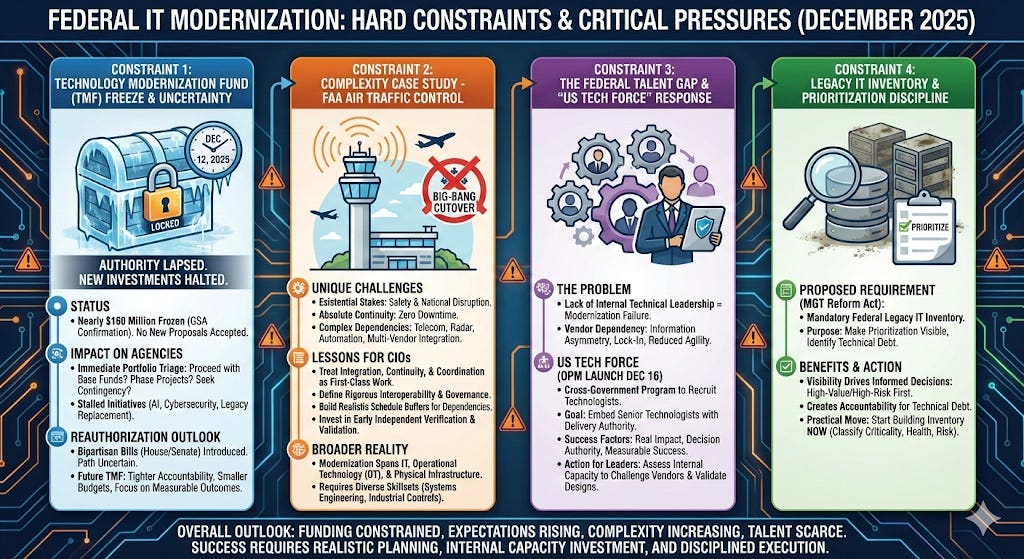
The Technology Modernization Fund lost its authority to approve new investments on December 12, 2025, under current law. The General Services Administration, which houses the TMF, confirmed that the fund cannot invest in new projects and is not accepting new proposals, though it can continue overseeing existing investments. Nearly $160 million in available funding is effectively frozen (Technology Modernization Fund, December 12, 2025). For federal CIOs, CFOs, and modernization program owners, this creates immediate portfolio triage decisions: which projects can proceed with base appropriations, which can be phased without breaking outcomes, and which need contingency funding so delivery does not stall.
Representative Nancy Mace introduced the bipartisan Modernizing Government Technology Reform Act on December 16, which would reauthorize the TMF and add governance requirements including a federal legacy IT inventory (House Oversight Committee, December 16, 2025). The inventory concept aims to make prioritization more visible and force agencies to identify technical debt that creates security and operational risk. Senators Jerry Moran and Gary Peters introduced companion legislation in the Senate. Despite bipartisan support, the path to reauthorization remains uncertain. Congress has been skeptical of the TMF’s funding structure since establishing it in 2017, often deciding not to add money to the fund outside of the $1 billion provided in the American Rescue Plan Act, later partially clawed back.
The underlying tension is that TMF was designed as a self-sustaining mechanism fueled by repayments from agencies that reaped savings from modernizations. That model has not panned out as envisioned. Repayment rules were relaxed by the Biden administration to require a minimum 50 percent repayment rate rather than full repayment within five years. For executives, the practical implication is that modernization funding remains fragile. Even if TMF is reauthorized, it may operate under tighter accountability requirements and potentially smaller budgets. Organizations that can demonstrate measurable outcomes (cost avoidance, improved service delivery, reduced security incidents) will be better positioned to secure funding when the window reopens.
The freeze arrives at a particularly bad time. Agencies face a December 29 deadline to finalize detailed AI use and procurement policies under earlier OMB guidance. They are navigating cybersecurity mandates including zero trust architecture implementation and supply chain risk management. Many are mid-flight on major platform modernizations for citizen services, benefits delivery, and internal operations. Without TMF access, these initiatives must compete for funding within base budgets that are already stretched across mission delivery, operations and maintenance, and other modernization priorities.
Air Traffic Control Modernization as a Case Study in Complexity
The Federal Aviation Administration’s air traffic control modernization effort drew renewed congressional scrutiny this week, with the Senate Committee on Commerce, Science, and Transportation holding a hearing focused on the program (Senate Commerce Committee, December 17, 2025). The FAA is pursuing a multi-billion dollar upgrade path that includes communications, surveillance, and radar systems across the nationwide air traffic control network. For technology leaders, this program illustrates why large-scale federal modernization is fundamentally different from enterprise IT projects.
First, the stakes are existential. Air traffic control failures do not just degrade service. They create safety risks and operational disruptions that cascade across the national transportation system. Second, continuity requirements are absolute. The FAA cannot take the air traffic control system offline for a big-bang cutover. Every component must be deployed and tested while the existing system remains operational, requiring precise sequencing and integration testing across multiple vendors and geographies. Third, vendor and supply chain dependencies are complex. The program involves telecom infrastructure, radar systems, automation platforms, and integration services from multiple prime contractors and subcontractors. A delay or quality issue from any supplier can block critical path work.
For federal CIOs and program executives managing large modernizations, the FAA experience offers several lessons. Treat integration testing, operational continuity, and vendor coordination as first-class delivery work, not afterthoughts. Define interoperability requirements, acceptance criteria, and governance for multi-vendor change control with the same rigor as technical specifications. Build schedule buffers that account for dependencies, because optimistic timelines are the enemy of realistic execution. Invest in independent verification and validation not to slow progress but to identify risks early when they are cheaper to address.
The FAA program also highlights a broader challenge: federal modernization programs increasingly span IT, operational technology, and physical infrastructure. Air traffic control is not just a software upgrade. It is a nationwide deployment of telecom, radar, and automation that must integrate with existing operations, meet stringent safety and reliability requirements, and coordinate with dozens of stakeholders including airports, airlines, and labor organizations. The skillsets required go well beyond traditional IT program management to include systems engineering, industrial controls, telecommunications, and operational change management.
The US Tech Force and the Federal Talent Problem
The U.S. Office of Personnel Management launched the United States Tech Force on December 16 as a cross-government program to recruit technologists for modernization delivery (OPM, December 16, 2025). The initiative acknowledges a reality that federal IT leaders have understood for years: modernization fails when government cannot retain enough technical leadership to own architecture, manage delivery, and hold vendors accountable for outcomes. Contract vehicles, cloud platforms, and security tools are necessary but not sufficient. Without internal technical capacity, agencies become dependent on contractors to define requirements, evaluate alternatives, and validate deliverables. That dependency creates information asymmetry, makes agencies vulnerable to vendor lock-in, and reduces the government’s ability to pivot when technology or requirements change.
The Tech Force model aims to embed senior technologists directly into agencies with clear authority to remove bottlenecks and drive delivery. For federal IT leaders, the critical questions are: how will Tech Force participants be placed so they can have real impact, what decision authority will they have, and how will success be measured. If Tech Force becomes a recruiting headline without empowerment, it will not move the needle. If participants are given ownership over key technical decisions, budget authority, and vendor oversight, it could meaningfully accelerate delivery.
For CIOs and CTOs, the Tech Force launch is a prompt to assess your own technical capacity. Do you have enough senior engineers and architects who can challenge vendor recommendations, validate technical designs, and make informed tradeoffs between cost, schedule, and risk. Can your team independently assess whether an AI model is fit for purpose, whether a cloud architecture meets security and performance requirements, or whether an integration pattern will scale. If the answer is no, then recruiting, retaining, and empowering technical talent should be a strategic priority, not a staffing afterthought.
The talent challenge extends beyond federal agencies. State and local governments face similar constraints. Illinois is recruiting a Chief Artificial Intelligence Officer to lead centralized AI strategy, standards, and governance (Illinois Department of Innovation & Technology, December 16, 2025). North Carolina named a Senior Adviser for Digital Experience to spearhead development of a new digital platform for service delivery (Governor’s Office of North Carolina, December 17, 2025). These moves signal that public sector leaders are treating technical leadership as an executive function, not a mid-level operations role. The governance and architecture decisions these leaders make will determine whether AI and modernization initiatives deliver measurable public value or become expensive experiments that fail to scale.
Federal Legacy IT Inventory and the Prioritization Problem
The proposed Modernizing Government Technology Reform Act includes a requirement for agencies to develop and maintain a federal legacy IT inventory (House Oversight Committee, December 16, 2025). On its face, this sounds like bureaucratic overhead. In practice, it could force the kind of prioritization discipline that has been missing from federal modernization efforts. Many agencies do not have a comprehensive view of their application and infrastructure portfolios. Systems proliferate over decades through mission-specific programs, emergency procurements, and shadow IT. The result is a fragmented landscape where leadership does not know how many applications are in production, which ones support critical business functions, where technical debt is concentrated, or which systems create the highest security and operational risk.
An inventory requirement forces visibility. Once you know what you have, you can make informed decisions about what to modernize first. Systems that support high-value services, create significant security exposure, or impose the highest maintenance burden rise to the top of the priority list. Systems that are rarely used, redundant with other capabilities, or candidates for retirement become obvious targets for decommissioning. The inventory also creates accountability, because leaders can no longer claim they did not know about technical debt when it becomes a security incident or operational failure.
For federal IT executives, the practical move is to start building that inventory now, whether or not the legislation passes. Use a simple framework: identify every application and major infrastructure component, classify it by business criticality and technical health, and estimate the cost and risk of continued operation versus modernization or retirement. The inventory does not need to be perfect to be useful. Even a rough-cut assessment can inform budget requests, guide security investments, and support conversations with leadership about why modernization cannot be delayed indefinitely.
The convergence of the TMF freeze, FAA scrutiny, Tech Force launch, and legacy IT inventory requirement reveals a federal modernization environment under stress. Funding is constrained, expectations are rising, technical complexity is increasing, and talent is scarce. Organizations that face these constraints directly, build realistic plans that account for dependencies and risks, and invest in internal technical capacity will deliver more effectively than those betting on unlimited budgets and frictionless execution.
Sources:
Technology Modernization Fund, “TMF Investments,” December 12, 2025, https://tmf.cio.gov/investments/
House Oversight Committee, “Mace introduces bipartisan bill to modernize federal IT systems,” December 16, 2025, https://oversight.house.gov/release/mace-introduces-bipartisan-bill-to-modernize-federal-it-systems/
U.S. Office of Personnel Management, “OPM launches US Tech Force to implement President Trump’s vision for technology leadership,” December 16, 2025, https://www.opm.gov/news/news-releases/opm-launches-us-tech-force-to-implement-president-trumps-vision-for-technology-leadership/
Senate Committee on Commerce, Science, and Transportation, “Hearing to modernize the nation’s air traffic control system,” December 17, 2025, https://www.commerce.senate.gov/2025/12/testimony-hearing-to-modernize-the-nation-s-air-traffic-control-system
Illinois Department of Innovation & Technology, “Employment Opportunities,” December 16, 2025, https://doit.illinois.gov/about/doit-employment/employmentopportunities.html
Governor’s Office of North Carolina, “New hires: Governor Stein prioritizes growing economy and modernizing government,” December 17, 2025, https://governor.nc.gov/news/press-releases/2025/12/17/new-hires-governor-stein-prioritizes-growing-economy-and-modernizing-government
AI Governance Crystallizes Into Requirements - From Principles to Procurement Controls
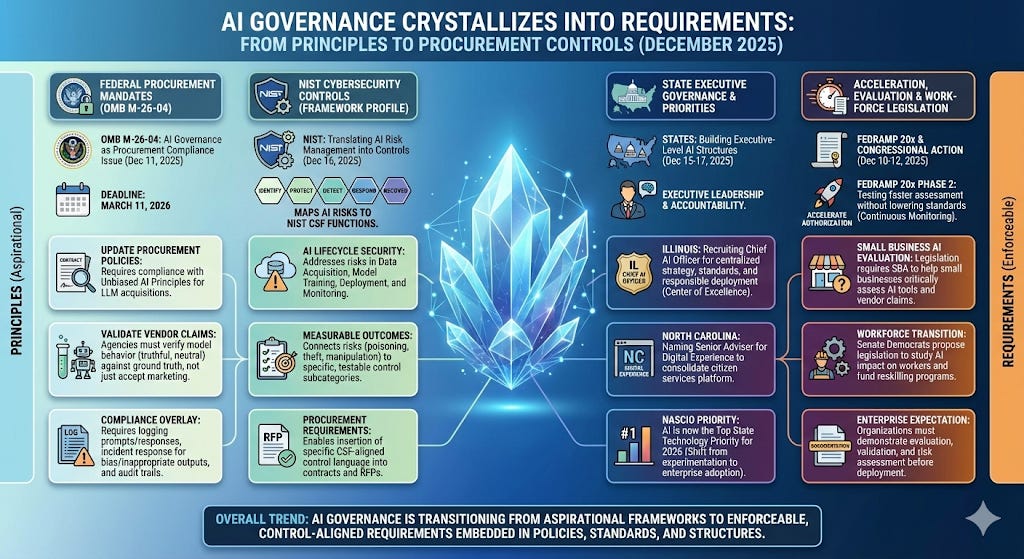
This week demonstrated that AI governance is transitioning from aspirational frameworks to enforceable requirements embedded in procurement policies, security standards, and organizational structures. The shift is not subtle. Federal agencies now face contractual obligations for AI procurement, state governments are creating executive-level AI leadership positions, and standards bodies are publishing control-aligned frameworks that translate risk management principles into measurable outcomes.
OMB M-26-04 Makes AI Governance a Procurement Compliance Issue
The Office of Management and Budget issued Memorandum M-26-04 on December 11, titled “Increasing Public Trust in Artificial Intelligence Through Unbiased AI Principles” (OMB, December 11, 2025). The memorandum requires agencies to update procurement policies no later than March 11, 2026 to include contractual requirements addressing compliance with Unbiased AI Principles for large language model acquisitions. This is not guidance or best practice. It is a mandate that turns AI governance into a procurement compliance requirement with specific deadlines and documented enforcement mechanisms.
For acquisition leaders, the practical implication is immediate: review every pending and planned LLM procurement to identify where contract language needs to be updated. The memorandum emphasizes that models should be truthful and neutral, avoiding manipulation in favor of ideological agendas. Contracts must include requirements for transparency about how models are trained, tested, and validated. They must specify processes for users to report concerns about bias, factual errors, or inappropriate outputs. And they must define vendor obligations for responding to those reports with measurable corrective actions.
For CIOs and CTOs, the operational question is how you validate vendor claims about model behavior. The memorandum pushes responsibility onto agencies to verify that LLMs meet bias and accuracy requirements, not just accept vendor marketing materials as truth. This means building or acquiring test harnesses that can evaluate model outputs against known ground truth, assess performance across demographic groups and use cases, and detect when models generate outputs that conflict with documented facts or organizational policies.
For CISOs, the compliance overlay extends to logging, monitoring, and incident response. If users report inappropriate AI outputs, security and compliance teams need audit trails showing what the model was asked, what it returned, and how the incident was handled. That requires logging architecture that captures user prompts and model responses without violating privacy requirements, alerting mechanisms that flag anomalies in model behavior, and escalation playbooks that define when AI incidents require executive notification or regulatory disclosure.
The March 11, 2026 deadline is aggressive. Agencies have less than three months to update procurement policies, brief acquisition professionals on new requirements, revise contract templates, and train program managers on how to write requirements and evaluate vendor responses. Organizations that treat this as a paperwork exercise will find themselves unprepared when auditors or inspectors general ask for evidence of compliance. Those that use the deadline as a forcing function to standardize AI governance across business units and programs will build capabilities that have value beyond regulatory compliance.
NIST Translates AI Risk Management Into Cybersecurity Controls
NIST released an initial public draft of the Cybersecurity Framework Profile for Artificial Intelligence on December 16, seeking public comment on how to translate AI lifecycle risks into control-aligned outcomes (NIST, December 16, 2025). The profile maps AI-specific risks (data poisoning, model theft, adversarial attacks, prompt injection, training data exposure, inference manipulation) to the NIST Cybersecurity Framework’s five functions: Identify, Protect, Detect, Respond, and Recover.
For CISOs and security architects, this is the translation layer that has been missing. The AI Risk Management Framework published by NIST earlier provided governance principles and risk categories, but it did not specify what controls to implement or how to validate effectiveness. The Cybersecurity Profile fills that gap by connecting AI risks to measurable security outcomes that can be tested, audited, and monitored over time.
The profile breaks AI security into lifecycle stages: data acquisition and preparation, model development and training, model deployment and inference, and ongoing monitoring and maintenance. For each stage, it identifies risks, maps them to CSF subcategories, and describes implementation approaches and validation methods. For example, in the data preparation stage, risks include poisoned training data, privacy violations from inadvertent exposure of sensitive information, and bias introduced through unrepresentative datasets. The profile maps these to CSF subcategories covering data classification, access controls, validation processes, and monitoring mechanisms.
For procurement teams, the profile provides requirements language that can be inserted directly into contracts and request for proposals. Instead of vague clauses about “responsible AI,” contracts can specify that vendors must implement controls aligned to specific CSF subcategories, provide evidence of testing and validation, and support ongoing monitoring that confirms controls remain effective over time. This shifts the conversation from principles to implementation. Vendors that cannot demonstrate control effectiveness or produce audit evidence will be at a competitive disadvantage against those that can.
For AI platform owners and engineering leaders, the profile creates a roadmap for secure AI development. Organizations can use it to conduct gap assessments that identify where current practices fall short of security expectations, prioritize investments in tooling and processes that address high-risk gaps, and define acceptance criteria for AI systems before they move to production. The profile also supports consistent risk communication. When AI teams want to deploy a new model, security leaders can evaluate the proposal against profile requirements and make risk-informed decisions about whether additional controls are needed, whether the model should be restricted to specific use cases, or whether deployment should be delayed pending further validation.
States Build Executive-Level AI Governance Structures
State governments moved aggressively this week to formalize AI governance through organizational structure and leadership accountability. Illinois is recruiting a Chief Artificial Intelligence Officer who will lead centralized strategy, standards, and responsible deployment across state government (Illinois Department of Innovation & Technology, December 16, 2025). The job framing emphasizes building a center of excellence operating model, defining standards for AI use, creating intake processes for new AI initiatives, and maintaining an inventory of AI and machine learning systems in production.
For state CIOs and enterprise architects, the Illinois model offers a blueprint. AI governance requires executive ownership, not a working group that meets quarterly to discuss principles. The Chief AI Officer role consolidates responsibility for strategy, standards, and operations, creating clear accountability when AI initiatives fail to deliver, create compliance risk, or generate public controversy. The center of excellence model provides shared services (evaluation frameworks, testing environments, procurement templates, policy guidance) that prevent every agency from reinventing AI governance independently.
North Carolina took a different approach by naming a Senior Adviser for Digital Experience who will spearhead development of a new digital platform for service delivery (Governor’s Office of North Carolina, December 17, 2025). The platform aims to consolidate the state’s digital front door for residents and businesses, addressing a common problem in government: citizens must navigate multiple websites, portals, and phone systems to access services that logically belong together. For technology leaders, the digital experience framing is significant because it positions technology as a service delivery problem, not an IT project. The focus is on citizen outcomes (faster service, fewer handoffs, clearer guidance) rather than technical deliverables (systems integrated, databases migrated, platforms deployed).
The practical implications are operational. Identity, accessibility, payments, and case management are where digital platforms win or lose. If users cannot authenticate easily across services, if the platform does not meet accessibility standards for people with disabilities, if payment processing is unreliable or confusing, or if case management does not give staff and citizens visibility into application status and next steps, then the platform will fail to deliver promised benefits. Organizations building digital platforms should anchor budgets and roadmaps to these operational capabilities, not to the underlying technology stack.
NASCIO Signals AI Is Now the Top State Technology Priority
The National Association of State Chief Information Officers released its 2026 Top Ten Policy and Technology Priorities on December 15, and for the first time, artificial intelligence took the number one spot (NASCIO, December 15, 2025). The ranking reflects a shift from experimentation to enterprise adoption. State CIOs are no longer asking whether to use AI. They are asking how to govern it, how to fund it, where to deploy it first, and how to build workforce capacity to operate and maintain AI-enabled systems.
For state IT leaders, the practical move is portfolio alignment. Inventory existing AI use cases across agencies and business units. Classify them by maturity (pilot, production, retired), business value (high, medium, low), and risk (compliance exposure, operational dependencies, security concerns). Use that inventory to inform governance decisions about where to invest, where to tighten controls, and where to consolidate redundant efforts. The inventory also supports budget conversations, because it makes AI investments visible and forces leadership to decide which initiatives merit continued funding.
Cybersecurity and identity remain tightly coupled to AI adoption in the NASCIO framework. As AI systems gain access to more data and take on more decision authority, the blast radius of a compromised AI system or poisoned model increases. That raises the bar for identity and access management, data governance, and security monitoring. Organizations should assume that AI systems will be targeted by adversaries seeking to manipulate outputs, steal training data, or use AI access as a pivot point to reach other systems. Design controls that limit blast radius, detect anomalies in AI behavior, and enable rapid containment when incidents occur.
FedRAMP 20x and the Race to Accelerate Authorization
FedRAMP 20x Phase 2 launched this week, testing a new approach to assessment and authorization designed to cut time-to-ATO without lowering risk management standards (FedRAMP, December 10, 2025). The underlying tension is that cloud and AI services move faster than traditional authorization timelines. Vendors release new features monthly or quarterly. Agencies need to adopt services quickly to remain competitive and deliver modern capabilities to citizens. But the FedRAMP authorization process can take 12 to 18 months from start to finish, creating a mismatch between technology velocity and government adoption cycles.
Phase 2 tests mechanics for faster authorization while preserving auditability and continuous monitoring. For vendors, the operational question is whether you can produce cleaner, more reusable control evidence that reduces rework during assessments. Can you automate evidence collection so assessors can validate controls continuously rather than through point-in-time audits. Can you structure your compliance posture so adding new features or services does not require restarting the authorization process from scratch.
For federal CIOs and security teams, Phase 2 offers a chance to influence what becomes standard practice. Watch what evidence formats are accepted in the pilot and what gets rejected. Observe how continuous monitoring is actually validated across providers. Pay attention to how reciprocity works when multiple agencies want to use the same service but have different risk tolerances. The patterns that emerge from Phase 2 will shape federal cloud adoption for the next several years. If the pilot produces authorization timelines measured in weeks rather than months without compromising security, it will accelerate enterprise cloud and AI adoption across government. If it creates new friction or fails to deliver promised speed improvements, agencies will continue operating under existing processes that constrain modernization velocity.
Small Business AI Evaluation and Workforce Legislation
Congress advanced legislation requiring the Small Business Administration to help small businesses critically evaluate AI tools (Congress.gov, December 12, 2025). The bill acknowledges that AI vendors are marketing tools to small businesses with claims about productivity gains, cost reduction, and competitive advantage, but many small business owners lack the technical expertise to assess whether those claims are accurate, whether the tools are appropriate for their use cases, or whether deployment will create new risks.
For enterprise leaders, the bill signals a broader expectation: organizations that deploy AI tools should be able to demonstrate that they evaluated alternatives, validated vendor claims, and assessed risks before committing to production deployments. That requires documentation showing what criteria were used to select models or platforms, what testing was conducted to validate performance and accuracy, what risks were identified and how they were mitigated, and what monitoring is in place to detect when AI systems fail to perform as expected. Organizations that cannot produce that documentation will struggle to defend AI deployments when they generate compliance issues, operational failures, or public controversy.
Senate Democrats also introduced legislation directing the Departments of Labor, Commerce, and Education to study AI’s impact on workers and fund programs supporting workforce transitions (Senate Democrats, December 2025). The proposal treats AI workforce impact as a planning and policy question, not an inevitable outcome. It directs agencies to collect data on job displacement, skill gaps, and transition pathways, and to fund reskilling programs that help workers move into roles created or reshaped by automation. For corporate and public sector leaders, this signals that AI workforce planning is becoming a governance expectation. Executives should expect tougher expectations around transparency when roles change, more scrutiny of automation decisions that affect frontline workers, and growing opportunities to align internal upskilling initiatives with federal grant programs.
The convergence of OMB procurement mandates, NIST security frameworks, state executive AI leadership positions, NASCIO priority rankings, FedRAMP acceleration, and workforce legislation reveals that AI governance is no longer optional or aspirational. It is becoming embedded in procurement requirements, security standards, organizational structures, and legislative expectations. Organizations that treat governance as compliance theater will find themselves unprepared when auditors, regulators, or incidents force accountability. Those that build governance into operations from day one will be better positioned to scale AI responsibly and sustain trust when things go wrong.
Sources:
Office of Management and Budget, “Memorandum M-26-04: Increasing Public Trust in Artificial Intelligence Through Unbiased AI Principles,” December 11, 2025, https://www.whitehouse.gov/wp-content/uploads/2025/12/M-26-04-Increasing-Public-Trust-in-Artificial-Intelligence-Through-Unbiased-AI-Principles-1.pdf
National Institute of Standards and Technology, “NIST seeks comments on draft Cybersecurity Framework Profile for Artificial Intelligence,” December 16, 2025, https://www.nist.gov/news-events/news/2025/12/nist-seeks-comments-draft-cybersecurity-framework-profile-artificial-intelligence
NIST Computer Security Resource Center, “Cybersecurity Profile for AI Systems (Initial Public Draft),” December 16, 2025, https://csrc.nist.gov/pubs/ai/100/1/cyber-security-profile/ipd
Illinois Department of Innovation & Technology, “Employment Opportunities,” December 16, 2025, https://doit.illinois.gov/about/doit-employment/employmentopportunities.html
Governor’s Office of North Carolina, “New hires: Governor Stein prioritizes growing economy and modernizing government,” December 17, 2025, https://governor.nc.gov/news/press-releases/2025/12/17/new-hires-governor-stein-prioritizes-growing-economy-and-modernizing-government
National Association of State Chief Information Officers, “2026 Top Ten Policy and Technology Priorities,” December 15, 2025, https://www.nascio.org/resource-center/resources/2026-top-ten-policy-and-technology-priorities/
FedRAMP, “FedRAMP 20x Phase 2,” December 10, 2025, https://www.fedramp.gov/fedramp-20x-phase-2/
Congress.gov, “Congressional Record Daily Digest (Volume 171, Issue 210),” December 12, 2025, https://www.congress.gov/congressional-record/volume-171/issue-210/daily-digest/article/D1262-3
Cybersecurity at Sprint Velocity - Exploitation Measured in Hours, Not Days
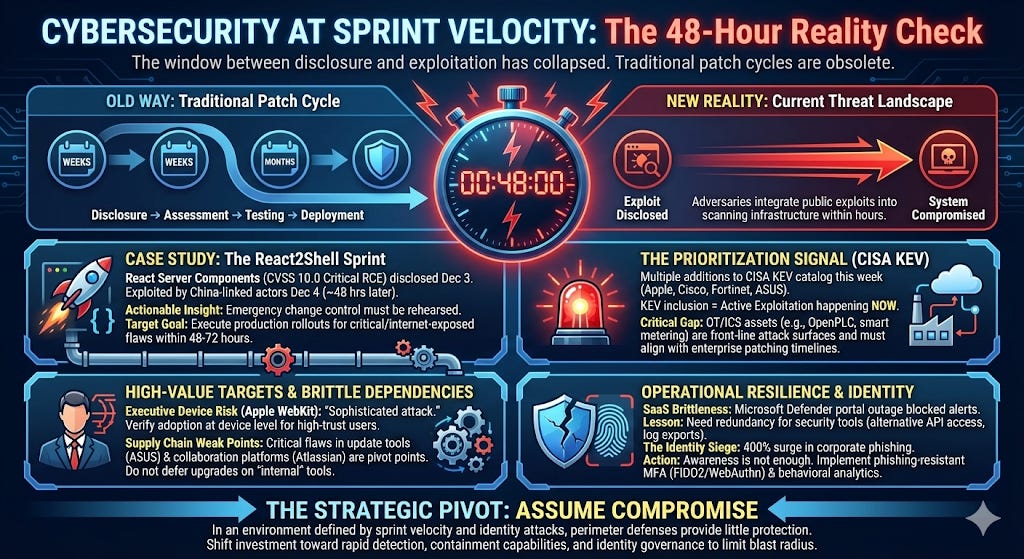
This week reinforced a reality that security teams already understand but organizations often resist acting on: the window between vulnerability disclosure and active exploitation has collapsed to the point where traditional patch cycles are inadequate for high-severity flaws in internet-exposed systems and common frameworks. Adversaries monitor security advisories, integrate public exploits into scanning infrastructure within hours, and launch broad campaigns across multiple vulnerabilities simultaneously to maximize their chances of finding vulnerable targets.
React2Shell Exploitation Within 48 Hours by Chinese Actors
AWS reported on December 4 that two China-linked threat actors, Earth Lamia and Jackpot Panda, attempted to exploit the React2Shell vulnerability (CVE-2025-55182) within 48 hours of public disclosure (AWS Security Blog, December 4, 2025). The vulnerability, disclosed by the React team on December 3, is a critical remote code execution flaw in React Server Components with a CVSS score of 10.0, the maximum severity (React Blog, December 3, 2025). The flaw allows unauthenticated remote code execution and has been addressed in React versions 19.0.1, 19.1.2, and 19.2.1.
AWS analysis of exploitation attempts in its honeypot infrastructure identified activity involving attempts to run discovery commands, write files, and read files containing sensitive information. The infrastructure used by the attackers was historically linked to known China state-nexus threat actors. AWS noted that threat actors monitor for new vulnerability disclosures, rapidly integrate public exploits into their scanning infrastructure, and conduct broad campaigns across multiple CVEs simultaneously to maximize their chances of finding vulnerable targets (AWS Security Blog, December 4, 2025).
For security teams, this demonstrates that the window between disclosure and exploitation is collapsing. Organizations that rely on monthly or quarterly patching cycles for web application frameworks are giving adversaries weeks or months of opportunity to compromise systems. React2Shell also highlights risk in modern front-end stacks. Many organizations have strong patch management for operating systems and databases but weaker discipline around JavaScript frameworks, npm packages, and front-end dependencies. Software bills of materials and patch pipelines must cover modern front-end stacks like React and Next, not just traditional server-side components.
The operational implication is that emergency change control needs to be a well-rehearsed capability, not an exception process that takes days to execute. Organizations should be able to identify which applications use affected frameworks, prioritize internet-exposed instances, validate patches in test environments, and execute production rollouts within 48 to 72 hours of critical vulnerability disclosure. That requires automation (dependency scanning, configuration management, deployment pipelines), clear decision authority (who can approve emergency changes without extended governance reviews), and coordination across development, operations, and security teams.
CISA KEV Additions Create Patch Prioritization Signals
CISA added multiple vulnerabilities to the Known Exploited Vulnerabilities catalog throughout the week, creating clear prioritization signals for security and operations teams. On December 11, CISA added CVE-2025-58360, a cross-site scripting vulnerability in OpenPLC Scada BR (CISA, December 11, 2025). On December 15, CISA added CVE-2025-14611 for Gladinet CentreStack and TrioFox (hardcoded cryptographic keys) and CVE-2025-43529 for Apple WebKit (CISA KEV Catalog, December 15, 2025). On December 17, CISA added CVE-2025-20393 for Cisco networking equipment and CVE-2025-59374 for ASUS update tools (NVD, December 17, 2025). On December 15, CISA reflected CVE-2025-59718 for Fortinet systems (NVD, December 15, 2025).
The KEV catalog is CISA’s way of signaling which vulnerabilities are being actively exploited in the wild and therefore require prioritized remediation. For federal agencies, KEV inclusion triggers binding operational directives that specify remediation timelines, typically 14 to 21 days depending on the vulnerability’s severity and exploitability. For private sector organizations, KEV inclusion should trigger similar urgency even though the directives are not legally binding. If CISA has evidence that adversaries are exploiting a vulnerability, you should assume your organization is or will be targeted.
The practical action for security teams is to map KEV additions to your asset inventory and exposure profile. Do you run any of the affected products. Are they internet-exposed or otherwise accessible to potential attackers. Can you patch within the required timeline, or do you need compensating controls (network segmentation, web application firewalls, enhanced monitoring) while patches are tested and deployed. The answer to these questions determines whether KEV additions create immediate operational work or can be managed through normal patch cycles.
The operational technology vulnerabilities in this week’s KEV additions (OpenPLC Scada BR, Fortinet edge devices) underscore that OT is now a front-line attack surface. Organizations that continue to manage OT assets on different patching cycles, with different monitoring tools, and without integration into enterprise security operations will find themselves unable to detect or respond to attacks that move between IT and OT environments. CISA issued multiple industrial control system advisories this week, including vulnerabilities in Iskra iHUB smart metering platforms, Industrial Video & Control Longwatch software, and Mirion EC2 NMIS BioDose software (CISA ICS Advisories, December 2, 2025). For CISOs and OT security leaders, the message is to treat metering, camera, support systems, and clinical operations software as critical OT assets requiring segmentation and patching aligned to KEV timelines.
Apple WebKit Exploitation and Executive Device Risk
Apple shipped Safari 26.2 security fixes on December 13, addressing CVE-2025-43529, a WebKit vulnerability (Apple Security Release, December 13, 2025). The advisory notes that Apple is aware the issue “may have been exploited in an extremely sophisticated attack.” This language should trigger accelerated patching for executive devices and high-trust users. When vendors acknowledge possible exploitation before patches are widely deployed, that is a signal that targeted attacks are in progress and that traditional patch cadence is insufficient.
For CIOs, CISOs, and endpoint management teams, the operational question is whether you can prove adoption at the device level, not just that you pushed the update. If you manage Apple endpoints with mobile device management, confirm that high-priority devices (executives, finance, HR, system administrators) have actually installed the update and are running current software versions. Also use this as a tabletop moment: if a targeted browser exploit hits a high-trust user, do you have a clean path to isolate the device, rotate credentials, and validate that the user’s cloud sessions are reset. A fast patch is good, but a fast containment playbook is better.
Browser vulnerabilities remain one of the cleanest paths to code execution because they require only that a user visit a malicious page. Phishing campaigns, watering hole attacks, and malvertising can all deliver browser exploits without requiring users to download files or disable security controls. Organizations should treat browser security as a critical control, not an afterthought. Keep browsers updated, deploy endpoint detection and response tools that can identify malicious behavior even when exploits succeed, and use network security controls (DNS filtering, web proxies, threat intelligence feeds) that block access to known malicious infrastructure.
Third-Party Dependency Risk in Update Tools and Collaboration Platforms
The ASUS update tool vulnerability (CVE-2025-59374) added to the KEV catalog highlights third-party dependency risk (NVD, December 17, 2025). Organizations often focus patch management on operating systems, applications, and infrastructure but overlook update mechanisms themselves. If an update tool is compromised or contains vulnerabilities, it becomes a vector for distributing malware to every system that uses it. For security teams, the practical action is to inventory third-party update tools (vendor utilities, driver updaters, firmware management platforms) and treat them as high-risk components requiring the same patching discipline as critical applications.
Atlassian published its December 2025 Security Bulletin on December 11, reporting nine critical-severity third-party vulnerabilities fixed across recent releases of Jira, Confluence, Bamboo, and other collaboration platforms (Atlassian Security Bulletin, December 11, 2025). Collaboration and workflow platforms sit at the center of engineering, change management, and operational workflows, making them attractive pivot points if they are exposed or under-patched. A security bulletin that includes multiple critical third-party issues is a reminder that dependency risk can become platform risk overnight.
The practical action is to match your upgrade cadence to your real risk posture. Verify product versions, flag externally reachable instances, schedule testing and change windows, and treat collaboration and workflow platforms as high-value infrastructure, not low-risk utilities. Organizations that defer Atlassian upgrades because “it is just a wiki” or “we only use it internally” are making risk decisions based on obsolete assumptions about threat models and attack surfaces.
Microsoft Defender Portal Outage and SaaS Security Operations Brittleness
Microsoft’s Defender portal suffered an outage this week that blocked access to some threat hunting alerts (BleepingComputer, December 4, 2025). The outage illustrates that SaaS security operations are brittle when a single console outage blinds analysts to threats. For security operations teams, this is a prompt to revisit outage playbooks for SaaS security tools and ensure that detection and response capabilities can continue when primary consoles are unavailable. Redundancy is not just for infrastructure. It is also needed for security operations platforms.
Organizations should maintain alternative access paths to critical security data (log exports, API access, backup dashboards) so analysts can continue threat hunting and incident response when primary tools are unavailable. They should also test these backup paths regularly, because capabilities that work in theory but have never been exercised under pressure tend to fail when needed most. The Defender portal outage is a reminder that cloud-native security operations introduce new failure modes that require updated operational playbooks.
Phishing Surges and Identity-Centric Attacks
Attackers have been using fake Calendly invitations to hijack Google and Facebook ad manager accounts (BleepingComputer, December 4, 2025). The campaign abuses marketing and collaboration tools that often have privileged access to advertising platforms and payment information. For CISOs, this reinforces that identity-centric attacks are moving beyond email to abuse SaaS platforms that employees use daily. Tightening identity and access controls around business platforms, implementing phishing-resistant multifactor authentication, and monitoring for anomalous activity in marketing and collaboration tools are now baseline security requirements, not optional enhancements.
SpyCloud reported a 400 percent year-over-year surge in successful phishing attacks, with a heavy skew toward corporate identities (SpyCloud, 2025). The report highlights that attackers are increasingly targeting employees rather than consumers, recognizing that corporate credentials provide access to more valuable data and systems. For security teams, this means employee security awareness training is not sufficient on its own. Organizations need technical controls that reduce the impact of successful phishing, including phishing-resistant multifactor authentication using FIDO2 or WebAuthn, conditional access policies that limit what compromised credentials can access, and behavioral analytics that detect when legitimate credentials are being used in anomalous ways.
The convergence of rapid exploitation timelines, KEV prioritization signals, browser and dependency vulnerabilities, SaaS brittleness, and identity-centric attacks creates an environment where traditional perimeter defenses provide little protection. Organizations should assume some percentage of corporate devices and accounts are compromised at any given time. Design controls that limit blast radius, detect anomalies, and enable rapid containment rather than betting on perfect prevention. The path forward requires investment in detection and response capabilities, identity governance that limits privilege and access, and a realistic assumption that some level of compromise is always present.
Sources:
AWS Security Blog, “China-nexus cyber threat groups rapidly exploit React2Shell vulnerability (CVE-2025-55182),” December 4, 2025, https://aws.amazon.com/blogs/security/china-nexus-cyber-threat-groups-rapidly-exploit-react2shell-vulnerability-cve-2025-55182/
React Blog, “Critical Security Vulnerability in React Server Components,” December 3, 2025, https://react.dev/blog/2025/12/03/critical-security-vulnerability-in-react-server-components
CISA, “CISA adds one known exploited vulnerability to catalog,” December 11, 2025, https://www.cisa.gov/news-events/alerts/2025/12/11/cisa-adds-one-known-exploited-vulnerability-catalog
CISA Known Exploited Vulnerabilities Catalog, December 15-17, 2025, https://www.cisa.gov/known-exploited-vulnerabilities-catalog
National Vulnerability Database, CVE-2025-14611, CVE-2025-43529, CVE-2025-20393, CVE-2025-59374, CVE-2025-59718, December 2025,
https://nvd.nist.gov/
Apple Security Release, “About the security content of Safari 26.2,” December 13, 2025, https://support.apple.com/en-us/125892
Atlassian Security Bulletin, “Security Bulletin: December 11, 2025,” https://confluence.atlassian.com/security/security-bulletin-december-11-2025-1689616574.html
BleepingComputer, “Microsoft Defender portal outage blocks access to security alerts,” December 4, 2025, https://www.bleepingcomputer.com/news/microsoft/microsoft-defender-portal-outage-blocks-access-to-security-alerts/
BleepingComputer, “Fake Calendly invites spoof top brands to hijack ad manager accounts,” December 4, 2025, https://www.bleepingcomputer.com/news/security/fake-calendly-invites-spoof-top-brands-to-hijack-ad-manager-accounts/
SpyCloud, “Phishing has surged 400 percent year-over-year,” 2025,
https://spycloud.com/
CISA ICS Advisories, December 2, 2025, https://www.cisa.gov/news-events/alerts/2025/12/02/cisa-releases-five-industrial-control-systems-advisories
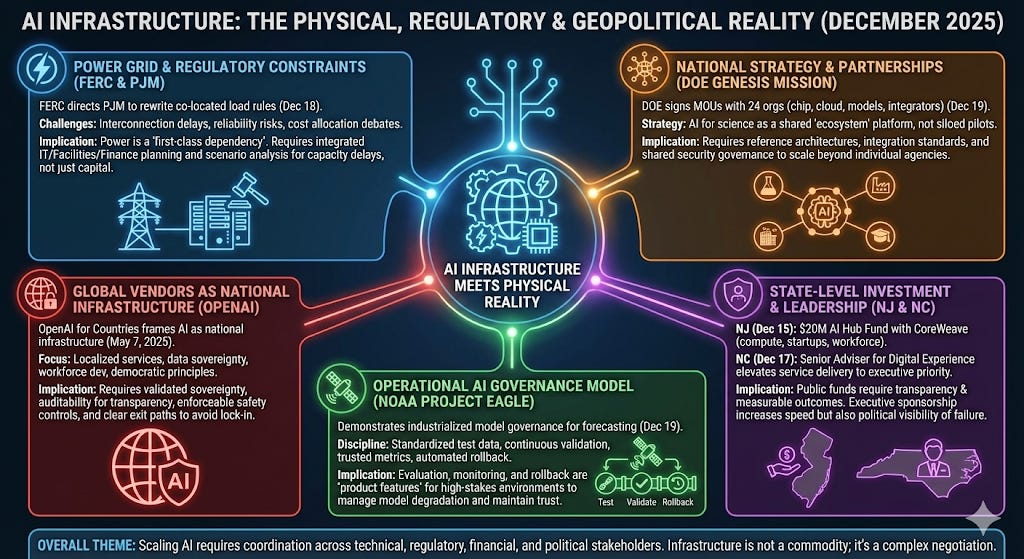
AI Infrastructure Meets Physical Reality - Power, Partnerships, and National Strategy
This week demonstrated that AI infrastructure is no longer primarily a technology or capital question. It is a physical, regulatory, and geopolitical challenge where grid capacity, interconnection queues, and national sovereignty concerns create constraints that roadmaps and budgets cannot solve alone. Organizations betting on frictionless AI scale are discovering that reality involves negotiations with utilities, compliance with energy regulators, and alignment with national infrastructure priorities.
FERC Directs PJM to Rewrite Co-Located Load Rules
The Federal Energy Regulatory Commission issued an order on December 18 directing PJM Interconnection, the nation’s largest grid operator, to create new rules for co-located load with explicit consumer protection language (FERC, December 18, 2025). The order addresses behind-the-meter co-location arrangements where AI data centers connect directly to power generation facilities rather than drawing power through the transmission grid. These arrangements can reduce interconnection delays and provide dedicated power for high-density compute, but they also create grid reliability risks and cost allocation questions that affect other electricity consumers.
FERC’s directive acknowledges that AI infrastructure cannot scale on demand. It requires interconnection approvals, cost allocation negotiations, and reliability assessments that can delay or block projects regardless of capital availability. For CIOs, CTOs, and infrastructure leaders, the practical implication is that power availability and tariff exposure are first-class dependencies in AI program plans, not background assumptions. Organizations expanding data center capacity, moving to more power-hungry AI-enabled services, or negotiating colocations should treat grid constraints as real planning variables, not obstacles that can be solved with more money or better vendor relationships.
The executive move is to align IT, facilities, finance, and risk into one portfolio view so grid constraints do not surprise leadership after contracts are signed. That means understanding interconnection timelines, cost allocation methodologies, and regulatory approval processes before committing to specific data center locations or capacity expansions. It also means building scenarios where planned capacity is delayed, reduced, or unavailable, and identifying what operational impacts those scenarios would create for AI deployments, service delivery, and business continuity.
The FERC order also highlights consumer protection as a priority. Regulators are concerned that behind-the-meter co-location arrangements could shift costs to other electricity consumers without corresponding benefits. For organizations pursuing co-location strategies, this means that regulatory approval is not guaranteed even when technical and financial arrangements are in place. Public utilities commissions, grid operators, and consumer advocacy groups will scrutinize proposals to ensure they do not create unacceptable cost or reliability impacts on other ratepayers.
Department of Energy Genesis Mission Scales Through Partnerships
The Department of Energy expanded the Genesis Mission this week by signing memorandums of understanding with 24 organizations across chip manufacturers, cloud providers, model builders, and systems integrators (DOE, December 19, 2025). The Genesis Mission treats AI for science as an ecosystem strategy rather than a collection of agency-specific pilots. The MOUs establish reference architectures, integration standards, and shared governance models that allow different organizations to contribute capabilities while maintaining interoperability.
For CIOs and CTOs, the Genesis Mission offers a blueprint for large AI initiatives. Treat them like platform programs with clear reference architectures, integration standards, and shared-services models that can scale beyond one lab or one agency. The alternative is a proliferation of bespoke AI systems that cannot share data, models, or infrastructure, creating redundant investment and limiting the ability to apply lessons learned across use cases.
For CISOs, the control plane must scale with the ecosystem. Multi-vendor partnerships mean multi-blast-radius if you do not design guardrails up front. Identity and access management, data handling policies, logging and monitoring, and third-party risk management must be standardized across partners so security operations teams can maintain visibility and control as the ecosystem expands. The Genesis Mission’s governance structure includes working groups focused on security, data sharing, and compliance, recognizing that technical coordination without security coordination creates systemic risk.
The Genesis Mission also signals that federal AI strategy is shifting from agency autonomy to enterprise coordination. Rather than letting every agency build its own AI infrastructure and governance frameworks, DOE is positioning the mission as a shared platform that multiple agencies and research institutions can leverage. This model reduces duplicated investment, accelerates adoption by providing proven reference implementations, and creates economies of scale that individual agencies could not achieve independently.
State-Level AI Infrastructure Investments Accelerate
New Jersey launched a $20 million AI Hub Fund in partnership with CoreWeave, bundling compute access, startup support, and workforce development into one competitiveness stack (NJEDA, December 15, 2025). The fund is designed to support AI startups, provide access to compute infrastructure, and fund workforce training programs that prepare residents for AI-related roles. For state CIOs and economic development leaders, the New Jersey model demonstrates how public-private partnerships can accelerate AI adoption while maintaining some level of public oversight and accountability.
The operational questions are: what eligibility rules determine which organizations can access funding and compute resources, what transparency mechanisms ensure public funds are used appropriately, and how outcomes are measured to validate that investments deliver promised economic and workforce benefits. Organizations considering similar partnerships should bake in transparency and public value measures from day one, because political and media scrutiny intensifies when public funds are involved and outcomes fall short of promises.
North Carolina’s Senior Adviser for Digital Experience appointment signals that digital service delivery is moving closer to executive leadership (Governor’s Office of North Carolina, December 17, 2025). The adviser will lead development of a new digital platform with the North Carolina Department of Information Technology, focusing on improving service delivery for residents and businesses. For state technology leaders, this reflects a broader trend: digital experience is becoming a gubernatorial priority, not just an IT initiative. That creates both opportunity and risk. Opportunity because executive sponsorship can cut through bureaucratic inertia and secure funding. Risk because failure becomes politically visible and can damage leadership credibility.
OpenAI for Countries and National AI Infrastructure Playbooks
OpenAI announced its “OpenAI for Countries” initiative this week, framing AI as national infrastructure requiring localized services, data sovereignty protections, and workforce development programs (OpenAI Global Affairs, May 7, 2025). The initiative targets an initial set of projects with individual countries or regions, providing technical support, funding for local data centers, safety controls aligned to democratic AI principles, and ecosystem development programs. For public sector AI leadership and national digital service teams, the OpenAI model offers a case study in how global AI vendors are positioning themselves as infrastructure partners rather than just software providers.
The governance implications are significant. Data sovereignty means AI workloads and training data remain within national borders, addressing concerns about foreign access to sensitive information. Auditability requirements specify that governments can inspect how models are trained, validated, and monitored, providing transparency that pure SaaS offerings typically do not support. Procurement lock-in risks remain, because moving from one vendor’s national AI infrastructure to another’s is not a simple migration. Enforceable safety controls require clear contract language defining what the vendor must do when models generate harmful outputs, how quickly they must respond to reported issues, and what remedies are available if controls fail.
For leaders evaluating OpenAI or similar national AI infrastructure partnerships, the checklist is familiar but critical: data sovereignty protections that can be validated through audits and technical controls, auditability mechanisms that provide visibility into model training and operation, procurement structures that avoid vendor lock-in or provide clear exit paths, and enforceable safety controls that define vendor obligations and remedies. Organizations that accept vendor claims without independent verification will find themselves unable to hold vendors accountable when things go wrong.
NOAA Project EAGLE as a Model for Operational AI Governance
NOAA’s Earth Prediction Innovation Center outlined this week how Project EAGLE is used to rapidly test and demonstrate near real-time AI models for global ensemble forecasting (NOAA EPIC, December 19, 2025). The project establishes a disciplined evaluation pipeline using trusted forecast metrics, with a pathway for top-performing models to move into demonstrations that deliver measurable public value. For CIOs and CTOs operationalizing AI in high-stakes environments, Project EAGLE demonstrates what industrialized model governance looks like: evaluation, monitoring, and rollback are treated as product features, not afterthoughts.
The operational discipline includes standardized test datasets, quantitative performance metrics that can be compared across models, continuous validation using real-world forecast data, and clear criteria for when models move from testing to demonstration to production. If models underperform or generate anomalous outputs, they are rolled back automatically rather than requiring manual intervention. For organizations deploying AI-enabled decision-making in areas where errors have real consequences (healthcare, finance, transportation, public safety), this level of lifecycle discipline keeps you out of the headline business.
The NOAA approach also addresses a common failure mode: organizations deploy AI models based on initial validation results without maintaining ongoing performance monitoring. Models that work well in test environments can degrade in production due to data drift, changes in underlying patterns, or adversarial manipulation. Continuous monitoring using trusted metrics provides early warning when models start to fail, enabling intervention before failures become visible to users or create operational impacts.
The convergence of FERC grid regulation, DOE ecosystem partnerships, state AI infrastructure investments, OpenAI national infrastructure positioning, and NOAA operational AI governance reveals that AI infrastructure is fundamentally about coordination across technical, regulatory, financial, and political stakeholders. Organizations that treat infrastructure as a commodity that can be purchased on demand will be disappointed. Those that build partnerships with utilities, regulators, government agencies, and ecosystem participants, and that maintain flexibility in their deployment strategies, will fare better in an environment where constraints are the norm.
Sources:
Federal Energy Regulatory Commission, “FERC directs nation’s largest grid operator to create new rules to embrace innovation and protect consumers from costly co-located load,” December 18, 2025, https://www.ferc.gov/news-events/news/ferc-directs-nations-largest-grid-operator-create-new-rules-embrace-innovation-and
U.S. Department of Energy, “Energy Department announces collaboration agreements with 24 organizations to advance Genesis Mission,” December 19, 2025, https://www.energy.gov/articles/energy-department-announces-collaboration-agreements-24-organizations-advance-genesis
New Jersey Economic Development Authority, “New Jersey Economic Development Authority announces $20 million AI Hub Fund,” December 15, 2025, https://www.njeda.gov/new-jersey-economic-development-authority-announces-20-million-ai-hub-fund/
Governor’s Office of North Carolina, “New hires: Governor Stein prioritizes growing economy and modernizing government,” December 17, 2025, https://governor.nc.gov/news/press-releases/2025/12/17/new-hires-governor-stein-prioritizes-growing-economy-and-modernizing-government
OpenAI Global Affairs, “OpenAI for Countries,” May 7, 2025, https://openai.com/global-affairs/openai-for-countries/
Reuters, “OpenAI taps former UK finance minister Osborne to lead global Stargate expansion,” December 16, 2025, https://www.reuters.com/business/openai-taps-former-uk-finance-minister-osborne-lead-global-stargate-expansion-2025-12-16/
NOAA Earth Prediction Innovation Center, “Project EAGLE Overview,” December 19, 2025, https://epic.noaa.gov/ai/eagle-overview/
The Week Ahead
The immediate priority for federal agencies is finalizing AI use and procurement policies before the December 29 deadline under earlier OMB guidance. Agencies that miss this deadline will face scrutiny from oversight bodies and potentially lose flexibility in how they deploy and acquire AI systems. For federal contractors and systems integrators, the period between now and year-end will clarify what AI compliance looks like in practice for the next several years. Organizations should monitor which agencies publish policies early and what requirements those policies contain, because they will set precedent for agencies that follow.
The Technology Modernization Fund reauthorization remains unresolved. If Congress passes legislation before year-end, agencies will regain access to flexible modernization capital and can restart project approvals. If reauthorization stalls, agencies will operate without TMF through at least the first quarter of 2026, forcing more aggressive portfolio triage and potentially delaying critical modernization initiatives. Watch whether reauthorization includes the proposed legacy IT inventory requirement, because that would create new documentation and reporting obligations for agencies starting in 2026.
FedRAMP 20x Phase 2 will produce initial results that indicate whether the faster authorization approach delivers promised speed improvements without compromising security. Vendors participating in the pilot should prepare to share lessons learned with other cloud service providers, because successful patterns will be adopted widely and failed approaches will be avoided. For federal CIOs and security leaders, tracking Phase 2 outcomes provides early insight into how cloud authorization may evolve governmentwide.
State legislatures are preparing for 2026 sessions, and AI legislation will be a major focus. Several states are expected to introduce bills creating AI governance structures similar to Illinois’s Chief AI Officer model or North Carolina’s digital platform initiative. Watch whether states adopt sector-specific AI frameworks (healthcare, education, criminal justice) or attempt broader horizontal governance that applies across all state agencies and programs. The approaches states choose will influence how companies that operate nationally structure compliance programs and technology deployments.
CISA Known Exploited Vulnerabilities catalog additions will continue as adversaries exploit newly disclosed flaws. Organizations should validate that KEV monitoring is automated and integrated into vulnerability management workflows, not a manual process that depends on analysts checking websites daily. The gap between KEV addition and remediation deadline is typically 14 to 21 days, which sounds generous until you account for testing, change approval, deployment windows, and validation. Organizations that cannot consistently meet KEV timelines should treat that as a capability gap requiring investment in automation, staffing, or process improvement.
The NIST Cybersecurity Framework Profile for Artificial Intelligence will remain open for public comment through early 2026. Organizations should review the draft and provide feedback based on operational experience, because the final profile will influence how auditors, regulators, and procurement officials evaluate AI security controls. Security teams that engage with the comment process can help ensure the final profile is practical and implementable, not just aspirational.
Grid and power constraints on AI infrastructure will continue generating regulatory and policy developments. Organizations planning data center expansions or AI deployments that require significant power increases should monitor Federal Energy Regulatory Commission proceedings, state public utilities commission decisions, and grid operator interconnection queue reports. These sources provide early warning when proposed projects face delays or when regulatory expectations shift in ways that affect cost or timeline.
The convergence of year-end policy deadlines, ongoing reauthorization debates, cybersecurity velocity, and infrastructure constraints suggests that the next several weeks will separate organizations that can execute under pressure from those that need perfect conditions to deliver. The path forward requires honest assessment of capabilities, realistic planning that accounts for dependencies and constraints, and willingness to adapt when circumstances change.
Closing Perspective
December 15-19, 2025 will be remembered as the week when AI governance moved from aspiration to operational requirement. The Technology Modernization Fund freeze forced federal agencies to confront modernization constraints at the exact moment when AI demands disciplined execution. OMB’s procurement mandate, NIST’s security framework, and state-level executive AI leadership positions signal that governance is no longer optional. It is becoming embedded in procurement requirements, security standards, and organizational structures.
The cybersecurity stories demonstrated that velocity matters more than intent. Adversaries exploit maximum-severity vulnerabilities within 48 hours of disclosure, CISA adds multiple KEV items weekly, and organizations that cannot execute emergency patching within days face elevated compromise risk. The infrastructure stories showed that AI scale depends on grid capacity, regulatory approvals, and national strategy alignment, not just capital and technology. FERC’s co-located load order, DOE’s Genesis Mission partnerships, and state AI infrastructure investments reveal that physical reality constrains digital ambition.
The organizations that will succeed are not those with the most ambitious roadmaps or largest budgets. They are the ones that recognize constraints as the defining feature of the landscape and build adaptive strategies around them. They treat AI governance as operational discipline, not compliance theater. They invest in security velocity that matches adversary speed. They acknowledge infrastructure limits and build partnerships that navigate regulatory and physical constraints. They staff technical leadership positions with people who have authority to make decisions, not just advisors who write reports.
The promise of AI remains transformative, but the path to delivering on that promise runs through constraints that cannot be wished away or solved with capital alone. This week made that reality impossible to ignore. The question is whether organizations will adapt their strategies to match operational reality or continue betting on frictionless scale that evidence suggests will not materialize.
This update was assembled using a mix of human editorial judgment, public records, and reputable national and sector-specific news sources, with help from artificial intelligence tools to summarize and organize information. All information is drawn from publicly available sources listed above. Every effort is made to keep details accurate as of publication time, but readers should always confirm time-sensitive items such as policy changes, budget figures, and timelines with official documents and briefings.
All original content, formatting, and presentation are copyright 2025 Metora Solutions LLC, all rights reserved. For more information about our work and other projects, drop us a note at info@metorasolutions.com