
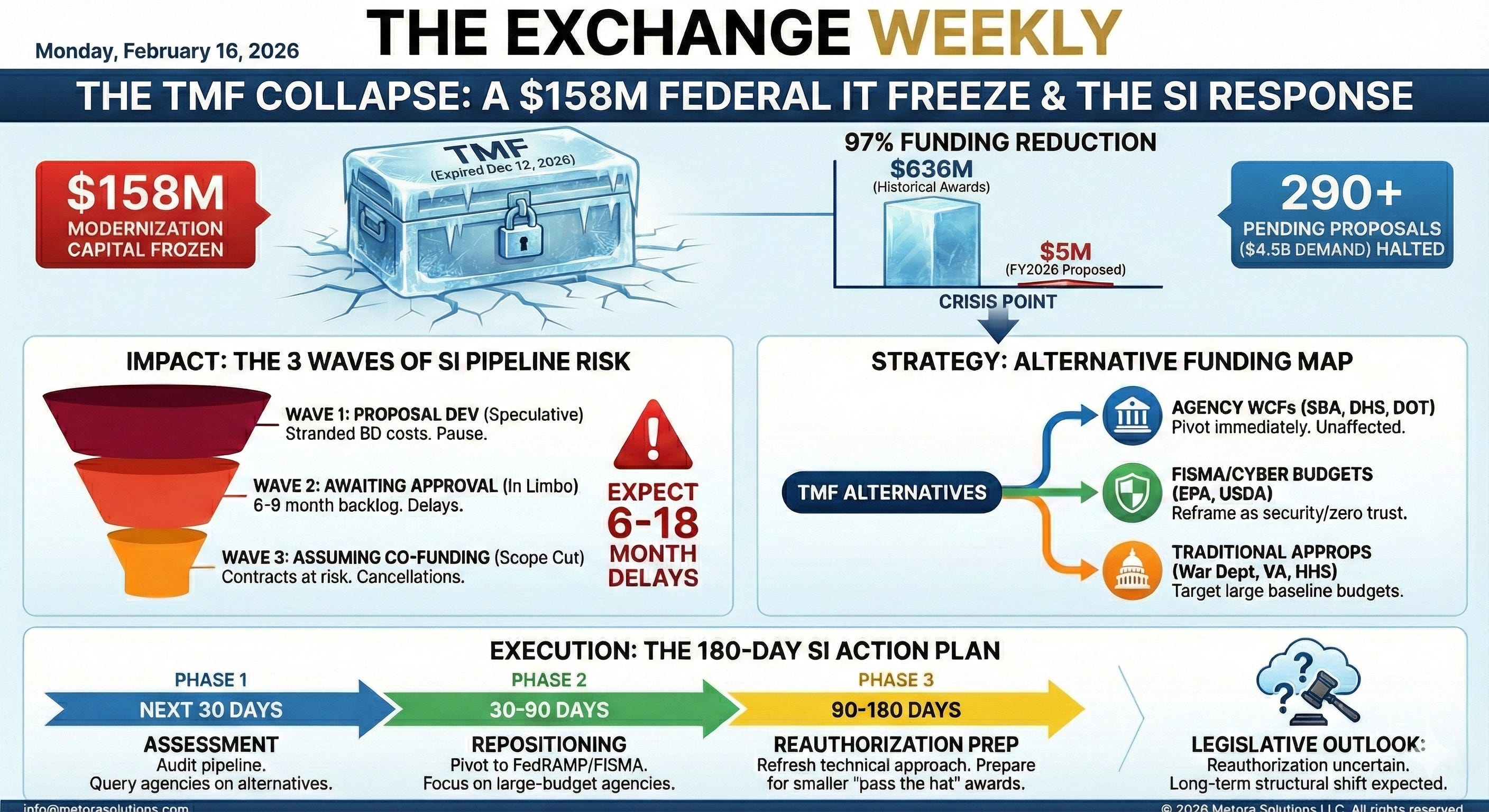
TL;DR: The Technology Modernization Fund (TMF) expired December 12, 2025, freezing $158 million in modernization capital and halting new awards across 290+ pending proposals worth $4.5 billion. System integrators must immediately reprogram Wave 1 pipelines, as the primary federal modernization financing vehicle is reduced to $5 million in FY2026 appropriations. This represents a 97% reduction in funding. Immediate actions include identifying agency-specific working capital funds, pivoting cloud and cyber proposals to traditional appropriations cycles, and preparing for 6- to 18-month project delays. The House Oversight Committee passed reauthorization legislation 42-0 in early February, but Senate action remains uncertain and will not prevent multi-month funding gaps.
Executive Summary
On December 12, 2025, the Technology Modernization Fund (TMF) ceased operations for the first time since its creation in 2017. Despite bipartisan support and active advocacy by the General Services Administration (GSA), Congress let the authorization lapse. While the GSA continues overseeing the $1.07 billion in existing TMF investments across 70 active projects, it cannot make new awards.
The immediate impact freezes $158 million that agencies were counting on for cybersecurity upgrades, cloud migrations, Artificial Intelligence (AI) platform development, and legacy system replacements.
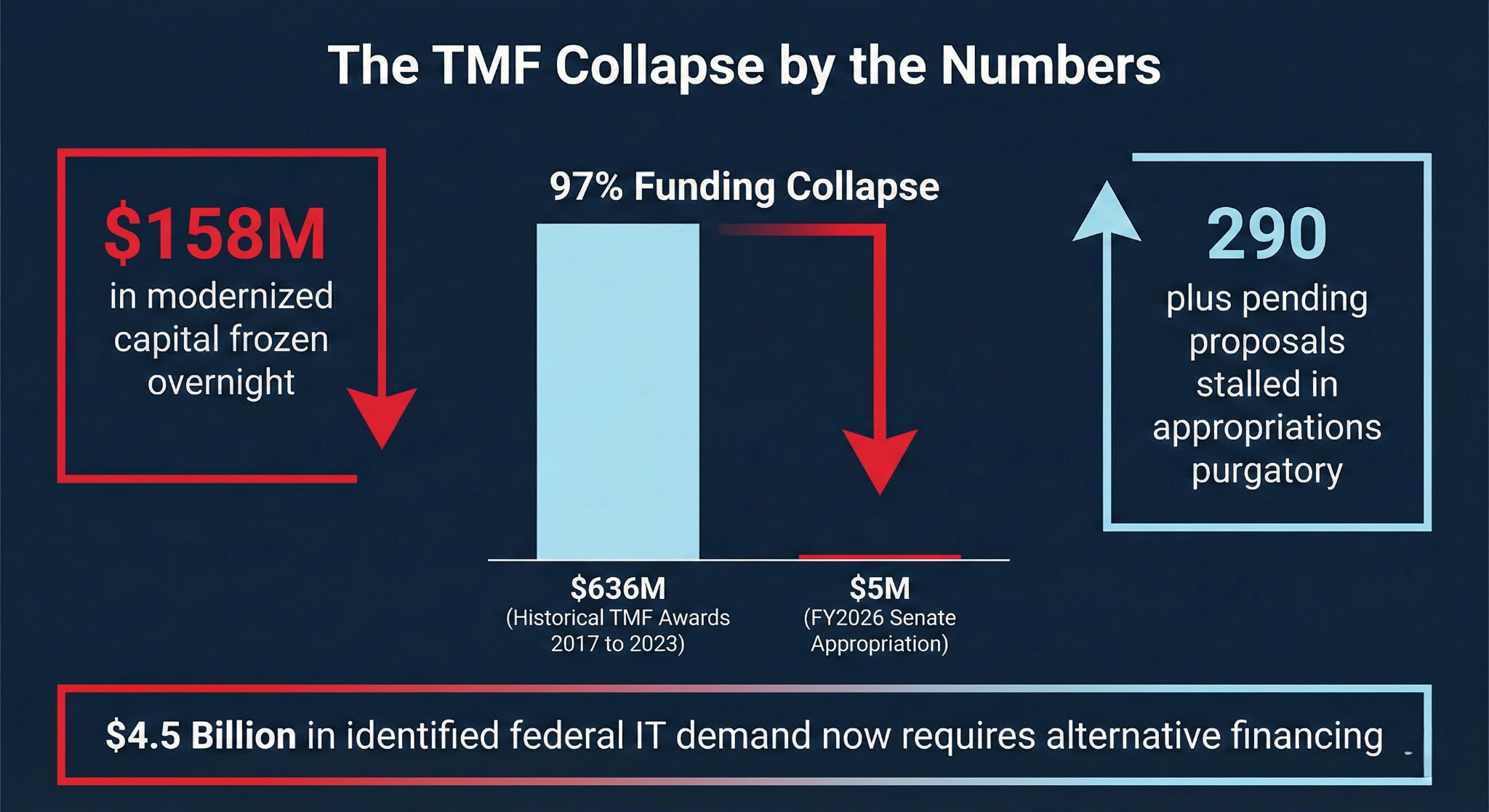
The 290+ pending proposals totaling $4.5 billion in identified demand sit in limbo. These are not theoretical projects. They represent specific modernization needs that passed initial agency screening, quantified cost savings or mission improvements, and identified funding gaps that only TMF could fill. Without TMF, most will end up in appropriations purgatory or face 18- to 36-month delays as agencies scramble to reprogram existing budgets.
Senate appropriators offered $5 million for FY2026. The Trump administration proposed a “pass the hat” model that would allow GSA to collect up to $100 million annually from agencies’ expired discretionary funds, but Congress has not authorized it. Even if authorized tomorrow, $100 million annually represents an 84% reduction from the $636 million TMF awarded between 2017 and 2023. This is not a temporary funding hiccup. This is the fundamental restructuring of how federal modernization gets financed, and system integrators face immediate pipeline disruption across cloud, cybersecurity, and infrastructure modernization portfolios.
The TMF Collapse and What It Means for Your Pipeline
What Happened This Week
Congress had multiple opportunities to save TMF and chose not to take any of them. The House Oversight and Government Reform Committee submitted bipartisan letters to congressional leadership requesting TMF reauthorization language in the FY2026 National Defense Authorization Act (NDAA). The language never made it into the negotiated bill text released in early December. When the NDAA passed without TMF reauthorization, Rep. Shontel Brown (D-Ohio) warned that nearly $200 million in funding for new projects would “disappear overnight.”
Rep. Nancy Mace (R-S.C.) and the late Rep. Gerry Connolly (D-Va.) introduced the Modernizing Government Technology (MGT) Reform Act in April 2025. This would have extended the fund through December 31, 2031. The bill passed the House Oversight Committee by a 42-0 vote in early February 2026, demonstrating genuine bipartisan support. But committee passage does not equal floor action, and the Senate has no companion bill. Even if both chambers pass the legislation tomorrow, TMF has been frozen for two months and will not restart immediately.
Why It Matters
1. System Integrators and Service Providers
TMF was the only federal financing mechanism that operated at modernization speed rather than appropriations speed. Traditional appropriations require agencies to wait for annual budget cycles, justify projects through multiple approval gates spanning 12 to 18 months, and hope Congress does not zero them out. TMF gave agencies access to capital within 60 to 90 days of board approval. This matched how system integrators (SIs) actually deliver cloud migrations, cybersecurity implementations, and application modernization.
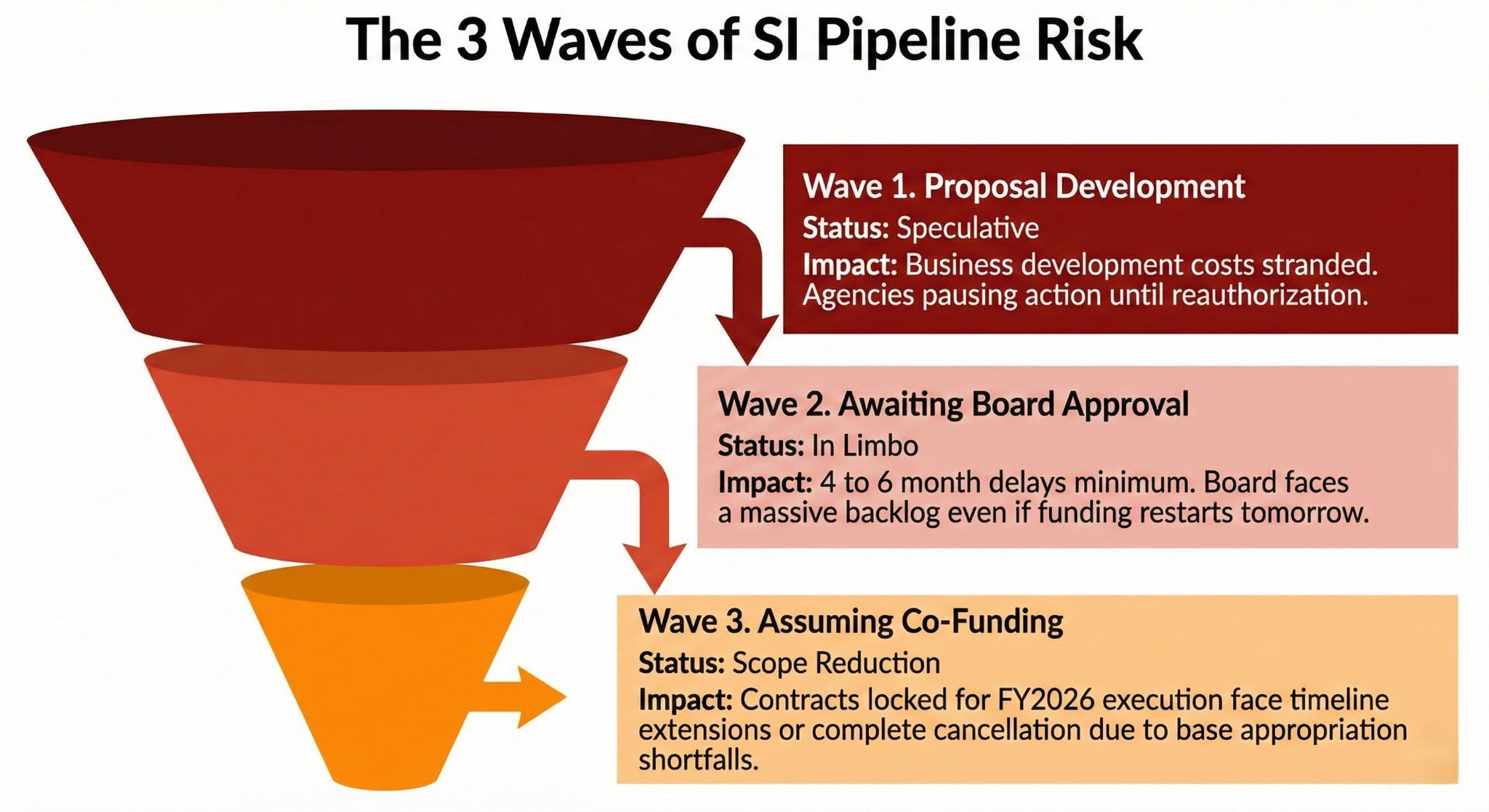
For system integrators, this creates immediate portfolio risk across three distinct phases:
Wave 1 Risk (Projects in Proposal Development): If you are working with an agency on a TMF proposal submission, that work just became speculative. Agencies will pause proposal development until they understand whether the TMF will be reauthorized, when it might resume, and what the new board priorities will be.
Wave 2 Risk (Projects Awaiting Board Approval): If your agency partner submitted a TMF proposal before the December 12 expiration, it sits in limbo. Even if Congress reauthorizes TMF in March 2026, the board will face a massive backlog.
Wave 3 Risk (Projects Assuming TMF Co-Funding): Some agencies structured modernization programs on the assumption that TMF would provide 30 to 50 percent of total funding. If TMF does not materialize, you face scope reduction, timeline extension, or complete cancellation.
