
GSA’s GSAR 552.239-7001 Clause Forces Every Federal AI Contract to Change
The General Services Administration released draft GSAR 552.239-7001, Basic Safeguarding of Artificial Intelligence Systems, on March 6, 2026. Comments close March 20. A mass modification will apply the clause to every Multiple Award Schedule contract in late March or early April 2026. The clause covers any solicitation, contract, or task order where an AI system is delivered to the government or used in contract performance.
The Contractor grants to the Government an irrevocable, royalty-free, non-exclusive license to use the AI System for any lawful government purpose. Models cannot refuse outputs or analyses based on the contractor’s or service provider’s discretionary policies. This requirement must not be construed to require retraining of the model or alteration of model weights. Government Data (every input and output with government context) belongs to the government. It cannot train models, inform commercial decisions, or be commingled. Custom fine-tuning and modifications transfer to the government. Outputs must follow Unbiased AI Principles: truthful, historically accurate, neutral, nonpartisan. American AI Systems only. Foreign components are banned anywhere in the stack. 72-hour incident reporting. 30-day notice for service-provider changes. Contractor pays decommissioning costs on termination.
This clause extends the Department of War’s supply-chain risk designation of Anthropic to all civilian agencies that buy through GSA schedules. It overrides commercial licenses and inserts procurement as the regulator of AI design, data control, and neutrality. System integrators and service providers face the highest revenue impact. GSA vehicles account for the majority of civilian federal AI spending. Federal AI obligations total $2.7 billion in fiscal year 2026 and rise to $3.1 billion by fiscal year 2028 (Deltek GovWin IQ, August 2025 forecast). One noncompliant model can freeze task-order pipelines worth millions.
Government IT leaders gain permanent data ownership and reduced vendor lock-in, but inherit verification costs and restricted model choices. Contracting officers receive clear enforcement tools that take precedence over seller terms. Policymakers watch buying power replace new legislation.
No other federal IT or AI development from March 8-15, 2026, matches this breadth or immediacy. The Anthropic lawsuits, ongoing state AI preemption discussions, and isolated agency pilots remain narrower. This clause rewrites the rules for the vehicles thousands of firms rely on for revenue.
The sections below detail the exact obligations, audience impacts ranked by revenue and operational effect, historical parallels, first-principles trade-offs, counter-arguments, legal risks, and recommendations. Other News covers the week’s additional developments in brief. The Week Ahead provides editorial forecasts on outcomes.
What Happened This Week
The clause organizes requirements into lettered sections (a) through (j). Key mandates include:
American AI Systems only, defined per OMB M-25-22. No foreign components in training data, libraries, inference hardware, or supply chain.
Service Provider definition reaches any model licensor, even at the third tier.
Government Data ownership: inputs, outputs, logs, and context belong to the government. Logical segregation required. No commingling with commercial datasets. No use for training or other clients. Deletion at contract end with written certification.
Custom Development ownership transfers to the government.
Irrevocable license granted by the Contractor to the Government for any lawful purpose. No inference-level refusals based on vendor policies (with model-weights qualifier). Human oversight tools, summarized reasoning traces, and automated bias/truthfulness checks are required.
Incident reporting within 72 hours to CISA and the contracting officer. Daily updates. 90-day artifact preservation.
Material changes that increase bias or affect lawful use must be disclosed within 7 days. Service-provider switches require a 30-day notice.
Outputs must comply with Unbiased AI Principles. The government can suspend or terminate its use. Contractor bears decommissioning costs.
Documentation demonstrating alignment with the NIST AI Risk Management Framework is available upon request.
The trigger is public. The Department of War formally notified Anthropic of supply-chain risk designation on March 5, 2026, after failed negotiations on “any lawful use” terms. Anthropic refused to remove guardrails on certain missions. The administration directed a phase-out. GSA now codifies the same standard for civilian schedules. Anthropic filed two complaints against the Department of War on March 9, 2026, in California and Washington, D.C.
Why It Matters
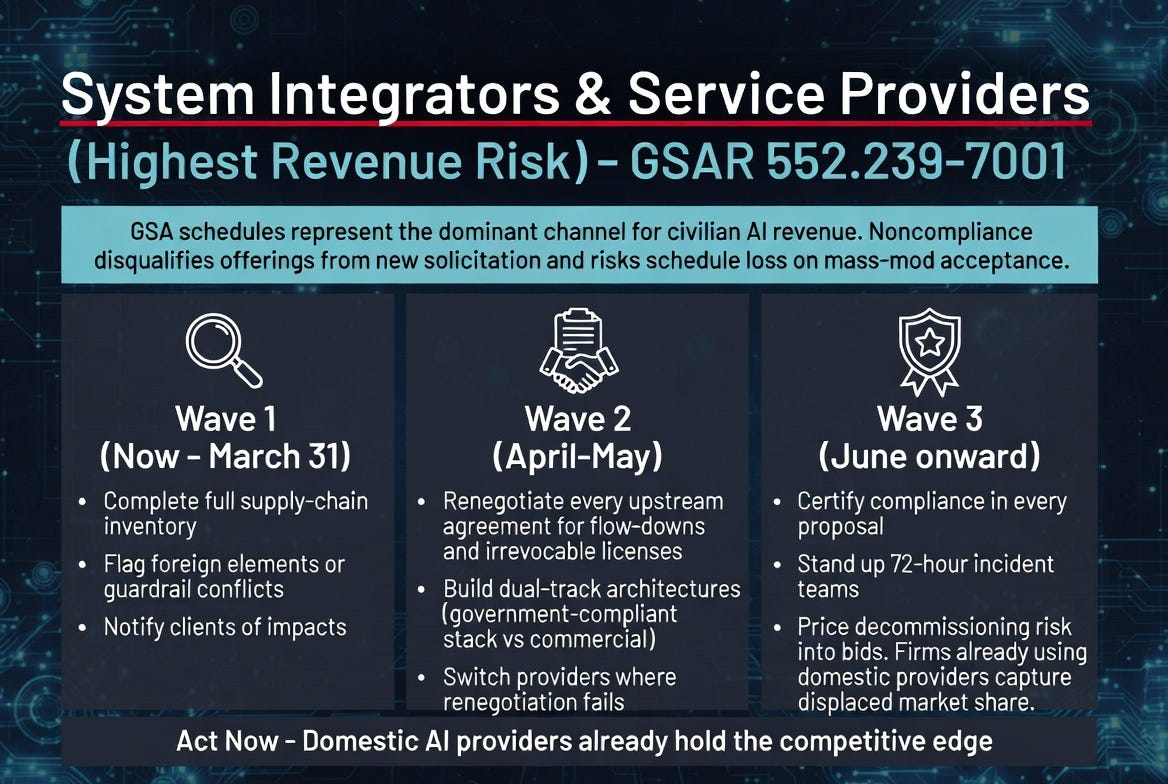
System Integrators and Service Providers (Highest Revenue Risk)
GSA schedules represent the dominant channel for civilian AI revenue. Noncompliance disqualifies offerings from new solicitations and risks schedule loss on mass-mod acceptance.
Wave 1 (now through March 31): complete full supply-chain inventory. Flag foreign elements or guardrail conflicts. Notify clients of impacts.
Wave 2 (April-May): renegotiate every upstream agreement for flow-downs and irrevocable licenses. Build dual-track architectures (government-compliant stack versus commercial). Switch providers where renegotiation fails.
Wave 3 (June onward): certify compliance in every proposal. Stand up 72-hour incident teams. Price decommissioning risk into bids. Firms already using domestic providers capture displaced market share.
Government IT Workers and Leaders
Permanent ownership of data and fine-tuned models ends vendor lock-in. Outputs stay neutral by contract. Integration becomes simpler. The cost arrives in new oversight budgets, segregation infrastructure, and lost access to some foreign models. Mission teams must plan data-export strategies and workforce training for verification layers.
Government Contracting Officers
New evaluation criteria include traceability testing, American AI certification, and change-notification plans. The clause overrides commercial terms and simplifies disputes. Suspension authority for bias or safety issues adds enforcement power. Updated solicitation language required. Vendor management shifts to include affirmative proof of compliance.
All Others
Procurement becomes the regulator. No statute needed. Buying power dictates model design, data rules, and neutrality across federal, state, and local ecosystems, buying off GSA schedules.
Strategic Context
The clause reflects a broader administration push to assert sovereign control over AI in government missions. It follows the Department of War’s March 5 designation and extends the logic to civilian agencies. This creates cross-agency consistency in AI sourcing and use. It connects to OMB M-25-22 guidance on American AI and NIST AI RMF standards. Broader trends include rising concerns over foreign model influence, data exfiltration risks, and private-sector bias in government outputs. Procurement serves as the enforcement mechanism where legislation lags.
What’s Coming Next
GSA issues Refresh 31 in March or April. Contractors accept the mass mod within 60 days or lose schedule status. Task orders issued after incorporation enforce the terms immediately. Agencies update solicitations. Noncompliant offerings disappear from catalogs.
Recommendations
System integrators execute the three waves listed above. Government IT leaders inventory current usage against the clause and budget oversight tools. Contracting officers update evaluation criteria and require compliance matrices in proposals.
Primary Topic Sources
Official draft: https://buy.gsa.gov/interact/system/files/GSA_Federal_Acquisition%20Service%20Proposed%20Government%20AI%20System%20Terms%20and%20Conditions.pdf (GSA, March 6, 2026).
Crowell & Moring analysis: https://www.crowell.com/en/insights/client-alerts/ai-for-government-7-days-for-contractor-comments-on-gsa-proposed-contract-clause-for-ai-systems (March 13, 2026).
Sheppard Mullin: https://www.sheppard.com/insights/blogs/gsas-new-proposed-american-ai-clause-for-schedule-contracts-what-contractors-need-to-know (March 10, 2026).
Gibson Dunn: https://www.gibsondunn.com/gsa-ai-procurement-rules-would-introduce-new-disclosure-and-use-rights-requirements-for-federal-contractors/ (March 12, 2026).
Venable: https://www.venable.com/insights/publications/2026/03/gsa-proposes-new-contract-clause-focused-on-the (March 13, 2026).
Jenner & Block: https://www.jenner.com/en/news-insights/client-alerts/ai-for-gsa-contractors-advanced-notice-of-mas-refresh-31-contains-significant-draft-changes-deadline-of-march-20-for-comments (March 12, 2026).
ExecutiveGov: https://www.executivegov.com/articles/gsa-draft-ai-contract-terms (March 11, 2026).
Deltek Federal AI Market 2026-2028 forecast: https://iq.govwin.com/neo/marketAnalysis/view/Federal-Artificial-Intelligence-AI-Market-2026-2028/68284 (August 28, 2025).
Anthropic litigation: Bloomberg (March 5, 2026), court filings (March 9, 2026), The New York Times (March 9, 2026): https://www.nytimes.com/2026/03/09/technology/anthropic-defense-artificial-intelligence-lawsuit.html.
Other News
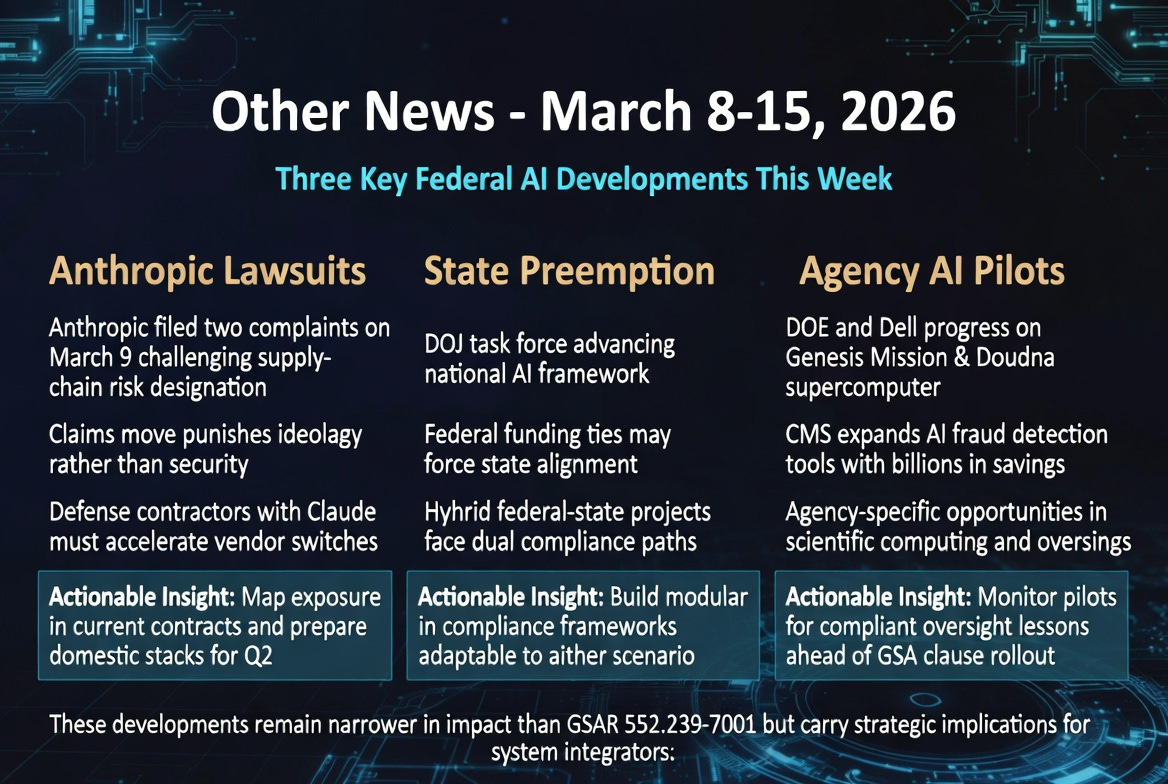
Anthropic Lawsuits Escalate Department of War Dispute
Anthropic filed two complaints against the Department of War on March 9, 2026, challenging the supply-chain risk designation and phase-out directive. The suits argue the move punishes ideological disagreement rather than genuine security risk. System integrators with embedded Claude dependencies must accelerate vendor switches or risk losing defense task orders. Government IT leaders in classified programs face immediate data-migration planning. Contracting officers see increased protest risk on existing awards. This story remains narrower than the GSA clause because it affects only defense pipelines, not civilian schedules.
Actionable insight: Primes should map Anthropic exposure in current contracts and prepare alternative domestic stacks for Q2 proposals. (Sources: The New York Times, March 9, 2026; Reuters, March 9, 2026; Anthropic statement, March 5, 2026.)
State AI Preemption Discussions Continue Under December 2025 Executive Order
Implementation of the December 11, 2025, national AI policy framework advanced with DOJ task-force deadlines and analyses from Ropes & Gray (March 11, 2026) and Baker Botts (early March 2026). Federal funding ties could force state alignment on interstate commerce grounds. System integrators bidding on hybrid federal-state projects face dual compliance paths. Government IT leaders must track preemption outcomes for cross-jurisdiction deployments. This development shapes long-term regulatory risk but does not require immediate contract modifications.
Actionable insight: Prepare modular compliance frameworks that adapt to either federal preemption or continued state variation. (Sources: Ropes & Gray client alert March 11, 2026; Baker Botts briefing early March 2026.)
Agency AI Pilots Advance at DoE and CMS
The Department of Energy and Dell Technologies highlighted progress on the Genesis Mission and Doudna supercomputer for AI-driven scientific discovery (March 12, 2026 coverage). The Centers for Medicare & Medicaid Services expanded the use of AI tools for fraud detection and contract oversight, resulting in billions in savings. These updates signal operational adoption but remain agency-specific. System integrators gain niche opportunities in scientific computing and fraud detection. Government IT leaders see proof-of-concept value for mission sets. Contracting officers note targeted vehicles rather than schedule-wide changes. Actionable insight: monitor these pilots to learn from compliant oversight tools before the broader GSA clause rollout. (Sources: MeriTalk, March 12, 2026; Federal News Network, March 2026 context.)
The Week Ahead
Taking an insights-driven approach to the clause reveals a permanent power shift from vendors to the government buyer. The March 20 comment deadline will surface pushback on data segregation and American definitions. Influence will shape GSA’s final language. Impact will hit pipelines immediately after the mass modification lands in late March or early April.
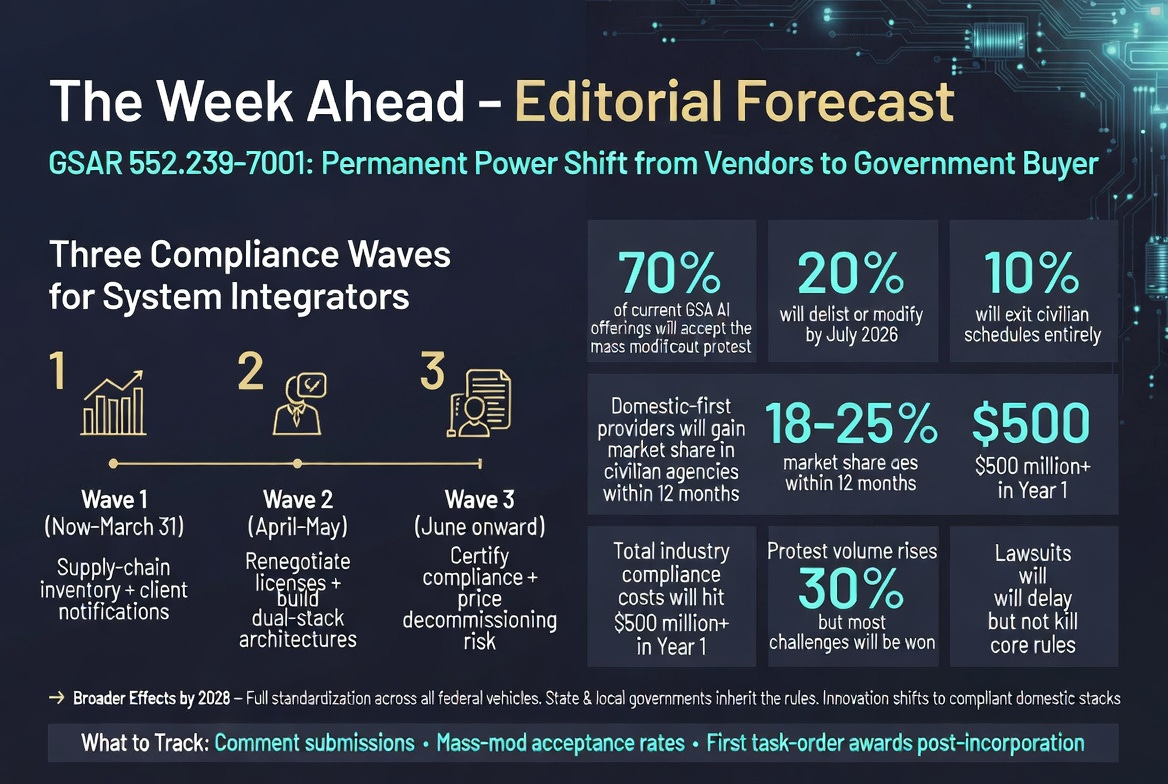
System integrators must implement changes in three waves to achieve the desired positioning. First, complete supply-chain inventories and client notifications by the end of March. Second, secure renegotiated licenses and dual-stack architectures by May. Third, certify and price risk into every proposal starting in June. Inspect results in real time through win rates on new task orders and schedule acceptance percentages. Review gaps quarterly and adjust: if domestic providers lag on performance, pressure GSA for allied-source clarifications in follow-on refreshes. Repeat the cycle until compliance becomes table stakes.
Prediction: Seventy percent of current GSA AI offerings will accept the mass modification without protest. 20% will be delisted or modified by July 2026. Ten percent will exit civilian schedules entirely. (This is our editorial forecast based on Section 889 and CMMC acceptance patterns.)
Prediction: Domestic-first providers will gain 18-25% market share in civilian agencies within 12 months. Anthropic will lose the majority of its federal work. Microsoft and new U.S.-only entrants will surge. (This is our editorial forecast based on historical procurement shifts.)
Prediction: Total industry compliance costs will hit $500 million plus in year one. (This is our editorial forecast derived from Section 889 audit benchmarks scaled to the AI market size.)
Prediction: Lawsuits will delay but not kill the core “any lawful use” and American AI rules. Courts will treat the designation as a matter of procurement discretion, not a First Amendment issue. By late 2026, the clause will appear in every major vehicle. (This is our editorial forecast based on prior supply-chain risk litigation outcomes.)
Prediction: Contracting officers will see protest volume rise 30 percent over data rights issues, but will win most challenges because the clause overrides commercial terms. (This is our editorial forecast drawn from CMMC protest data.)
Broader effects will appear by 2028. Full standardization across all federal vehicles. State and local governments that buy from GSA schedules will inherit the rules. Innovation will shift toward compliant domestic stacks. Safety trade-offs will materialize in edge-case deployments, but gains in national security and neutrality will outweigh them.
Inspecting early signals: track comment submissions, mass-mod acceptance rates, and first task-order awards post-incorporation. Those metrics will reveal winners and losers faster than any earnings call.
Closing Perspective
This clause ends vendor discretion in federal AI once and for all. The government correctly uses its buying power to dictate terms because it funds the work and bears the risk. System integrators who treat compliance as optional will lose access to the largest AI buyer on earth. Those who execute the three compliance waves fastest will dominate civilian contracts for the next decade. The trade-off is real: reduced model diversity and weakened safety guardrails in exchange for sovereign control and data ownership. History proves procurement hammers reshape entire industries faster than legislation. Section 889 eliminated Chinese telecom gear. CMMC forced cybersecurity maturity. GSAR 552.239-7001 will do the same for AI. It prioritizes American control and neutrality over open-innovation risks, and that bet is correct. Contractors who complain about costs simply confirm they never understood who holds the checkbook.
This update was assembled using a mix of human editorial judgment, public records, and reputable national and sector-specific news sources, with help from artificial intelligence tools to summarize and organize information. All information is drawn from publicly available sources listed above. Every effort is made to keep details accurate as of publication time, but readers should always confirm time-sensitive items such as policy changes, budget figures, and timelines with official documents and briefings.
This publication is for informational purposes only and does not constitute legal, technical, acquisition, financial, or compliance advice. It is not a substitute for professional guidance. Readers should consult qualified legal counsel, technical experts, acquisition professionals, financial advisors, and compliance officers before making any decisions or taking any action based on this content. Always validate with primary sources before proceeding.
All original content, formatting, and presentation are copyright 2026 Metora Solutions LLC, all rights reserved. For more information about our work and other projects, drop us a note at info@metorasolutions.com