If 2025 was the year enterprise leaders experimented with AI, this week is the moment AI turns into accounting. Real billing clocks are starting, real governance decisions are due, and the gap between “we’re piloting” and “we’re operating” is about to show up in variance reports and audit questions.
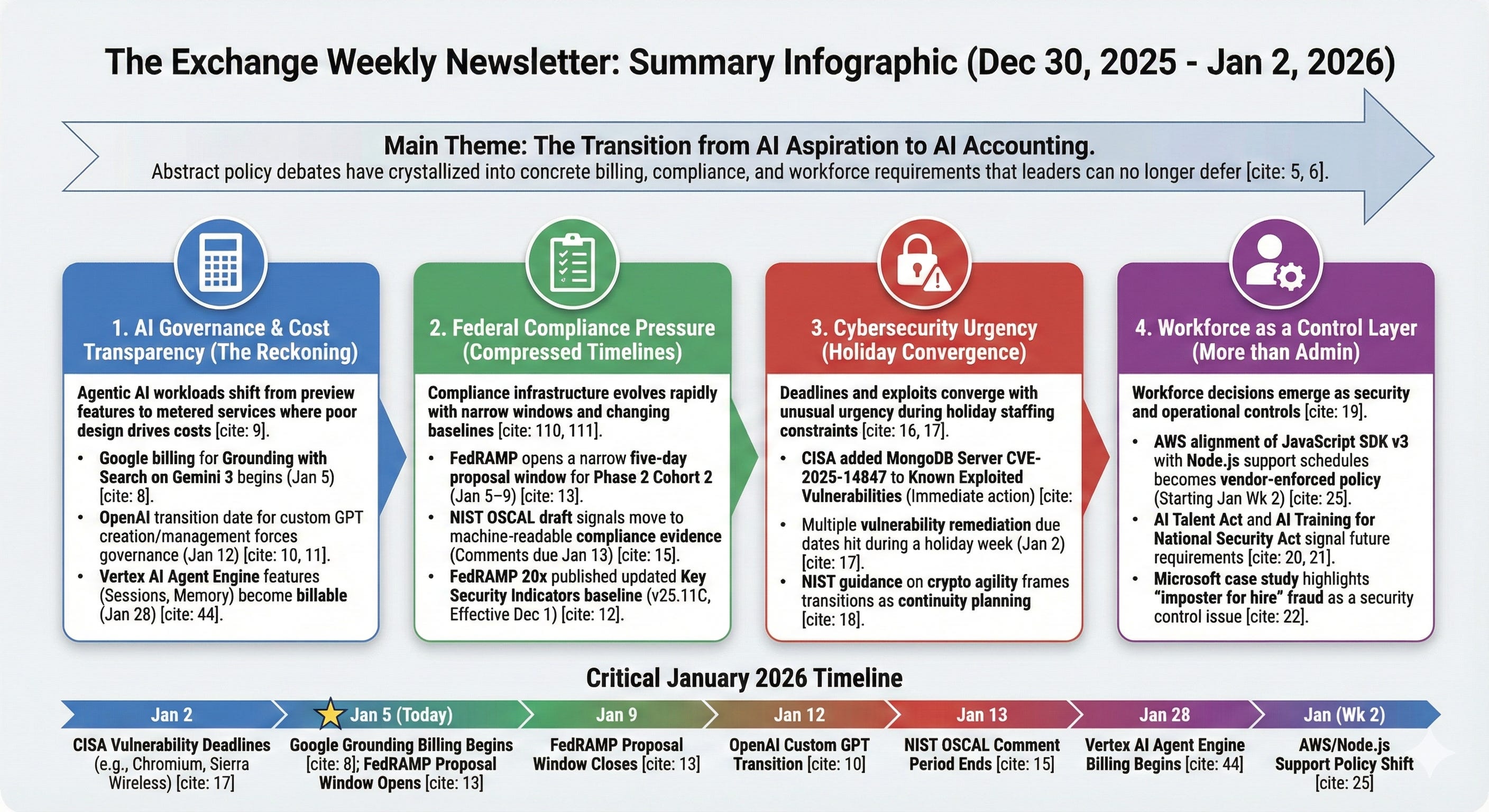
The headline shift is simple. AI governance is no longer just policy language and model selection. It’s cost transparency, billing discipline, and the ability to explain AI unit economics to finance, risk, and the board. Starting today, Google’s documentation signals that grounding with Google Search on Gemini 3 moves into a billed service. That changes how you design retrieval, how you control who can trigger web-grounded queries, and how you allocate those costs back to products and business units. Another hard date is already queued up. January 28 brings new charging mechanics for Vertex AI Agent Engine components like sessions, memory, and code execution, which means “agent experiments” can quietly become production spend if you don’t separate pilots from governed deployments.
In parallel, federal compliance infrastructure is compressing timelines and raising expectations. FedRAMP 20x continues pushing toward security controls that are increasingly machine-readable and built for automated validation. The operational implication applies well beyond federal teams. Your vendors will start showing up with faster authorization promises, narrower submission windows, and more pressure to prove control maturity with evidence, not narratives. If you buy SaaS, you’re going to feel this in procurement cycles and renewal negotiations.
Cybersecurity urgency didn’t wait for a clean calendar reset. Known exploited vulnerability pressure converged with holiday staffing realities, and the “patch calendar” became a business calendar. At the same time, crypto transitions and identity-driven attack patterns are reinforcing a theme that shows up across multiple stories this week. Workforce is no longer an administrative layer. It’s a control layer. Remote work guidance, telework posture, and identity verification practices increasingly define your security boundary.
Finally, platform engineering choices that used to be treated as preferences are hardening into vendor-enforced policy. Node.js lifecycle alignment and SDK support timelines are turning routine upgrades into governance events. This is where platform engineering meets FinOps, and where “we’ll get to it later” becomes measurable risk and measurable cost.
In the full issue, we break this down into executive decision notes. You’ll get the “what changed,” the dates that matter, the budget and controls impact, and the questions CIOs, CISOs, and CTOs should be asking their teams and vendors right now.
Subscribe to keep reading.
If you’re using The Exchange to stay ahead of AI cost exposure, compliance compression, and fast-moving security deadlines, subscribe now and unlock the full weekly brief and action guidance.
Executive Summary
The final days of 2025 and opening hours of 2026 marked a transition from AI aspiration to AI accounting. What had been abstract policy debates about governance frameworks crystallized into concrete billing mechanisms, compliance deadlines, and workforce requirements that technology leaders can no longer defer or delegate. The week’s developments reveal an emerging pattern: organizations that treat AI as a budget line item without understanding the underlying cost drivers, governance requirements, and workforce implications will find themselves surprised by bills they cannot explain and compliance gaps they cannot close.
Google Cloud documentation confirms that billing for Grounding with Google Search on Gemini 3 models begins January 5, 2026, coinciding with this newsletter’s publication. This is not a minor product change. It represents a fundamental shift in how agentic AI workloads are priced, turning what had been preview features into metered services where poor prompt design, inadequate caching, and loose usage policies can drive costs that overwhelm project budgets. OpenAI rolled out GPT-5.2 early access to Enterprise and Education workspaces while setting a January 12, 2026 transition date for custom GPT creation and management. For organizations that have allowed internal teams to build custom GPTs without governance, this timeline forces immediate decisions about who can publish, what data sources are allowed, and how approvals will work.
Federal compliance infrastructure continued its rapid evolution. FedRAMP 20x published the current Key Security Indicators baseline as Version 25.11C (effective December 1, 2025), with no material changes but minor wording adjustments that still require review for teams with authorization packages in flight or continuous monitoring evidence collection underway. The program opened a narrow five-day window from January 5 through January 9, 2026 for Phase 2 Cohort 2 proposals, compressing vendor preparation timelines and forcing agencies to make rapid decisions about which cloud services to prioritize for accelerated authorization. The Department of Health and Human Services formally withdrew remaining non-finalized provisions from the HTI-2 proposed rule, eliminating work that health IT vendors and providers had staffed based on earlier regulatory signals. NIST published a draft on the future of OSCAL with public comment open through January 13, 2026, signaling that compliance evidence is moving toward machine-readable formats and automated validation.
Cybersecurity deadlines converged with unusual urgency. CISA added MongoDB Server CVE-2025-14847 to the Known Exploited Vulnerabilities catalog with active exploitation confirmed, requiring immediate inventory, patching, and validation across internet-facing database infrastructure. Multiple vulnerabilities hit remediation due dates of January 2, 2026, including issues tied to Chromium and Sierra Wireless, forcing security operations teams to execute against compressed timelines during a holiday week when staffing and change windows were already constrained. NIST released guidance on crypto agility considerations and a second public draft of the CSF 2.0 quick-start guide, framing cryptographic transitions and enterprise risk management integration as planning imperatives for 2026.
Workforce emerged as a control layer rather than an administrative function. Congress introduced the AI Talent Act to create internal AI talent teams inside federal agencies, signaling that AI strategy requires dedicated staffing, not just contractor augmentation or policy memos. The AI Training for National Security Act reinforced that competency expectations around AI will increasingly appear in contract language and program performance measures. Microsoft Incident Response published a detailed case study on “imposter for hire” fraud where operatives pose as legitimate remote hires, slip past human resources checks, and gain system access, turning hiring and onboarding into security controls that require verification, not just paperwork. The Office of Personnel Management published an updated Guide to Telework and Remote Work in the Federal Government, connecting operational policy to security posture and endpoint management in distributed work environments.
Platform engineering decisions that had been treated as technical preferences became vendor-enforced policy. AWS announced it will align the AWS SDK for JavaScript v3 with the Node.js release schedule for ending support, starting in the second week of January 2026. This eliminates the flexibility that many development teams assumed they had around runtime lifecycle decisions, forcing organizations to treat Node.js upgrades as routine work rather than optional projects. AWS also published guidance on efficient image and model caching strategies for AI and ML workloads on Amazon EKS, demonstrating that storage and caching decisions drive startup time, GPU utilization, and total cost in ways that platform engineering and FinOps teams must measure and optimize.
Strategic signals came from unlikely sources. Intel completed a $5 billion private placement issuance to NVIDIA at $23.28 per share, a transaction that speaks to long-term AI infrastructure alignment and potential supplier concentration risk for organizations betting on specific accelerator roadmaps. NIST launched two AI Economic Security Centers focused on manufacturing productivity and critical infrastructure security, framing AI as an applied capability that requires evaluation methods and defenses, not just innovation headlines.
The convergence of billing clarity, compliance deadlines, workforce requirements, and platform constraints creates an environment where waiting for perfect information is itself a decision with consequences. Organizations that use the first weeks of 2026 to audit their AI cost drivers, align their compliance roadmaps to the latest baselines, formalize their workforce plans, and verify their platform lifecycle management will enter the year prepared. Those that delay will find themselves explaining variances they do not understand and addressing gaps they did not anticipate.
1: AI Governance Moves from Policy to Accounting - Cost Transparency, Billing Discipline, and the January 5 Reckoning
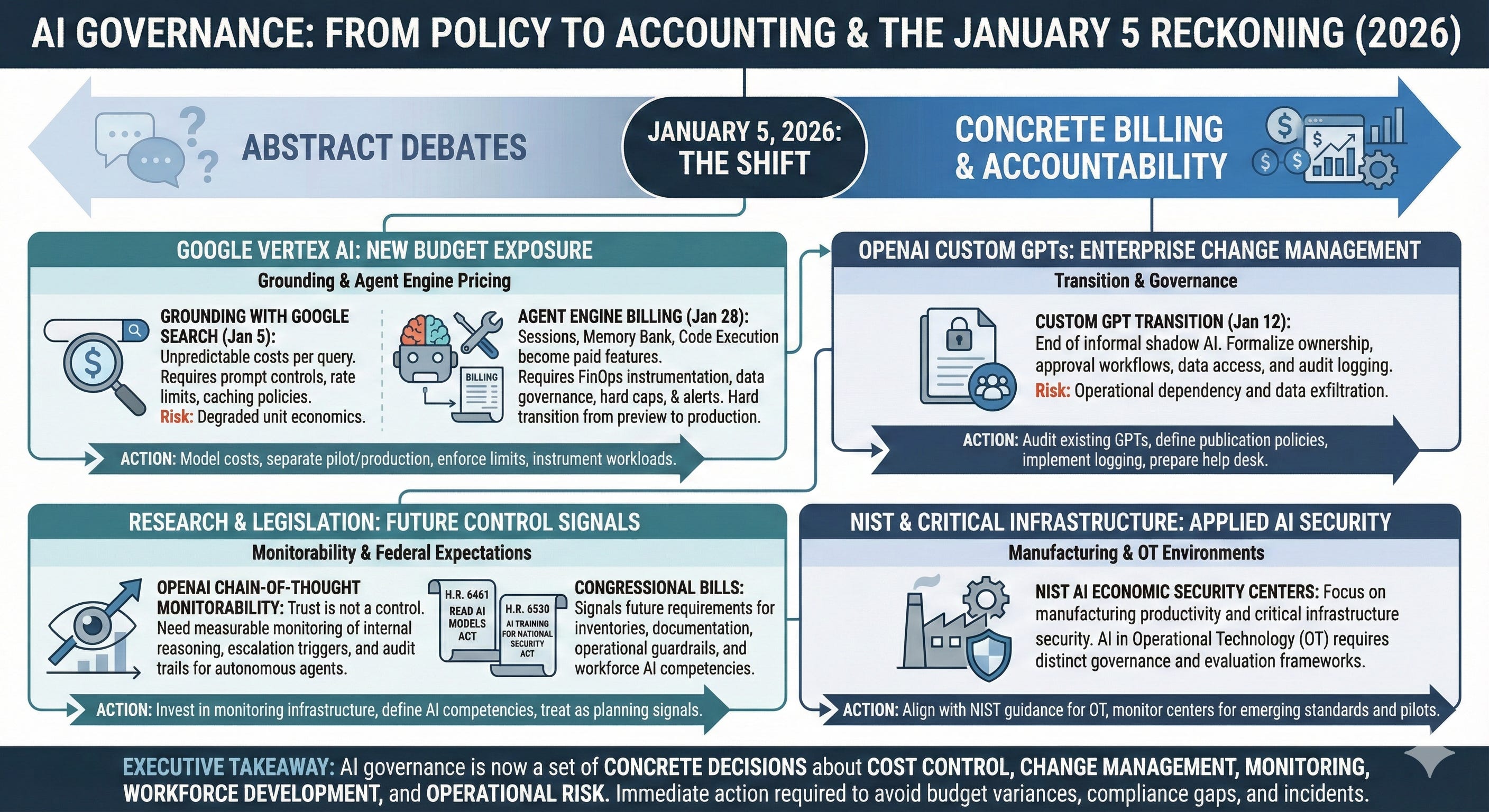
The transition from 2025 to 2026 brought a fundamental shift in how organizations must think about AI deployment. What had been abstract governance debates about transparency and accountability crystallized into concrete billing mechanisms that will appear on budget variance reports in Q1 2026. The practical message for CIOs, CTOs, and finance leaders is direct: if you do not understand the cost drivers behind your AI workloads, you will not be able to forecast spending, control variance, or explain outcomes to stakeholders who expect AI to deliver measurable returns.
Google Vertex AI Grounding and Agent Engine Pricing Create New Budget Exposure
Google Cloud documentation confirms that billing for Grounding with Google Search on Gemini 3 models begins January 5, 2026 (Google Cloud Documentation, updated January 2, 2026). Grounding allows AI models to retrieve current information from Google Search rather than relying solely on training data, improving accuracy for time-sensitive queries. However, each search query triggers billing, and without controls on prompt design, query frequency, and result caching, grounding can become a significant and unpredictable cost driver.
The practical implications are immediate. If your users can trigger search queries at scale through poorly designed prompts or workflows that do not cache and reuse results, your unit economics will degrade rapidly. For security teams, the governance question is what data can be sent to external search services and what must remain inside controlled retrieval layers. For finance teams, the budgeting question is which workloads should use external grounding versus internal retrieval-augmented generation, and how to tag and allocate those costs back to products or business units.
Organizations should measure query volume by use case, enforce rate limits and caching policies, and build cost models that assume worst-case usage patterns rather than average behavior. The gap between planned and actual spending on grounding will show up in variance reports, and executives who cannot explain the drivers will face tough questions about whether AI investments are under control.
On January 28, 2026, Google will begin charging for Vertex AI Agent Engine features including Sessions, Memory Bank, and Code Execution (Vertex AI Release Notes, December 16, 2025). This date represents a hard transition from preview pricing to production billing for organizations building agentic workflows that rely on persistent memory and tool execution. For teams experimenting with AI agents for customer support, internal IT, or workflow automation, this is not an incremental cost increase. It is the activation of billing for features that may already be deeply integrated into production workflows.
The operational response requires separation of pilots from production, explicit usage limits and alerting on features that are about to become billable, and cost modeling per active user, per session, and per tool call. Organizations that have not instrumented their agent workloads to measure these dimensions will be unable to forecast spending or identify which use cases drive costs. When memory becomes a paid feature, it also becomes a data retention feature, creating governance obligations around what is stored, for how long, and who can retrieve it. January 28 is the deadline for having both FinOps instrumentation and data governance policies in place, not just budget approvals.
The convergence of grounding charges (now active as of January 5) and agent billing creates a scenario where AI costs can escalate rapidly without additional headcount or infrastructure, simply through usage patterns that were acceptable during preview periods but become unsustainable under production pricing. CIOs should review current agent deployments, identify which features will become billable, model costs under realistic usage scenarios, and implement hard caps and alerts before January 28. CFOs should expect budget variance explanations that connect AI spending to measurable business outcomes, not just technology adoption metrics.
OpenAI Custom GPT Transition and Enterprise Change Management
OpenAI updated release notes for ChatGPT Enterprise and Education, announcing GPT-5.2 early access for eligible workspaces and setting a January 12, 2026 transition date for custom GPT creation and management (OpenAI Release Notes, December 11, 2025). For organizations that have allowed business units to create and deploy custom GPTs without centralized governance, this timeline forces immediate decisions about ownership, approval processes, data source policies, and audit logging.
Custom GPTs have proliferated inside enterprises as a form of shadow AI, where individual teams build specialized chatbots for internal workflows, customer interactions, or knowledge management without involving central IT or security. The January 12 transition means these informal arrangements must formalize quickly. Organizations need to identify who currently owns custom GPTs, which data sources they access, what business processes depend on them, and how updates and approvals will be managed going forward.
The practical steps include standardizing publication policies that define who can create and deploy custom GPTs, establishing approval workflows that involve both business owners and technical reviewers, implementing logging and monitoring that captures usage patterns and data access, and preparing help desk teams for day-one confusion when the transition occurs. This is not optional work. Custom GPTs that break or become inaccessible during the transition will create immediate business impact if they support production workflows.
For CISOs, the transition is a governance moment. Custom GPTs often have broad access to enterprise data, third-party APIs, and external services. Without proper controls, they represent both data exfiltration risk and operational dependency risk. The January 12 deadline creates an opportunity to audit existing custom GPTs, enforce data classification policies, and ensure that access controls align with least privilege principles. Organizations that treat this as a vendor change notification rather than a governance milestone will find themselves exposed to risks they did not recognize.
OpenAI Chain-of-Thought Monitorability Research Signals Future Control Requirements
OpenAI published research on evaluating chain-of-thought monitorability, introducing methods to measure whether a system’s internal reasoning can be supervised reliably (OpenAI, December 18, 2025). This work addresses a fundamental challenge with agentic AI: systems that make autonomous decisions across multiple steps are difficult to monitor using only output-level controls. When AI systems can plan, reason, and execute actions without human approval at each step, output-only monitoring can miss the decision path that created harm, especially in high-stakes contexts.
The executive takeaway is that trust is not a control, but measurable monitoring can become a control if designed and tested properly. Organizations deploying AI agents in environments where decisions affect financial transactions, customer relationships, regulatory compliance, or safety must implement telemetry that captures intermediate reasoning, escalation triggers that flag suspicious decision patterns, and audit capabilities that can reconstruct what the system was attempting to do when incidents occur.
The OpenAI research provides a framework for thinking about monitorability as a measurable property rather than an assumed characteristic. Organizations should not assume that because an AI system produces explainable outputs, its internal reasoning is actually visible or controllable. Testing for monitorability requires evaluating whether human reviewers can detect when a system’s reasoning diverges from expected patterns, whether escalation triggers fire before harm occurs, and whether audit trails contain sufficient detail to support investigations and regulatory inquiries.
For governance teams building AI oversight frameworks, this research suggests that control maturity for agentic systems requires investment in monitoring infrastructure, not just policy documentation. Controls that work for supervised learning models where humans review outputs before deployment may fail completely for autonomous agents that make decisions in real time. Organizations deploying agentic AI should budget for monitoring platforms that capture decision telemetry, hire or train staff who can interpret that telemetry, and establish escalation protocols that define when human intervention is required.
Congressional Bills Signal Future Inventory and Training Requirements
Congress introduced two bills during the week that provide early signals about future AI governance expectations. The READ AI Models Act (H.R. 6461) points toward greater federal visibility into AI model usage and related reporting requirements (Congress.gov, December 4, 2025). While nothing is final, the bill suggests that agencies and contractors will face expectations around AI inventories, documentation of model purpose and ownership, evaluation records, and operational guardrails. Organizations that standardize model records now, including fields for purpose, data sensitivity, evaluation notes, and operational constraints, will be prepared when requirements mature.
The AI Training for National Security Act (H.R. 6530) reinforces that AI strategy is also workforce strategy, particularly for organizations supporting national security missions (Congress.gov, December 9, 2025). National security AI training pipelines tend to accelerate ahead of broader government requirements, and expectations often flow into contract language, staffing plans, and program performance measures. Organizations delivering into defense-adjacent missions should assume training requirements could appear in future solicitations and should define role-based AI competencies across engineering, security, legal, and operations teams.
The practical move for federal contractors and grant recipients is to treat these bills as planning signals rather than immediate mandates. Define AI competencies that map to organizational roles, attach them to training paths with measurable outcomes, and document how competency development connects to project delivery and quality. When training requirements appear in contracts, organizations with mature competency frameworks will be able to demonstrate compliance quickly, while those starting from scratch will face staffing and delivery risk.
NIST AI Economic Security Centers Connect AI to Manufacturing and Critical Infrastructure
NIST launched two AI Economic Security Centers focused on manufacturing productivity and critical infrastructure security (NIST, December 22, 2025). The framing is significant because it positions AI as an applied capability that requires evaluation methods, adoption support, and defenses, not just innovation narratives. For organizations operating in manufacturing or critical infrastructure sectors, this signals that NIST will develop measurement practices, pilot programs, and frameworks that reduce deployment risk and strengthen assurance.
The practical implication is that AI adoption in operational technology environments will increasingly need to align with NIST guidance, particularly where AI touches production systems, safety controls, or essential services. Organizations should monitor these centers for evaluation frameworks, pilot opportunities, and emerging standards that can inform internal governance and provide credibility with regulators, customers, and auditors. NIST’s involvement also suggests that AI in OT will face different governance expectations than AI in IT, reflecting the physical consequences of failure in industrial and infrastructure environments.
For CIOs and CISOs in critical infrastructure sectors, the NIST centers represent both opportunity and obligation. Participating in pilots and contributing to framework development provides early visibility into future requirements and influence over how they are defined. However, it also signals that regulatory and procurement expectations around AI in OT are maturing, and organizations that delay governance investments will face compliance and assurance gaps when standards crystallize.
The week’s convergence of billing transparency (now active), platform transitions, monitorability research, legislative signals, and NIST infrastructure investments reveals that AI governance is no longer an abstract policy exercise. It is a set of concrete decisions about cost control, change management, monitoring infrastructure, workforce development, and operational risk that executive teams must make in the first weeks of 2026. Organizations that treat these as technical issues to be handled by platform teams will find themselves unprepared for budget variances, compliance inquiries, and operational incidents that demand executive accountability.
Sources:
Google Cloud Documentation, “Grounding with Google Search,” updated January 2, 2026, https://cloud.google.com/vertex-ai/generative-ai/docs/grounding/grounding-with-google-search
Vertex AI Release Notes, “Agent Engine Pricing Change,” December 16, 2025, https://cloud.google.com/vertex-ai/docs/release-notes
OpenAI Release Notes, “ChatGPT Enterprise and Edu Release Notes,” December 11, 2025, https://help.openai.com/en/articles/10128477-chatgpt-enterprise-edu-release-notes
OpenAI, “Evaluating Chain-of-Thought Monitorability,” December 18, 2025, https://openai.com/index/evaluating-chain-of-thought-monitorability/
Congress.gov, “H.R. 6461 - READ AI Models Act,” December 4, 2025, https://www.congress.gov/bill/119th-congress/house-bill/6461
Congress.gov, “H.R. 6530 - AI Training for National Security Act,” December 9, 2025, https://www.congress.gov/bill/119th-congress/house-bill/6530
NIST, “NIST Launches Centers for AI in Manufacturing and Critical Infrastructure,” December 22, 2025, https://www.nist.gov/news-events/news/2025/12/nist-launches-centers-ai-manufacturing-and-critical-infrastructure
2: Federal Compliance Infrastructure Compresses Timelines and Raises Stakes - FedRAMP Baselines, Narrow Windows, and Regulatory Withdrawals
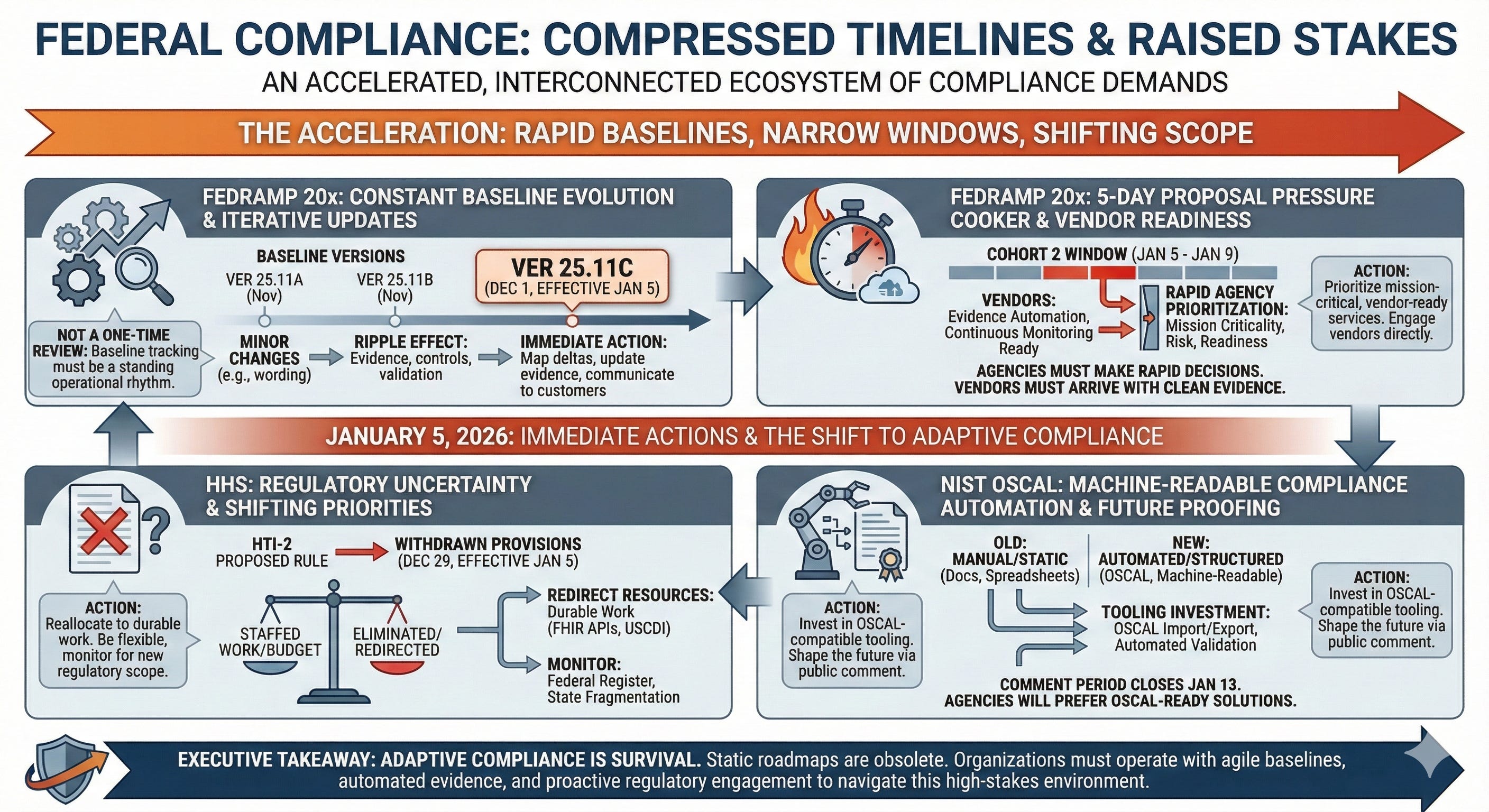
Federal compliance infrastructure evolved rapidly during the week, creating compressed timelines and forcing immediate decisions for agencies, vendors, and systems integrators. The pattern across FedRAMP updates, proposal windows, and regulatory withdrawals is clear: compliance roadmaps that were built on assumptions about stable requirements and gradual change are no longer viable. Organizations must operate with the expectation that baselines will update frequently, proposal windows will be narrow, and regulatory scope can shift without lengthy transition periods.
FedRAMP 20x Key Security Indicators Baseline Update Creates Immediate Work
FedRAMP 20x published the current Key Security Indicators baseline as Version 25.11C (effective December 1, 2025), with no material changes but minor wording adjustments (e.g., “process” instead of “standard” in some indicators and a note on potential infinite loops in KSI-AFR-02) (FedRAMP, December 1, 2025). For teams with authorization packages in flight or continuous monitoring evidence collection underway, these iterative updates still ripple into what evidence must be collected, how controls are described, and what validation procedures apply. This is not a future planning item. It is an immediate action for engineering and governance teams that must identify what changed, assess impact on current work, and update documentation and procedures to align with the latest baseline.
The practical response requires assigning a single owner to read the version history, compare the current baseline to the previous version, identify deltas that affect the system under assessment, and create a dated checklist for implementation. For vendors selling cloud services to government, this update creates a customer communication requirement. Downstream agency teams need to understand what changed, what stays the same, and what actions they must take to maintain compliance with the updated baseline.
Organizations targeting FedRAMP 20x pathways in 2026 should treat baseline tracking as a standing operating rhythm, not a one-time review. The publication pattern of Version 25.11C (and prior 25.11A/B in November) signals that FedRAMP will continue to iterate on control baselines and that vendors must be prepared to adapt authorization packages and continuous monitoring programs as requirements evolve. The alternative is to discover deltas late in the assessment process when remediation is more expensive and timelines are at risk.
For CISOs and GRC leaders, the baseline update underscores that FedRAMP compliance is not a static achievement but an ongoing operational discipline. Continuous monitoring is not just about collecting evidence on existing controls. It is about adapting to control baseline changes, vendor updates, and emerging threats in a way that maintains authorization without requiring full reassessment. Organizations that treat continuous monitoring as a compliance checkbox rather than an operational capability will struggle when baselines change and auditors expect rapid adaptation.
Phase 2 Cohort 2 Proposal Window Compresses Vendor Preparation to Five Days
FedRAMP 20x opened a Phase 2 Cohort 2 proposal window running from January 5 through January 9, 2026, a five-day period that compresses vendor preparation timelines and forces agencies to make rapid prioritization decisions about which cloud services to accelerate for authorization (FedRAMP Blog, December 10, 2025). For vendors, this window requires readiness in evidence automation, control inheritance documentation, and continuous monitoring plans. Organizations that do not have these capabilities developed cannot assemble credible proposals in five days.
For agencies, the narrow window creates pressure to prioritize cloud services based on mission criticality, risk appetite, and vendor readiness rather than waiting for comprehensive assessments of all available options. The promise of FedRAMP 20x is faster authorization through streamlined processes and clearer expectations, but that promise only delivers if vendors arrive with clean evidence and agencies have the capacity to review proposals and make decisions quickly.
CIOs buying cloud services should use this window to engage vendors directly. Ask whether they are submitting proposals for Cohort 2, which authorizations they are targeting, and how they will keep agency customers informed as controls are validated and authorizations progress. For CISOs, the key question is whether vendors can demonstrate operational security maturity beyond the paperwork. Authorization packages that look clean on paper but reflect weak operational practices will create risk after go-live, particularly in environments where agency data and federal systems depend on vendor infrastructure.
The compressed timeline also creates planning risk for systems integrators and program offices that depend on specific cloud services for delivery. If a vendor does not make it into Cohort 2 or faces delays in authorization, downstream programs may need to identify alternatives, adjust architectures, or revise timelines. Organizations should maintain contingency plans that include multiple vendors and deployment models rather than assuming that preferred services will receive authorization on desired timelines.
HHS Withdrawal of HTI-2 Provisions Eliminates Staffed Work and Shifts Priorities
The Department of Health and Human Services formally withdrew remaining non-finalized provisions from the HTI-2 proposed rule, effective December 29, 2025 (Federal Register, December 29, 2025). For health IT vendors, providers, and interoperability teams, this withdrawal eliminates work that had been staffed based on earlier regulatory signals. Programs that allocated budget, hired contractors, or initiated technical work around the withdrawn provisions now face decisions about reallocating resources, pausing or canceling contracts, and updating stakeholder communications.
The operational response requires mapping what remains binding under finalized rules, what has been superseded by subsequent guidance, and what can be paused without creating compliance debt or capability gaps. For CIOs, this is an opportunity to reallocate time and budget toward interoperability work that is clearly durable, such as implementing FHIR APIs, addressing information blocking requirements, and supporting USCDI data standards. For compliance leaders, it is a reminder to monitor Federal Register notices and agency guidance closely, because regulatory scope can change faster than program planning cycles typically assume.
The HHS withdrawal also highlights a broader pattern in federal rulemaking where proposed provisions may not survive to final rules, creating planning risk for organizations that invest heavily in compliance readiness before requirements are finalized. The lesson for healthcare IT leaders is to distinguish between proposed, finalized, and effective requirements in planning documents and to maintain flexibility in program staffing and vendor contracts so that resources can be redirected when regulatory scope changes.
For vendors, the withdrawal creates both relief and uncertainty. Relief because work that would have been expensive and complex is no longer required. Uncertainty because the absence of clear federal requirements may lead to fragmented state-level initiatives or customer-driven expectations that are harder to navigate than uniform federal rules. Organizations should engage with customers and industry groups to understand whether withdrawn federal provisions will be replaced by state laws, voluntary frameworks, or procurement requirements that achieve similar outcomes through different mechanisms.
NIST OSCAL Draft Signals Move to Machine-Readable Compliance Evidence
NIST published a draft titled “Charting the Course for NIST OSCAL” with a public comment period open through January 13, 2026 (NIST CSRC, December 2, 2025). The document outlines NIST’s vision for the Open Security Controls Assessment Language, a framework for representing security controls, assessments, and compliance artifacts in machine-readable formats that support automation and continuous validation. For GRC leaders, security architects, and compliance teams, this draft signals that federal compliance is moving away from narrative documents and static spreadsheets toward structured data that can be validated programmatically.
The practical implication is that organizations should begin investing in tooling and processes that can produce and consume OSCAL-formatted data. This includes control implementation statements, system security plans, assessment results, and continuous monitoring evidence. Vendors that can export compliance artifacts in OSCAL formats will have advantages in federal procurement, because agencies will increasingly prefer solutions that integrate with automated compliance pipelines rather than requiring manual evidence collection and validation.
For CIOs and CISOs planning compliance automation investments, the OSCAL draft provides a planning anchor. Rather than building proprietary compliance dashboards and evidence repositories, organizations should evaluate whether tools support OSCAL import and export, whether control frameworks are mapped to OSCAL control identifiers, and whether assessment workflows can produce OSCAL-formatted results that auditors and agencies can consume directly. The alternative is to build compliance infrastructure that will require costly retrofitting when OSCAL becomes a procurement and audit expectation.
The public comment period through January 13 provides an opportunity for organizations to influence how OSCAL evolves. Comments that describe operational challenges, interoperability requirements, and implementation barriers will help NIST refine the framework in ways that make it more practical and adoptable. Organizations that participate in the comment process will also gain early visibility into how OSCAL will be used in federal compliance programs, providing a planning advantage when agencies begin requiring OSCAL-formatted evidence.
The convergence of FedRAMP baseline updates, compressed proposal windows, regulatory withdrawals, and OSCAL evolution reveals that federal compliance infrastructure is in a state of accelerated change. Organizations that built compliance roadmaps assuming stable requirements, predictable timelines, and gradual adoption of new frameworks will find themselves constantly behind. Those that build adaptive compliance capabilities, maintain close engagement with program offices and regulators, and invest in automation and structured data will be better positioned to navigate an environment where change is the norm rather than the exception.
Sources:
FedRAMP, “Key Security Indicators Version 25.11C,” December 1, 2025, https://www.fedramp.gov/docs/key-security-indicators/
FedRAMP Blog, “FedRAMP 20x Phase 2 Is Here,” December 10, 2025, https://www.fedramp.gov/blog/fedramp-20x-phase-2-is-here/
Federal Register, “Health Data, Technology, and Interoperability: Patient Engagement, Information Sharing, and Public Health Interoperability,” December 29, 2025, https://www.federalregister.gov/documents/2025/12/29/2025-23890/health-data-technology-and-interoperability-patient-engagement-information-sharing-and-public-health
NIST CSRC, “Draft: Charting the Course for NIST OSCAL,” December 2, 2025, https://csrc.nist.gov/News/2025/draft-charting-the-course-for-nist-oscal
3: Cybersecurity Deadlines Converge with Holiday Compression - KEV Pressure, Crypto Transitions, and Workforce Clarity
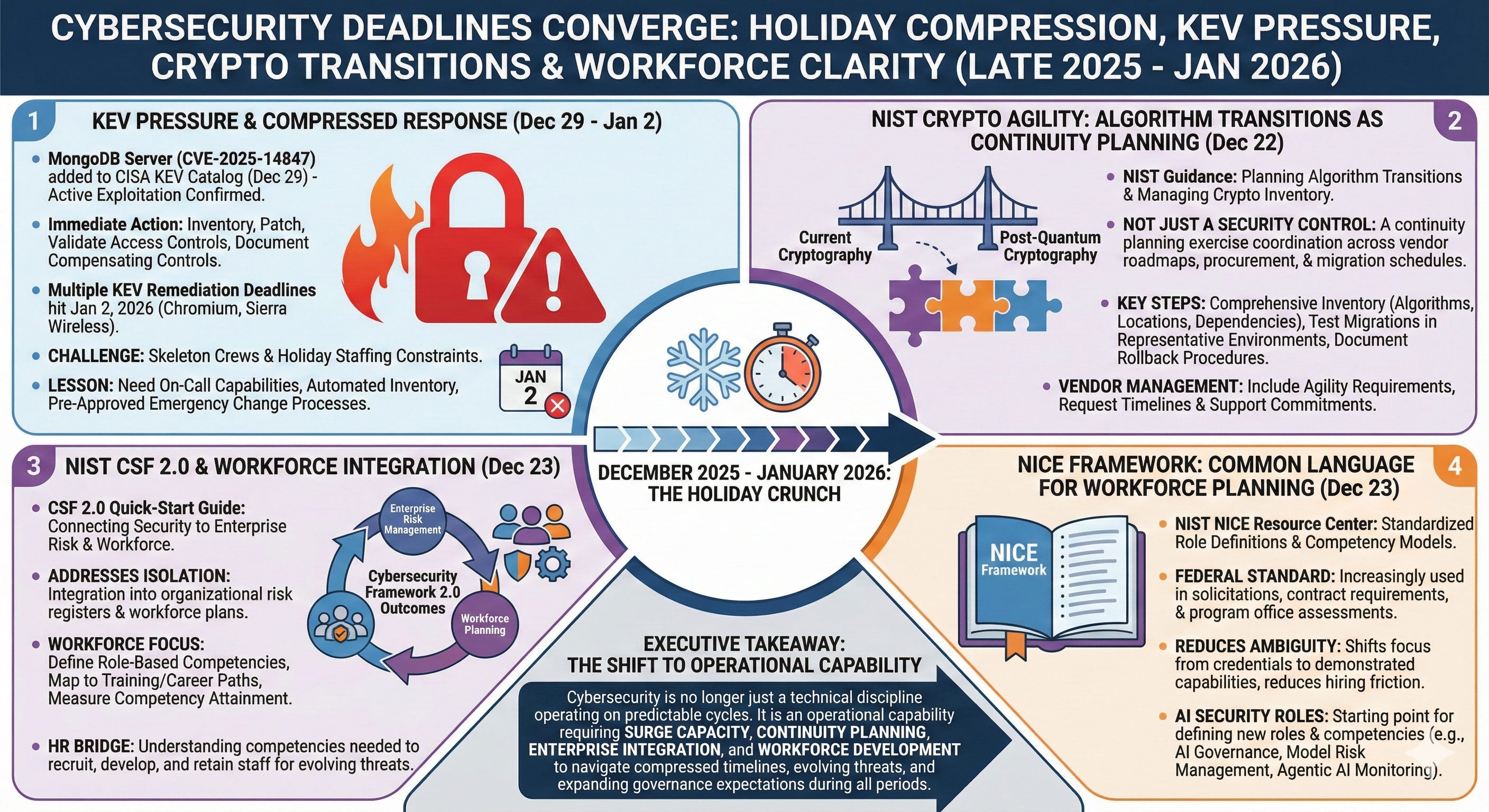
The final week of 2025 brought an unusual convergence of cybersecurity deadlines, active exploitation, and guidance releases that created operational pressure during a period when staffing and change windows were already constrained. The pattern across CISA Known Exploited Vulnerabilities additions, January 2 remediation deadlines, and NIST guidance updates is that cybersecurity is no longer operating on predictable cycles that align with organizational planning calendars. Organizations must maintain surge capacity to respond to exploited vulnerabilities, compressed remediation timelines, and guidance releases that require review and action even during holiday periods.
MongoDB Server and January 2 KEV Deadlines Force Compressed Response
CISA added MongoDB Server CVE-2025-14847 to the Known Exploited Vulnerabilities catalog with active exploitation confirmed (National Vulnerability Database, December 29, 2025). When a database platform vulnerability receives KEV status, it transitions from theoretical risk to operational urgency because exploitation is occurring in the wild and attackers have working techniques. The immediate operational response requires inventory of all MongoDB instances, including managed services, development clusters that drifted into production, and any instances reachable from public networks. Organizations must confirm versions, apply vendor patches, validate that access controls restrict connections to authorized sources only, and document compensating controls for any systems that cannot be patched immediately.
The MongoDB KEV addition occurred during the final week of December, a period when IT operations teams are typically running with reduced staffing and limited change windows due to holiday schedules. This creates a planning challenge: organizations cannot assume that vulnerabilities will be disclosed and exploited during convenient periods. Incident response plans must account for the reality that critical security work may be required during periods when normal operations are suspended and when key personnel are unavailable.
For CISOs and security operations leaders, the lesson is to maintain on-call capabilities and documented runbooks that enable rapid response even when normal staffing is unavailable. This includes automated inventory systems that can identify affected assets quickly, pre-approved emergency change processes that allow patching outside normal windows, and communication plans that can reach decision-makers and technical staff regardless of holiday schedules.
Multiple vulnerabilities hit remediation due dates of January 2, 2026, including issues tied to Chromium and Sierra Wireless (CISA KEV Catalog, December 12, 2025). These deadlines created a compressed timeline where security teams had to validate patching status, confirm detection coverage, and document exceptions during a holiday week when many organizations operate with skeleton crews. The convergence of multiple deadlines on a single date during a low-staffing period suggests that CISA’s deadline calculations do not account for organizational capacity constraints during holidays, creating execution risk for teams that must balance security obligations with operational realities.
Organizations should use January 2026 as a case study for improving their vulnerability management processes. Review which vulnerabilities had January 2 deadlines, assess whether remediation was completed on time, identify bottlenecks that delayed patching or validation, and document lessons learned for future KEV responses. The goal is not just to meet this specific deadline but to build processes that can handle compressed timelines and holiday execution challenges in future cycles.
NIST Crypto Agility Guidance Frames Algorithm Transitions as Continuity Planning
NIST published considerations for achieving crypto agility, providing a framework for planning algorithm transitions and managing cryptographic inventory (NIST CSRC, December 22, 2025). The guidance addresses how organizations can reduce outage risk and maintain operational continuity during transitions to post-quantum cryptography and other algorithm updates. For CISOs, enterprise architects, and PKI teams, this is not just a security control but a continuity planning exercise that requires coordination across vendor roadmaps, procurement language, testing environments, and migration schedules.
The practical steps include creating a comprehensive inventory of cryptographic implementations across applications, infrastructure, and third-party services. This inventory must identify which algorithms are used, where they are implemented, what dependencies exist between systems, and which vendors control update timelines. Organizations that do not have this inventory cannot plan migrations effectively because they lack visibility into where cryptographic changes will create breakage or performance impacts.
The NIST guidance emphasizes testing migrations in representative environments before executing in production. Cryptographic transitions can break authentication, data access, integrations, and compliance validation in ways that are difficult to predict without testing. Organizations should establish test environments that mirror production configurations, execute migration procedures in those environments, validate that applications and integrations continue to function correctly, and document rollback procedures for migrations that create unexpected issues.
For procurement and vendor management teams, crypto agility guidance creates expectations around vendor roadmaps and support commitments. Organizations should include cryptographic agility requirements in contracts, request vendor timelines for post-quantum cryptography support, and establish service level agreements around how quickly vendors will implement algorithm updates when NIST or other authorities deprecate older standards. Vendors that cannot provide credible roadmaps for cryptographic transitions represent long-term risk because their products may become inoperable or non-compliant when algorithm standards change.
NIST CSF 2.0 Quick-Start Guide Connects Cybersecurity to Enterprise Risk and Workforce
NIST released a second public draft of Special Publication 1308, the CSF 2.0 Quick-Start Guide for Cybersecurity, Enterprise Risk Management, and Workforce Management (NIST, December 23, 2025). The document provides practical steps for connecting NIST Cybersecurity Framework 2.0 outcomes to enterprise risk management processes and workforce planning activities. For CIOs, CISOs, and risk leaders, this guide addresses a persistent challenge: cybersecurity teams often operate in isolation from enterprise risk committees and workforce planning processes, creating gaps where cyber risks are not integrated into organizational risk registers and where workforce plans do not account for cybersecurity staffing and competency needs.
The quick-start guide provides templates and examples for mapping CSF outcomes to enterprise risk scenarios, identifying workforce roles and competencies required to achieve specific cybersecurity outcomes, and integrating cybersecurity performance metrics into executive dashboards and board reporting. Organizations should use this guide to audit whether their cybersecurity programs are actually integrated with enterprise governance or whether they operate as standalone technical functions with limited executive visibility.
The workforce management section is particularly relevant given the broader theme of AI-era workforce requirements. The guide emphasizes that cybersecurity outcomes depend on having staff with appropriate skills, not just having security tools deployed. Organizations should define role-based competencies for security functions, map those competencies to training programs and career paths, and measure competency attainment as a performance indicator alongside traditional security metrics like patching rates and incident response times.
For HR leaders and chief human capital officers, the quick-start guide provides a bridge between cybersecurity technical requirements and workforce planning processes. Understanding what competencies cybersecurity teams need and how to recruit, develop, and retain staff with those competencies is essential for maintaining security posture as threats evolve and as organizations adopt new technologies like AI that create new security requirements.
NICE Framework Resources Provide Common Language for Workforce Planning
NIST maintains the National Initiative for Cybersecurity Education Framework Resource Center, which provides standardized role definitions, competency models, and workforce development resources (NIST NICE, December 23, 2025). The NICE framework offers a common taxonomy that helps organizations describe cybersecurity roles consistently, identify skills gaps, write job descriptions that align with industry standards, and evaluate candidates using shared competency definitions.
For federal agencies and contractors, the NICE framework is increasingly becoming the standard language for workforce planning and contract requirements. Solicitations may reference NICE roles and competencies when describing staffing expectations, and program offices may use NICE-aligned competency assessments to evaluate whether contractors have the necessary skills to deliver secure systems and operate security functions effectively.
The practical value of the NICE framework is that it reduces ambiguity in workforce discussions. Rather than debating whether a security architect role requires specific certifications or years of experience, organizations can reference NICE competency definitions that describe what security architects must be able to do. This shifts conversations from credentials and tenure to demonstrated capabilities and reduces hiring and staffing friction.
For organizations building AI security programs, the NICE framework provides a starting point for defining new roles and competencies that may not have existed in traditional cybersecurity structures. As AI governance, model risk management, and agentic AI monitoring become operational functions, organizations will need to define what those roles entail, what competencies they require, and how to develop staff who can fill them. Using NICE-aligned taxonomy provides consistency and makes it easier to collaborate with other organizations, participate in industry working groups, and demonstrate capability to customers and regulators.
The convergence of MongoDB exploitation, January 2 deadlines, crypto agility guidance, CSF 2.0 workforce integration, and NICE framework resources reveals that cybersecurity is no longer just a technical discipline. It is an operational capability that requires surge capacity, continuity planning, enterprise integration, and workforce development. Organizations that treat cybersecurity as a set of tools and processes will struggle when deadlines compress, exploits accelerate, and governance expectations expand. Those that build cybersecurity as an organizational capability with adaptive processes, integrated governance, and competent staff will be better positioned to navigate an environment where urgency is constant and where the boundary between security, risk, and operations is increasingly blurred.
Sources:
National Vulnerability Database, “CVE-2025-14847,” December 29, 2025, https://nvd.nist.gov/vuln/detail/CVE-2025-14847
CISA Known Exploited Vulnerabilities Catalog, December 12, 2025, https://www.cisa.gov/known-exploited-vulnerabilities-catalog
NIST CSRC, “Considerations for Achieving Crypto Agility,” December 22, 2025, https://csrc.nist.gov/news/2025/considerations-for-achieving-crypto-agility
NIST, “CSF 2.0 Quick-Start Guide: Cybersecurity, ERM, and Workforce Management (Second Public Draft),” December 23, 2025, https://www.nist.gov/publications/csf-20-quick-start-guide-cybersecurity-erm-and-workforce-management-second-public
NIST NICE, “NICE Framework Resource Center,” December 23, 2025, https://www.nist.gov/itl/applied-cybersecurity/nice/nice-framework-resource-center/nice-framework-and-workforce-framework-cybersecurity
4: Workforce Becomes a Security Control - Identity Verification, Remote Work Governance, and AI Talent Pipelines
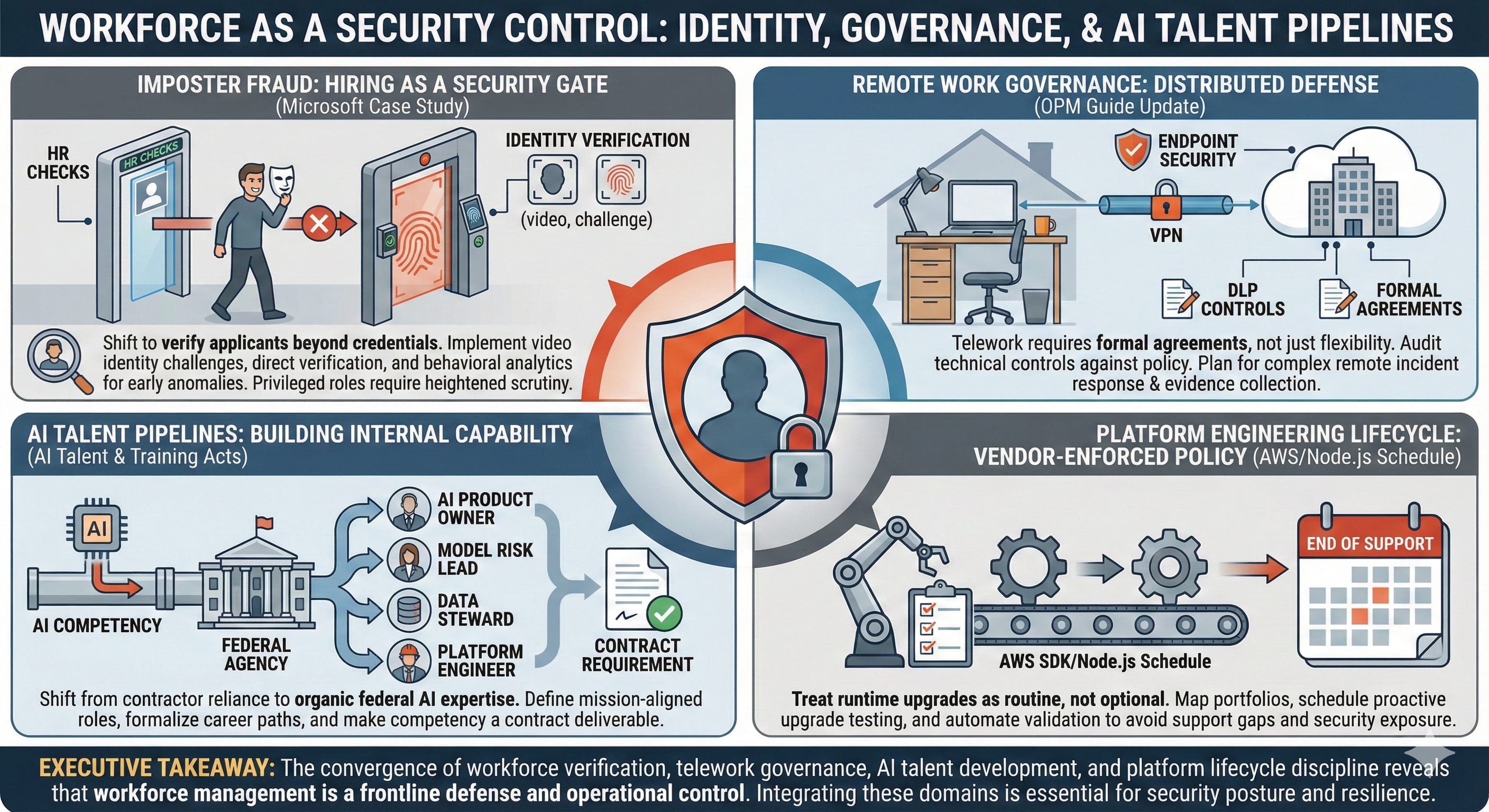
The week’s developments revealed that workforce decisions are no longer purely administrative matters but have become security and operational controls that require the same rigor applied to technical architecture and system design. Microsoft’s case study on imposter fraud, the Office of Personnel Management’s updated telework guidance, and congressional bills on AI talent teams converged to frame workforce management as a front-line defense against insider threats, a governance mechanism for distributed operations, and a capability requirement for AI execution.
Microsoft Imposter for Hire Case Study Turns Hiring into a Security Control
Microsoft Incident Response published a detailed analysis of “imposter for hire” fraud where operatives pose as legitimate remote hires, slip past human resources checks, and gain system access (Microsoft Security Blog, December 11, 2025). The case study describes how attackers use false identities, forged credentials, and manipulated background checks to secure employment with organizations operating distributed workforces. Once hired, these operatives have legitimate access to systems, data, and collaboration tools, making their activities difficult to distinguish from normal employee behavior.
The practical implication for CISOs, CIOs, and HR leaders is that hiring and onboarding are now security controls that require verification beyond standard employment screening. Organizations must implement identity verification procedures that confirm applicants are who they claim to be, not just that credentials and references appear legitimate. This includes video interviews with identity challenges, verification of educational and employment history through direct contact with institutions rather than relying solely on applicant-provided documentation, and monitoring for behavioral anomalies during onboarding that suggest the person logging into systems is not the person who interviewed.
For security operations teams, the imposter threat requires detection capabilities that can identify when legitimate credentials are being used in ways that suggest compromise or fraud. This includes behavioral analytics that establish baselines for how individual employees access systems and data, anomaly detection that flags unusual activity patterns during early employment when legitimate behavior is still being established, and response playbooks that define how to investigate and remediate when imposter activity is suspected.
The Microsoft case study also highlights that imposter fraud is not limited to low-level positions. Attackers target roles with privileged access, including IT administrators, finance staff, and executives, because these positions provide direct access to valuable systems and data. Organizations should apply heightened verification procedures for roles with elevated access and should maintain continuous monitoring for all privileged accounts regardless of how recently the account holder was hired or promoted.
For organizations operating globally or hiring remote workers across jurisdictions, the imposter threat is magnified because traditional in-person verification is not practical. Video conferencing and digital documentation can be manipulated, and attackers have demonstrated ability to maintain false identities through extended interview and onboarding processes. Organizations should consider whether certain roles should require in-person verification, whether probationary periods should include enhanced monitoring, and whether separation of duties and access controls can limit the damage that a single compromised insider can cause.
OPM Telework Guide Update Connects Distributed Work to Security Posture
The Office of Personnel Management published an updated Guide to Telework and Remote Work in the Federal Government on December 31, 2025 (OPM, December 31, 2025). The document provides operational guidance on telework governance, security controls for distributed work environments, and policy alignment across federal agencies. For federal CIOs, CISOs, and chief operating officers, this guide clarifies expectations around how agencies should manage telework programs, what security controls apply to remote workers, and how to balance workforce flexibility with operational security.
The practical sections of the guide address endpoint security, network access controls, data handling procedures, and collaboration tool governance for telework environments. Organizations should audit whether current telework policies align with OPM guidance, whether technical controls match policy expectations, and whether gaps exist between what policies require and what technical implementations actually enforce.
The guide emphasizes that telework is not simply allowing employees to work from home but requires formal agreements that define where work can be performed, what security controls apply, how sensitive data will be protected, and what expectations exist around availability and communication. For HR and operations teams, this means telework agreements must be specific and enforceable rather than generic documents that employees sign without understanding obligations.
For security teams, the OPM guide reinforces that distributed work environments require endpoint detection and response capabilities, secure collaboration platforms, data loss prevention controls, and regular security awareness training tailored to remote work scenarios. Organizations that extended telework during pandemic periods without updating security controls should use the OPM guide as a checklist for identifying gaps and prioritizing remediation.
The connection between telework governance and security posture also extends to incident response. When security incidents occur in distributed work environments, investigation and containment become more complex because affected systems may not be on corporate networks, users may not be physically accessible for interviews or device collection, and evidence may be dispersed across personal and corporate devices. Incident response plans should account for these challenges and should define procedures for remote investigation, communication with distributed users, and evidence preservation when physical access is not available.
AI Talent Act Signals Federal Commitment to Internal Capability Building
Congress introduced the AI Talent Act (H.R. 6573) to create internal AI talent teams inside federal agencies (Congress.gov, December 10, 2025). The bill signals that federal AI strategy is moving beyond contractor augmentation and policy development toward building organic agency capability to recruit, retain, and deploy AI skills. For federal CIOs and chief human capital officers, this legislation provides justification for formalizing AI roles, establishing career paths, and investing in training programs that develop internal expertise rather than depending entirely on external contractors.
The practical implication is that agencies should begin defining AI roles that align with mission needs rather than waiting for the bill to pass. Typical roles include AI product owners who translate mission requirements into AI capabilities, model risk leads who evaluate AI systems for bias and performance issues, data stewards who govern data quality and access for AI workloads, and platform engineers who operate AI infrastructure and ensure availability and security. These roles require competencies that blend technical skills, domain knowledge, and governance understanding in ways that traditional IT or data science roles may not provide.
For contractors and systems integrators, the AI Talent Act signals a shift in how federal agencies will structure AI programs. Rather than expecting contractors to own AI strategy and execution, agencies will increasingly expect contractors to work alongside internal AI teams, transfer knowledge through delivery, and support capability building rather than creating dependency. Proposals that demonstrate how contractor work will develop agency capability will be more competitive than proposals that position contractors as the sole source of AI expertise.
The workforce planning challenge extends beyond technical roles. AI governance, legal review, procurement, and communications functions all require staff who understand AI capabilities and limitations well enough to make informed decisions about risk, contracting, and stakeholder engagement. Organizations should assess whether staff in these functions have adequate AI literacy and should invest in training programs that build competency across roles rather than concentrating AI knowledge only in technical teams.
AI Training for National Security Act Reinforces Competency as Contract Requirement
The AI Training for National Security Act (H.R. 6530) focuses on establishing AI training pipelines for national security missions (Congress.gov, December 9, 2025). The bill reinforces that AI competency is becoming a contract requirement, not just a technical preference. Organizations delivering into defense and intelligence missions should expect that training requirements will appear in solicitations, that competency assessments will be part of contract performance evaluation, and that demonstrating AI capability will require more than listing credentials or past projects.
The practical response is to define role-based AI competencies that map to national security mission areas, create training paths that develop those competencies with measurable outcomes, and document how competency development connects to project quality and delivery success. Organizations that can demonstrate mature competency development programs will have advantages in competitive procurements because they can show government customers that AI capability is embedded in organizational processes rather than dependent on individual staff.
For staffing and recruitment teams, the emphasis on training pipelines suggests that organizations should prioritize hiring staff with learning capacity and mission domain knowledge over staff with narrow AI technical skills that may become obsolete. AI technologies evolve rapidly, but mission understanding and ability to learn new techniques provide more durable value. Training programs should focus on building foundational competencies in AI concepts, responsible AI practices, and mission application rather than training staff on specific tools or frameworks that may change.
Platform Engineering Lifecycle Becomes Vendor-Enforced Policy
AWS announced it will align the AWS SDK for JavaScript v3 with the Node.js release schedule for ending support, starting in the second week of January 2026 (AWS Developer Blog, December 8, 2025). This policy change eliminates flexibility that development teams had around runtime lifecycle decisions and forces organizations to treat Node.js upgrades as routine work rather than optional projects. For platform engineering teams, this is a shift from managing runtime currency as a best practice to managing it as a vendor-enforced requirement where falling behind creates support gaps and potential security exposure.
The practical move is to map application portfolios to supported Node.js long-term support versions, schedule upgrade testing as routine platform work, and build automated testing that can validate applications against new Node.js versions before they become the minimum supported runtime. Organizations that treat Node.js upgrades as emergency projects when vendor support ends will create unnecessary delivery risk and will consume engineering capacity that could be applied to feature development or technical debt reduction.
The AWS policy also signals a broader trend where cloud vendors are enforcing lifecycle discipline through support policies rather than waiting for customers to voluntarily upgrade. This reduces vendor support burden but transfers lifecycle management responsibility to customers who must now plan upgrades proactively. Organizations should review vendor support policies across their technology stack to identify where similar lifecycle enforcement may occur and should build platform management processes that can handle regular upgrade cycles without disrupting application delivery.
The convergence of imposter fraud, telework governance, AI talent legislation, training requirements, and platform lifecycle enforcement reveals that workforce and platform management are no longer separate from security and operational resilience. Organizations that treat hiring as an HR function, telework as a flexibility benefit, and runtime upgrades as technical preferences will find themselves exposed to risks and compliance gaps that executives must explain. Those that integrate workforce verification into security controls, align telework governance with operational requirements, formalize AI competencies, and enforce platform lifecycle discipline will be better positioned to operate in an environment where the boundary between people, process, and technology is increasingly blurred.
Sources:
Microsoft Security Blog, “Imposter for Hire: How Fake People Can Gain Very Real Access,” December 11, 2025, https://www.microsoft.com/en-us/security/blog/2025/12/11/imposter-for-hire-how-fake-people-can-gain-very-real-access/
OPM, “Guide to Telework and Remote Work in the Federal Government,” December 31, 2025, https://www.opm.gov/policy-data-oversight/worklife/reference-materials/guide-to-telework-and-remote-work-in-the-federal-government.pdf
Congress.gov, “H.R. 6573 - AI Talent Act,” December 10, 2025, https://www.congress.gov/bill/119th-congress/house-bill/6573
Congress.gov, “H.R. 6530 - AI Training for National Security Act,” December 9, 2025, https://www.congress.gov/bill/119th-congress/house-bill/6530
AWS Developer Blog, “AWS SDK for JavaScript Aligns With Node.js Release Schedule,” December 8, 2025, https://aws.amazon.com/blogs/developer/aws-sdk-for-javascript-aligns-with-node-js-release-schedule/
The Week Ahead
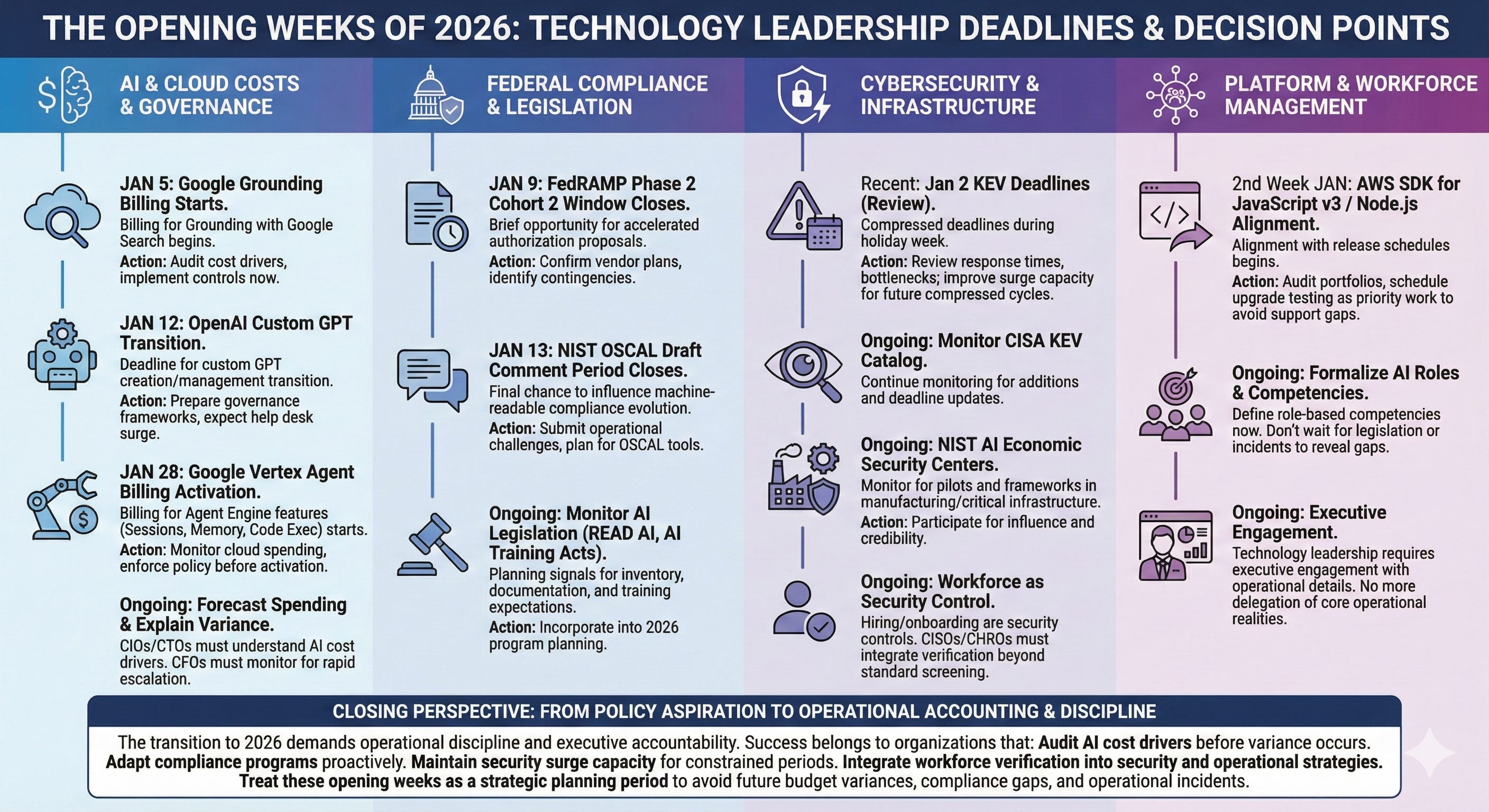
The opening week of 2026 brings several concrete deadlines and decision points that technology leaders should monitor closely. The FedRAMP 20x Phase 2 Cohort 2 proposal window closes on January 9, creating a brief opportunity for vendors to submit applications for accelerated authorization. Agencies should receive vendor communications this week clarifying which cloud services are pursuing Cohort 2 and what timelines to expect for authorization milestones. Organizations that depend on specific cloud services for delivery should confirm vendor plans and identify contingencies if preferred services do not advance through the accelerated pathway.
The NIST OSCAL draft comment period closes on January 13, providing a final opportunity for organizations to influence how machine-readable compliance frameworks will evolve. Comments that describe operational challenges, tool integration requirements, and adoption barriers will help NIST refine OSCAL in ways that make it more practical for agencies and vendors. Organizations that participate in the comment process will gain early visibility into how federal compliance programs will use OSCAL and will be better positioned to plan investments in tools and processes that support OSCAL workflows.
OpenAI’s January 12 transition date for custom GPT creation and management will create immediate operational impact for organizations that have allowed business units to build custom GPTs without centralized governance. IT and security teams should expect help desk volume and user confusion as the transition occurs. Organizations that prepared governance frameworks, migration checklists, and user communications will fare better than those treating the transition as a routine vendor update.
Google’s January 28 activation of billing for Vertex AI Agent Engine features including Sessions, Memory Bank, and Code Execution will trigger budget variance for organizations that have deployed agentic workflows without implementing cost controls. Finance teams should monitor cloud spending closely in the last week of January and first week of February to identify unexpected increases and should be prepared to implement usage caps and alerts if spending exceeds forecasts. Technology teams should prioritize cost instrumentation and policy enforcement before the billing activation date rather than responding reactively to variance reports.
AWS’s alignment of the AWS SDK for JavaScript v3 with Node.js release schedules starting in the second week of January will create immediate planning work for platform engineering teams. Organizations should audit application portfolios to identify which applications depend on Node.js versions that will lose vendor support and should schedule upgrade testing as priority work. Delaying this work will create support gaps that manifest as incidents or failed deployments when Node.js versions fall out of support.
Cybersecurity teams should continue monitoring the CISA Known Exploited Vulnerabilities catalog for additions and deadline updates. The convergence of multiple vulnerabilities with January 2 deadlines during a holiday week demonstrates that KEV deadlines do not align with organizational capacity or operational convenience. Security operations teams should review response times for recent KEV additions, identify bottlenecks that delayed patching or validation, and adjust processes to improve surge capacity for future compressed deadlines.
Federal agencies should monitor congressional activity around AI legislation, particularly the READ AI Models Act and AI Training for National Security Act, to understand how AI governance and workforce expectations may evolve. While neither bill has passed, they provide planning signals about inventory requirements, documentation standards, and training expectations that agencies and contractors should incorporate into 2026 program planning.
Organizations operating in manufacturing and critical infrastructure sectors should monitor NIST’s AI Economic Security Centers for pilot opportunities, framework releases, and collaboration events. Participating in early-stage development of AI evaluation methods and security frameworks provides influence over how standards evolve and offers credibility when customers and regulators ask about AI governance maturity.
The convergence of vendor product updates, federal compliance deadlines, legislative signals, and cost activation dates creates an environment where waiting for perfect information is itself a decision with consequences. Organizations that use the first weeks of 2026 to audit cost drivers, align compliance roadmaps, formalize workforce plans, and verify platform lifecycle management will be better positioned than those deferring action until problems manifest as budget variances, compliance gaps, or operational incidents.
Closing Perspective
The transition from 2025 to 2026 marked a shift from AI policy aspiration to AI operational accounting. The week’s developments revealed that organizations can no longer defer decisions about how AI will be governed, what it will cost, who will operate it, and what compliance obligations it creates. Google’s billing activation for Grounding with Google Search on January 5, OpenAI’s January 12 custom GPT transition, FedRAMP’s compressed proposal windows and iterative baselines, CISA’s holiday-week KEV deadlines, and congressional signals about AI workforce requirements converged to create an environment where executive attention is required, not just technology team implementation.
The organizations that will succeed in 2026 are not those with the most ambitious AI roadmaps or the largest cloud budgets. They are the ones that recognize AI governance is now about cost control, that compliance infrastructure is in continuous evolution, that cybersecurity operates under compressed timelines regardless of organizational capacity, and that workforce management has become a security and operational control requiring the same rigor applied to technical architecture. These organizations audit cost drivers before budget variance occurs, adapt compliance programs to baseline changes without waiting for audit findings, maintain surge capacity for security response during constrained periods, and integrate workforce verification and development into security and operational resilience strategies.
The week’s developments make clear that technology leadership in 2026 requires executive engagement with operational details that were previously delegated to specialists. CIOs and CTOs must understand AI cost drivers well enough to forecast spending and explain variance. CISOs must integrate workforce verification into security controls and maintain response capacity during holidays and other constrained periods. CFOs must recognize that AI costs can escalate through usage patterns without additional headcount or infrastructure. CHROs must understand that hiring and onboarding are security controls requiring verification beyond standard employment screening.
The path forward requires organizations to treat the first weeks of 2026 as a strategic planning period rather than a gradual return to normal operations. Audit AI workloads for cost drivers and implement controls now that grounding billing is active. Review custom GPT governance and prepare for January 12 transitions. Map compliance programs to the latest FedRAMP baselines and OSCAL frameworks. Assess whether cybersecurity response capacity can handle compressed deadlines during staffing constraints. Formalize AI roles and competencies rather than waiting for legislation to pass or for incidents to reveal gaps.
The promise of AI, cloud efficiency, streamlined compliance, and distributed work remains intact. But delivering on that promise requires organizations to face operational realities that cannot be abstracted away through policy documents or delegated to technology teams. The week’s convergence of billing transparency, compliance evolution, deadline compression, and workforce integration signals that technology strategy in 2026 requires operational discipline, executive accountability, and realistic assessment of constraints. Organizations that recognize these requirements will be the ones still delivering when the gap between aspiration and reality becomes too wide for others to navigate.
This update was assembled using a mix of human editorial judgment, public records, and reputable national and sector-specific news sources, with help from artificial intelligence tools to summarize and organize information. All information is drawn from publicly available sources listed above. Every effort is made to keep details accurate as of publication time, but readers should always confirm time-sensitive items such as policy changes, budget figures, and timelines with official documents and briefings.
All original content, formatting, and presentation are copyright 2025 Metora Solutions LLC, all rights reserved. For more information about our work and other projects, drop us a note at info@metorasolutions.com