If you’re finding The Exchange Daily useful for keeping up with AI, cyber, and federal IT, this is the time to go a little deeper with us. The Exchange Weekly is our Monday long-form breakdown that takes one big story and turns it into concrete questions, checklists, and next steps for leaders. It’s free through the end of December, while the Daily will stay free as your weekday briefing. Subscribe now so you get both the fast headline scan and the deeper context in your inbox.
Executive Summary
This past week marked a critical inflection point, where the promise of transformative AI collided with the physical, political, and security realities that will determine whether America can deliver on it. Federal and state governments are locked in an escalating fight over who sets AI rules, with dozens of lawmakers and attorneys general pushing back against efforts to preempt state authority through the National Defense Authorization Act. At the same time, agencies are racing toward a December 29 deadline to finalize detailed AI acquisition and use policies, creating a compressed window where procurement expectations will crystallize across the entire federal enterprise.
The infrastructure picture grew even more complex. AI data centers sparked organized local opposition in rural Pennsylvania as residents protested the tradeoff between promised economic benefits and real impacts on farmland, water, and power costs. BlackRock warned that physical constraints on land, permitting, and electricity in the United States and Europe are becoming hard limits on how fast AI capacity can grow. At the same time, Morgan Stanley quietly began exploring ways to reduce its exposure to data center loans. Major announcements from Palantir, AWS, and HPE introduced new infrastructure models designed to navigate these constraints. Still, the underlying message is clear: even with capital and technology, delivery timelines remain uncertain.
Federal IT modernization faced its own reckoning this week. The Technology Modernization Fund will lose its authority to make new investments on December 12 without congressional action, freezing more than $150 million in available funding. The House passed the SBA IT Modernization Reporting Act in response to repeated platform failures that affected thousands of small businesses seeking federal certifications, signaling that high-stakes modernization projects now invite statutory reporting mandates when they fail in production. HHS rolled out Anthropic’s Claude department-wide, moving AI from pilot to enterprise operations, while Medicare prepared a controversial pilot using AI for prior authorization reviews.
The cybersecurity picture deteriorated across multiple fronts. CISA added vulnerabilities in industrial control systems ranging from smart meters to nuclear medicine software to its Known Exploited Vulnerabilities catalog, underscoring that operational technology is now a primary attack surface. Chinese state-linked actors began actively exploiting the maximum-severity React2Shell vulnerability within 48 hours of disclosure, demonstrating how quickly adversaries weaponize new flaws. Microsoft’s Defender portal suffered an outage that blocked access to threat hunting alerts, attackers used fake Calendly invitations to hijack Google and Facebook ad manager accounts, and SpyCloud reported a 400 percent year-over-year surge in successful phishing attacks targeting corporate identities.
Two acquisitions signaled where the market sees future control points. ServiceNow’s reported $1 billion deal to acquire Veza treats identity governance as the essential control plane for AI-native operations. At the same time, CISA, NSA, and Canadian cybersecurity authorities issued a joint advisory on Brickstorm malware targeting VMware vSphere and Windows systems, underscoring that nation-state adversaries are moving up the stack to compromise virtualization and management layers. Congress introduced the SAFE CHIPS Act to lock in export controls on advanced AI chips to China and the No Robot Bosses Act to add worker protections against AI-driven hiring and management systems, framing geopolitical and labor concerns as legislative priorities rather than regulatory afterthoughts.
Taken together, this week revealed an emerging pattern: AI is moving from aspiration to execution, and every layer of that execution (policy, infrastructure, operations, security) is hitting constraints faster than anticipated. The organizations that recognize these limits and build realistic roadmaps around them will fare better than those betting on frictionless scale.
AI Governance at the Crossroads – Federal Authority, State Resistance, and the December 29 Reckoning
This week laid bare the central tension that will define AI policy for the next several years: whether the United States will operate under a unified federal framework or a patchwork of state-level rules. The fight is playing out in real time, with high stakes and compressed timelines that leave little room for executives to wait and see.
The Federal Preemption Push and State Pushback
House leaders confirmed they are exploring whether to insert language into the National Defense Authorization Act that would block or sharply limit state AI laws. The proposal comes as 38 states have already enacted more than 100 AI-related laws this year, covering deepfakes, transparency requirements, and government use of AI (TechCrunch, November 28, 2025). The push for federal preemption gained momentum after a $10 million lobbying campaign launched by Leading the Future, a political action committee that argued that a patchwork of state regulations would slow innovation and weaken America’s position against China (TechCrunch, November 28, 2025).
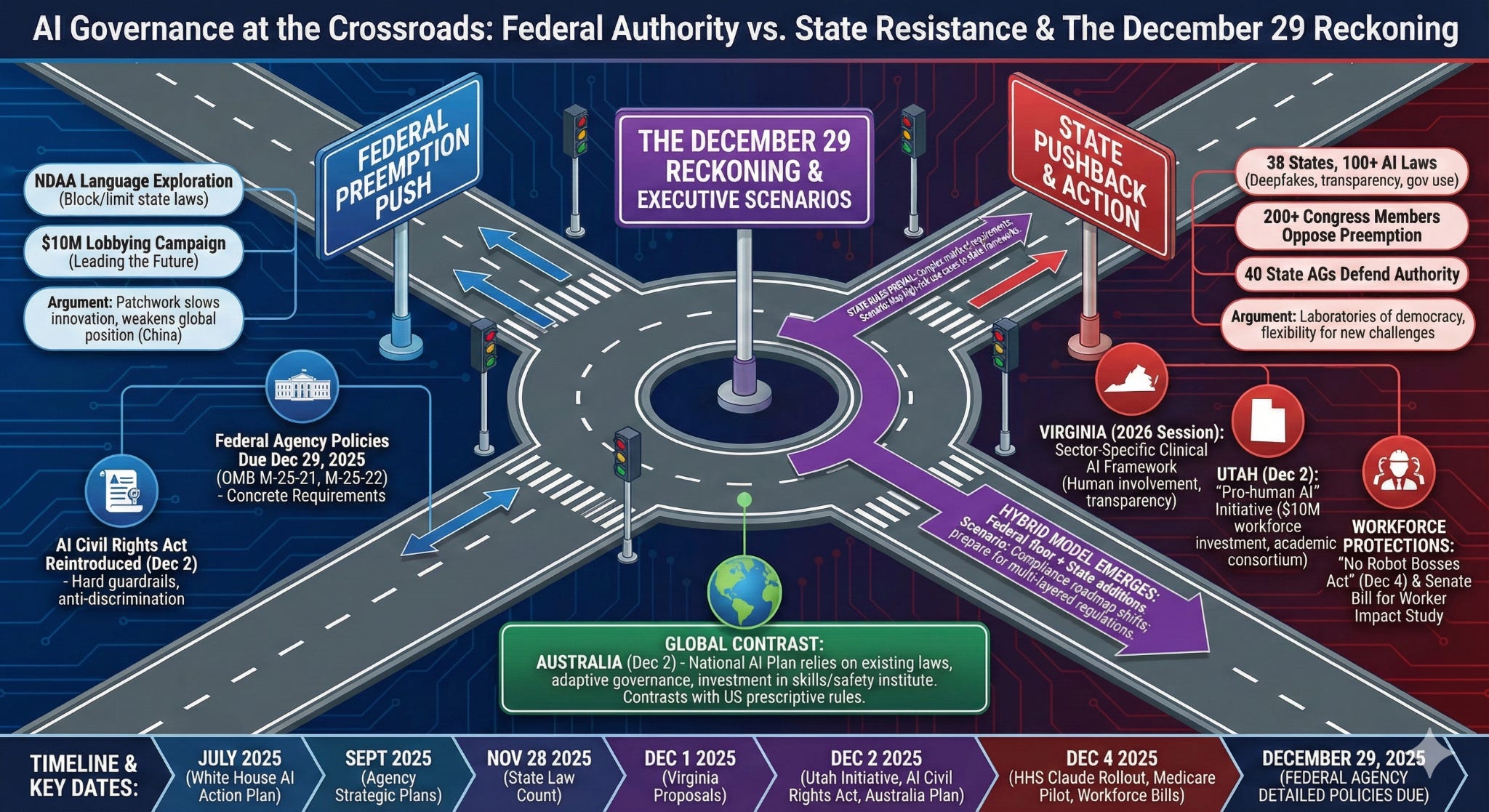
The opposition is organized and vocal. More than 200 members of Congress signed an open letter opposing preemption in the NDAA, arguing that states serve as laboratories of democracy and must retain flexibility to confront new digital challenges as they arise (USA - CSMonitor.com https://www.csmonitor.com/2004/0429/p20s03-nbgn.html). Nearly 40 state attorneys general sent their own letter defending state authority to protect residents (TechCrunch, November 28, 2025). For technology and risk leaders, this is not an abstract constitutional debate. Your AI compliance roadmap could shift overnight from navigating a complex matrix of state requirements to operating under a more centralized federal regime, or it could get stuck in political and legal limbo if the NDAA provisions trigger a broader fight that delays any resolution.
The practical implication is that any AI system touching high-risk decisions (housing, credit, employment, education, public benefits) should be mapped to both current state rules and potential federal standards. Executives need scenario plans for at least three outcomes: state rules remain in effect, federal preemption overrides them, or a hybrid model emerges in which federal law sets a floor, and states can add requirements on top. Now is the time to identify which high-risk use cases depend on state-level frameworks and which assumptions would break if those frameworks were frozen or invalidated.
Sector-Specific State Frameworks Are Emerging Anyway
Even as the federal preemption debate rages, States are not waiting. Virginia’s Joint Commission on Technology and Science endorsed a package of recommendations for bills in the 2026 legislative session that would establish one of the first sector-specific AI frameworks for clinical use. The proposals would require hospitals and health systems to develop internal standards for clinical AI tools, maintain human involvement in care decisions, and increase transparency about how patient data is used (Exchange Daily, December 1, 2025).
This is significant because it moves beyond generic AI principles to operational requirements that map directly to how health systems deploy and govern AI. For healthcare executives, Virginia’s framework offers a preview of what is coming elsewhere. Even if you never operate in Virginia, the structure provides a valuable template. Make sure every clinical AI tool has a named owner, a documented validation process, clear patient disclosure language, and a defined playbook for when a human must override the model. These are not aspirational best practices. They are rapidly becoming the baseline expectation for any organization that uses AI in clinical workflows.
Utah took a different approach, launching a “pro-human AI” initiative that blends moonshot innovation with workforce policy. Governor Spencer Cox announced a $10 million investment to build an AI-ready workforce across key sectors and established an academic consortium focused on human-centered AI (Deseret News, December 2, 2025). The initiative signals that states see themselves as active players in shaping how AI integrates with labor markets and education systems, not passive observers waiting for federal direction. If federal preemption remains unresolved, state-level initiatives like Utah’s will fill the vacuum, creating the very fragmentation that preemption advocates warn against.
Australia’s announcement of a National AI Plan this week offered a sharp contrast to the U.S. approach. Australia decided to rely on existing legal frameworks rather than enact AI-specific laws, choosing instead to invest strategically in advanced data centers, skills programs, and an AI Safety Institute, set to launch in 2026 (Reuters, December 2, 2025). For global CIOs and chief risk officers, this divergence matters. Where you place AI workloads, where you recruit AI talent, and how you structure compliance operations will increasingly depend on whether jurisdictions favor prescriptive rules or adaptive governance. The global landscape is fracturing faster than most multinational compliance teams anticipated.
The AI Civil Rights Act Returns with Hard Guardrails
Representative Pramila Jayapal, Senator Ed Markey, and colleagues reintroduced the AI Civil Rights Act on December 2, with explicit bans on discriminatory AI in high-stakes decisions affecting housing, credit, employment, education, and public services (House Press Release, December 2, 2025). The bill would require organizations to conduct impact assessments, test for bias, monitor algorithmic performance over time, and provide transparency about how decisions are made. While the legislation faces a long road to passage, it represents an early blueprint for what U.S. AI compliance expectations may look like if Congress moves forward with civil rights-focused regulation.
For technology leaders, the Civil Rights Act framework is a valuable planning tool regardless of whether this specific bill becomes law. The requirements for impact assessments, ongoing monitoring, and human review align with emerging best practices and are increasingly reflected in state laws, procurement contracts, and enforcement actions. Organizations that treat these as optional or aspirational will find themselves retrofitting systems under pressure when regulations tighten or when incidents trigger investigations. Building these capabilities now (clear data lineage, bias testing at each model update, documented override processes, audit trails that can reconstruct decisions) provides both compliance readiness and operational resilience.
Federal Agencies Face a December 29 Deadline That Will Crystallize Expectations
While Congress debates preemption and new legislation, federal agencies are moving forward under existing authorities. The Office of Management and Budget issued Memorandum M-25-21 in February 2025, directing agencies to accelerate AI adoption through innovation, governance, and public trust, and M-25-22 on efficient AI acquisition (News | The Regulatory Group http://www.regulationwriters.com/news/31). Agencies were required to publish strategic AI plans by September 2025 and now face a December 29, 2025, deadline to issue detailed policies on AI use and procurement (Ogletree, December 5, 2025).
These policies will clarify how agencies expect contractors to identify and document AI used in performance, particularly where federal contract information and controlled unclassified information are processed. They will also define how agencies review planned acquisitions of AI systems, convene cross-functional teams to coordinate decisions, and ensure appropriate contract terms for intellectual property rights (Ogletree, December 5, 2025). For federal contractors and systems integrators, December 29 is not a symbolic deadline. It is the date when vague guidance becomes concrete requirements with enforcement risk.
Agencies, including the Department of Homeland Security, Department of Energy, Department of State, Department of Veterans Affairs, Consumer Financial Protection Bureau, General Services Administration, National Archives and Records Administration, and the Federal Reserve Board, have already published AI strategies (Ogletree, December 5, 2025). These plans converge on several themes: scalable AI infrastructure, quality data, an AI-ready workforce, proportional risk governance, and standardized secure development and testing. The December 29 policies will translate these themes into operational mandates around AI inventories, data governance, human oversight, rigorous testing, and alignment with agency-specific expectations.
The White House AI Action Plan released in July 2025 laid out more than 90 federal policy actions across three pillars: accelerating innovation, building American AI infrastructure, and leading in international AI diplomacy and security (White House, July 23, 2025). The plan emphasized removing onerous regulations that hinder AI development, factoring state-level AI regulatory climates into federal funding decisions, and establishing procurement standards that emphasize truth-seeking and ideological neutrality in large language models (Holland & Knight, July 2025). An executive order issued concurrently directed the Office of Management and Budget to issue guidance within 120 days on “Unbiased AI Principles” for federal procurement, requiring that large language models be truthful and neutral, avoiding manipulation in favor of ideological agendas (White House Executive Order, July 23, 2025).
For contractors and grant recipients, the message is clear: early adopters of AI inventories, strong data governance policies, consistent human oversight, rigorous testing, and alignment with partner agency expectations will be best positioned to avoid costly retrofitting when policies finalize at the end of this month. Success will not be measured solely by direct savings from technology, but by broader efficiencies such as improvements in operational effectiveness, reductions in administrative burdens, and enhanced service delivery to users.
HHS Claude Rollout and Medicare’s AI Prior Auth Pilot Show Execution Challenges
The Department of Health and Human Services this week rolled out Anthropic’s Claude as a departmentwide tool, building on earlier deployments of ChatGPT through government OneGov contracts (FedScoop, December 4, 2025). Staff across operating divisions will use Claude to draft documents, summarize regulatory text, and support day-to-day analytical tasks within guardrails defined by HHS’s internal AI policies and broader federal guidance. This is a live case study of what scaled AI adoption looks like inside a cabinet agency. It pairs a written AI strategy with a small set of enterprise platforms and shared services rather than a sprawl of pilots, and it signals the level of governance needed around access controls, logging, and data residency when generative AI becomes a standard productivity tool for tens of thousands of knowledge workers.
At the same time, Medicare is preparing a pilot that will let private contractors use AI to review specific prior authorization requests under a new model aimed at cutting wasteful and inappropriate services across six states. Physician groups and some lawmakers are raising alarms that financial incentives tied to denials, combined with opaque AI models, could worsen delays and reduce access to medically necessary care for older adults (Stateline, December 4, 2025). For CIOs and chief data officers in healthcare and public programs, this pilot is an early test of algorithmic decision-making at the heart of a federal entitlement. It underscores that explainability, appeals processes, and data quality are not abstract governance topics but fundamental determinants of patient experience and political risk. Any AI used in coverage, utilization management, or payment will face intense scrutiny from clinicians, advocacy groups, and Congress if it is perceived as a deny-by-default mechanism.
Workforce Protections Move from Policy to Legislation
Senate Democrats introduced a bill directing the Departments of Labor, Commerce, and Education to study AI’s impact on workers and fund programs that help people transition into new roles created or reshaped by automation (FedScoop, December 4, 2025). Rather than trying to stop AI, the proposal leans into agency-led planning, data collection, and grants to support both reskilling and worker protections as AI tools spread across sectors. For corporate and public sector leaders, this signals that AI workforce impact is moving from slide decks to policy. Executives should expect more challenging transparency requirements when roles change, greater scrutiny of automation decisions that affect frontline workers, and more opportunities to align internal upskilling initiatives with federal grant programs.
The No Robot Bosses Act was reintroduced on December 4 to add protections for workers and job applicants from AI-based hiring and management tools (House Press Release, December 4, 2025). The bill focuses on transparency, fairness, and accountability in automated decision systems used in the workplace. This is an early signal of where U.S. workplace AI regulation may head, affecting monitoring, scheduling, performance management, and HR analytics tools. Having a documented workforce transition and change management plan for AI is increasingly a governance requirement, not a nice-to-have.
The convergence of federal policy deadlines, state legislative activity, civil rights frameworks, and workforce protections creates a governance environment where waiting for clarity is itself a risk. Organizations need to move forward with AI deployments, but they must do so with governance structures that can adapt quickly when rules crystallize.
Sources:
TechCrunch, “The race to regulate AI has sparked a federal vs. state showdown,” November 28, 2025, https://techcrunch.com/2025/11/28/the-race-to-regulate-ai-has-sparked-a-federal-vs-state-showdown/
White House, “White House Unveils America’s AI Action Plan,” July 23, 2025, https://www.whitehouse.gov/articles/2025/07/white-house-unveils-americas-ai-action-plan/
Ogletree, “Federal Agencies Roll Out AI Strategy Plans: Takeaways for Government Contractors,” December 5, 2025, https://ogletree.com/insights-resources/blog-posts/federal-agencies-roll-out-ai-strategy-plans-takeaways-for-government-contractors/
Holland & Knight, “America’s AI Action Plan: What’s In, What’s Out, What’s Next,” July 2025, https://www.hklaw.com/en/insights/publications/2025/07/americas-ai-action-plan-whats-in-whats-out-whats-next
White House Executive Order, “Preventing Woke AI in the Federal Government,” July 23, 2025, https://www.whitehouse.gov/presidential-actions/2025/07/preventing-woke-ai-in-the-federal-government/
House Press Release, Representative Pramila Jayapal, “Jayapal, Markey, Clarke, Lee Reintroduce AI Civil Rights Act,” December 2, 2025, https://jayapal.house.gov/2025/12/02/jayapal-markey-clarke-lee-reintroduce-ai-civil-rights-act-to-eliminate-ai-discrimination-and-enact-guardrails-on-use-of-algorithms-in-decisions-impacting-peoples-rights-civil-li/
Reuters, “Australia rolls out AI roadmap, steps back from tougher rules,” December 2, 2025, https://www.reuters.com/world/asia-pacific/australia-rolls-out-ai-roadmap-steps-back-tougher-rules-2025-12-02/
Deseret News, “Gov. Cox announces Utah ‘pro-human AI’ initiative,” December 2, 2025, https://www.deseret.com/business/2025/12/02/gov-cox-announces-utah-pro-human-ai-initiative/
FedScoop, “HHS rolls out Claude, Anthropic AI tool,” December 4, 2025, https://fedscoop.com/hhs-rolls-out-claude-anthropic-ai-tool/
Stateline, “Medicare’s new AI experiment sparks alarm among doctors, lawmakers,” December 4, 2025, https://stateline.org/2025/12/04/medicares-new-ai-experiment-sparks-alarm-among-doctors-lawmakers/
FedScoop, “AI workforce bill Senate Democrats labor commerce education,” December 4, 2025, https://fedscoop.com/ai-workforce-bill-senate-democrats-labor-commerce-education/
House Press Release, Representative Chris Deluzio, “Deluzio, Bonamici, Moylan restart push to protect workers from AI and robot bosses,” December 4, 2025, https://deluzio.house.gov/media/press-releases/deluzio-bonamici-moylan-restart-push-protect-workers-ai-and-robot-bosses
Physical Reality Hits AI Infrastructure Dreams – Local Opposition, Power Constraints, and Financial Risk
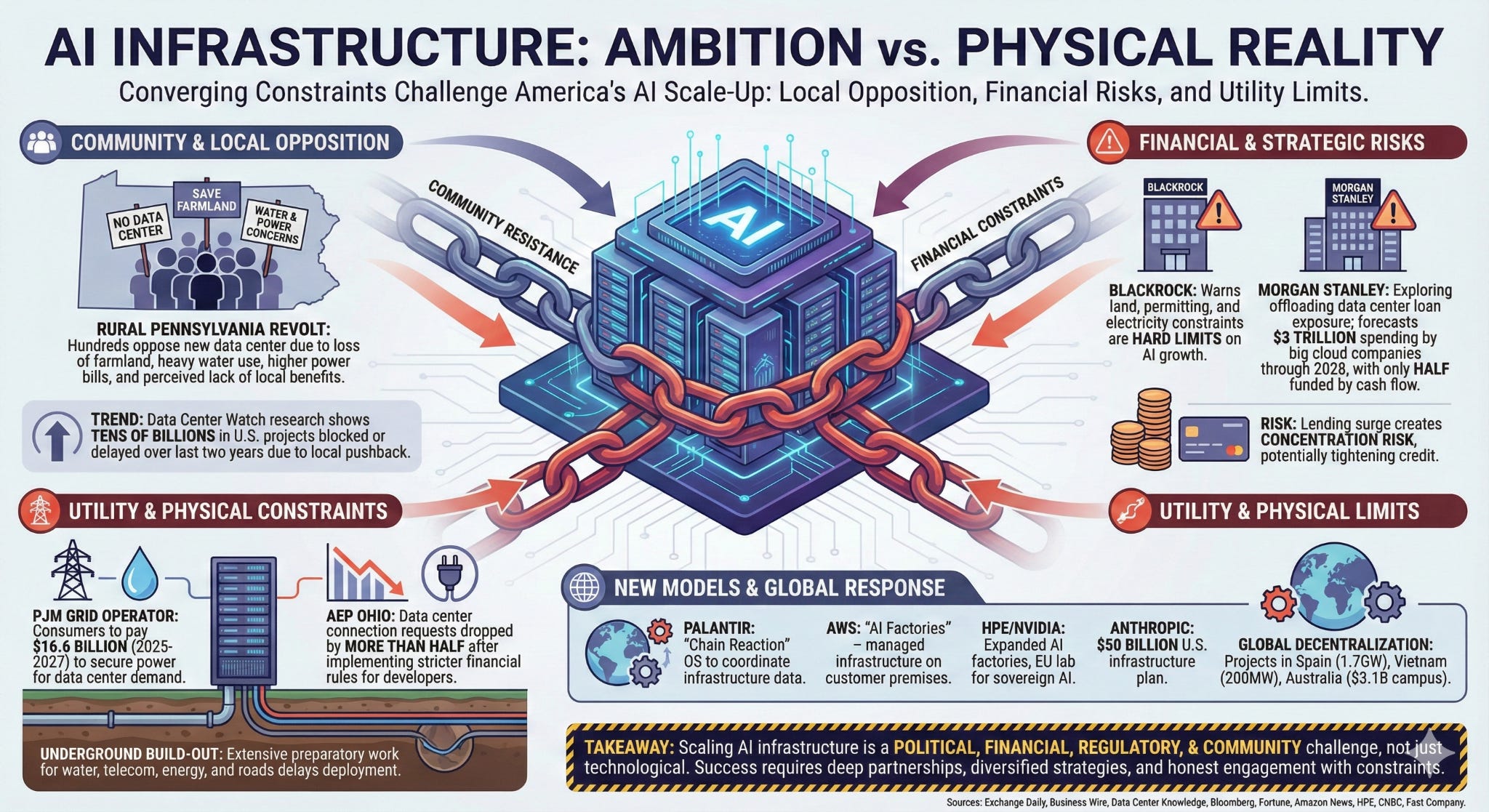
The gap between AI ambition and infrastructure reality widened this week, as community resistance, physical constraints, and financial risk converged to challenge assumptions about how quickly America can scale AI capacity. The stories from Pennsylvania to Wall Street reveal that even with capital and technology, delivery remains uncertain.
Rural Pennsylvania Revolt Against AI Data Centers
In rural Pennsylvania, hundreds of residents packed public meetings to oppose a massive new data center complex and rezoning request (Exchange Daily, December 1, 2025). Their concerns reflect a pattern emerging across the country: loss of farmland, heavy water consumption, higher power bills, and the perception that the benefits of AI infrastructure flow elsewhere while local communities absorb the impact. Notably, many of these residents are strong supporters of the current administration, demonstrating that data center opposition is not a partisan issue but a local quality-of-life concern that transcends politics.
Research from Data Center Watch shows that tens of billions of dollars in U.S. data center projects have been blocked or delayed over the last two years, in part due to local opposition (Exchange Daily, December 1, 2025). For CIOs and CTOs, the message is direct: do not treat hyperscaler roadmaps as guaranteed. When planning new AI workloads, build scenarios that account for data center capacity, power availability, or local permits slipping by years. Diversify across regions wherever possible, and engage with community concerns early rather than assuming projects will move forward on announced timelines.
The Pennsylvania story highlights a broader strategic risk. Organizations betting on specific data center locations or availability dates may find themselves unable to deploy models or scale operations when local governments deny permits or utilities fail to deliver promised power. This is not a hypothetical scenario. It is happening now, and it affects both hyperscaler buildouts and enterprise colocation strategies.
BlackRock and Morgan Stanley Signal Financial Constraints
BlackRock’s latest investment outlook and new data center analysis warned that land, permitting, and electricity constraints in the United States and Europe are emerging as hard limits on how fast AI capacity can grow (Business Wire, December 4, 2025). At the same time, Morgan Stanley is exploring ways to offload some of its data center exposure through a significant risk transfer tied to a portfolio of loans to businesses involved in AI infrastructure (Bloomberg, December 3, 2025). Morgan Stanley strategists forecast that big cloud computing companies will spend about $3 trillion on data center infrastructure projects through 2028, with cash flow funding only about half of that, and the rest raised via debt markets (Fortune, December 4, 2025).
The fact that one of the key players in financing the AI race is considering reducing its exposure should get executive attention. Banks and other lenders involved in financing data center construction loans are likely a key driver of the recent spike in the cost of protecting Oracle’s debt against default (Fortune, December 4, 2025). The lending surge may leave banks overexposed to a small group of companies, creating concentration risk that could tighten credit availability if projects fail to deliver expected returns.
For executive teams planning big AI workloads, the message is that physical infrastructure is becoming as strategic as cloud contracts. Even with budget approval, projects may run into power caps, grid constraints, or local opposition, slowing deployment. That puts a premium on deeper partnerships with utilities, diversified hosting strategies that mix hyperscalers and colocation, and honest conversations with boards about the time, capital, and tradeoffs involved in building or leasing AI-ready capacity.
To effectively communicate these infrastructure risks and tradeoffs to the board, frame them as essential considerations for sustainable growth and competitive advantage. Highlight the importance of forward-thinking investment in diversified infrastructure to mitigate the risks of project delays and cost overruns. Discuss concrete scenarios where grid constraints or local opposition could impact operational plans and propose solutions that involve strategic partnerships and infrastructural innovation. Encourage the board to consider these factors as long-term strategic priorities, ensuring that AI infrastructure investments align with the organization’s broader mission and risk tolerance.
Utility constraints are real and growing. A recent analysis showed that consumers served by PJM, the largest U.S. grid operator, will pay $16.6 billion just to secure power supplies to meet data center demand from 2025 through 2027 (CNBC, December 3, 2025). If demand forecasts are wrong, consumers could end up paying for expensive infrastructure for data centers that are not built or require less power than projected. One utility, AEP Ohio, saw data center connection requests drop by more than half after implementing stricter rules requiring developers to pay for 85 percent of the energy they claim to need and imposing exit fees for canceled projects (CNBC, December 3, 2025). When faced with financial commitments, the most speculative projects did not submit load study requests.
New Infrastructure Models Attempt to Navigate Constraints
Against this backdrop, several major players announced new models designed to address infrastructure bottlenecks. Palantir unveiled Chain Reaction, an operating system for American AI infrastructure built with partners including CenterPoint Energy and Nvidia to coordinate power, grid, and construction data for new AI data centers (Business Wire, December 4, 2025). The platform is designed to accelerate deployment by creating better visibility across stakeholders, but it also implicitly acknowledges that infrastructure coordination is now a fundamental constraint on AI scale.
AWS announced AI Factories, a new offering that brings managed AI infrastructure directly into customer data centers (Amazon News, December 2, 2025). The service provides dedicated AI infrastructure operated by AWS inside customer premises, supporting high-performance AI workloads while keeping data in customer-controlled environments. For CIOs and chief architects, this model addresses data sovereignty, latency, and regulatory concerns. Still, it also shifts operational responsibility and raises questions about vendor lock-in and long-term flexibility. The announcement signals that hyperscalers recognize customers need more control and are willing to offer hybrid architectures rather than insisting on pure cloud deployment.
HPE and Nvidia expanded their AI factory offerings this week, introducing new solutions for secure and scalable AI factories, new AI data center interconnect to optimize workload performance across clusters, and the first AI factory lab in the European Union for customers to test and validate sovereign AI factories (HPE, December 1, 2025). The lab in Grenoble, France, allows customers to validate performance on infrastructure located and running in the EU, addressing data sovereignty and regulatory compliance needs. HPE also partnered with Carbon3.ai to launch a Private AI Lab in Manchester, UK, designed to accelerate UK enterprise AI adoption. These moves reflect the reality that geographically distributed, sovereign AI infrastructure is becoming a requirement, not an option, for global enterprises operating under different regulatory regimes.
Anthropic announced plans to spend $50 billion on U.S. AI infrastructure, starting with custom data centers in Texas and New York developed in partnership with GPU cloud provider Fluidstack (CNBC, November 12, 2025). The facilities will create 800 permanent jobs and more than 2,000 construction roles, with the first sites going live in 2026. The move positions Anthropic as a major domestic player in physical AI infrastructure and reflects policymakers’ focus on U.S.-based compute capacity and technological sovereignty. However, Anthropic’s earlier suggestion of federal guarantees for AI infrastructure investment, which the company later walked back, underscores the political and financial uncertainty surrounding how and by whom America’s AI infrastructure will be funded.
Data Center Boom Drives Underground Infrastructure Build-Out
An often-overlooked aspect of the data center boom is the extensive preparatory work required to build the infrastructure that those facilities rely on. Before AI data centers can operate, there must be massive construction of underground systems for water, telecommunications, energy, and road access (Fast Company, December 5, 2025). Companies like CRH, a $81 billion market-cap building materials company, are seeing thriving business providing raw materials for this infrastructure. The focus tends to be on the data center facility itself, but what gets less attention is the infrastructure around and below it, including water systems, telecom conduits, energy distribution, and road systems for access (Fast Company, December 5, 2025).
This underground build-out has its own timeline, cost, and resource requirements that can delay or constrain data center deployment even when the building itself is ready. For infrastructure planners, this reinforces the need to engage early with local governments, utilities, and construction firms to understand not just the headline data center timeline but the full lifecycle of enabling infrastructure that must be in place first.
Global Announcements Reflect Decentralized Growth
Data center activity this week was not limited to the United States. In Spain, ACS and BlackRock agreed to collaborate on a new data center project to develop 1.7 GW of capacity, with BlackRock committing about half of the €2 billion upfront (Data Center Knowledge, December 3, 2025). In Vietnam, Kinh Bac City Development Holding Corporation signed a memorandum of agreement to develop a 200 MW AI data center project in Ho Chi Minh City. In Australia, New South Wales approved a $3.1 billion data center campus to be constructed by CDC Data Centers in Marsden Park, which will be the southern hemisphere’s largest data center project (Data Center Knowledge, December 3, 2025). (”Marine Electronics.” Sea Technology, vol. 58, no. 5, 2017, p. 53.)
The decentralization of AI infrastructure development presents both opportunities and challenges. It expands the global footprint available for AI workloads, but it also creates fragmentation in regulatory compliance, data sovereignty requirements, and operational standards. For international enterprises, this implies that the infrastructure strategy must align with the regulatory strategy. Where you locate AI workloads is increasingly a question of which legal and regulatory framework you can navigate most effectively, not just where compute is cheapest or fastest to provision.
The week’s developments converge on a single point: scaling AI infrastructure is not primarily a technology problem. It is a political, financial, regulatory, and community problem that requires engagement far beyond technology teams. Organizations that treat data center capacity as a commodity that can be purchased on demand will be disappointed. Those that build partnerships with utilities, local governments, and financial institutions and maintain flexibility in their deployment strategies will fare better in an environment where constraints are the norm, not the exception.
Sources:
Exchange Daily, “AI data centers face local opposition in Pennsylvania,” December 1, 2025
Business Wire, “Palantir Launches Chain Reaction to Build American AI Infrastructure,” December 4, 2025, https://www.businesswire.com/news/home/20251204391468/en/Palantir-Launches-Chain-Reaction-to-Build-American-AI-Infrastructure-Founding-Partners-Include-CenterPoint-Energy-and-NVIDIA
Data Center Knowledge, “Physical constraints threaten US and European AI ambitions, BlackRock says,” December 2025, https://www.datacenterknowledge.com/investing/physical-constraints-threaten-us-and-european-ai-ambitions-blackrock-says
Bloomberg, “Morgan Stanley Considers Offloading Some of Its Data-Center Exposure,” December 3, 2025, https://www.bloomberg.com/news/articles/2025-12-03/morgan-stanley-sounds-out-investors-for-srt-tied-to-data-centers
Fortune, “Morgan Stanley considers offloading some of its data-center exposure,” December 4, 2025, https://fortune.com/2025/12/04/morgan-stanley-significant-risk-transfer-loans-data-center-ai-infrastructure-exposure/
Amazon News, “AWS Data Centers AI Factories,” December 2, 2025, https://www.aboutamazon.com/news/aws/aws-data-centers-ai-factories
HPE, “HPE and NVIDIA simplify AI-ready data centers with secure next-gen AI factories,” December 1, 2025, https://www.hpe.com/us/en/newsroom/press-release/2025/12/hpe-and-nvidia-simplify-ai-ready-data-centers-with-secure-next-gen-ai-factories.html
CNBC, “Anthropic to spend $50 billion on U.S. AI infrastructure,” November 12, 2025, https://www.cnbc.com/2025/11/12/anthropic-ai-data-centers-texas-new-york.html
CNBC, “How families could get stuck with higher electric bills if the AI data center boom goes bust,” December 3, 2025, https://www.cnbc.com/2025/12/03/families-could-get-see-higher-electric-bills-if-ai-data-boom-goes-bust.html
Fast Company, “The AI data center building boom is also an infrastructure boom,” December 5, 2025, https://www.fastcompany.com/91450218/ai-data-center-boom-unexpected-winner
Data Center Knowledge, “New Data Center Developments: December 2025,” December 3, 2025, https://www.datacenterknowledge.com/data-center-construction/new-data-center-developments-december-2025
Federal IT Modernization Under Pressure – TMF at the Cliff, Platform Failures, and Scaled AI Deployment
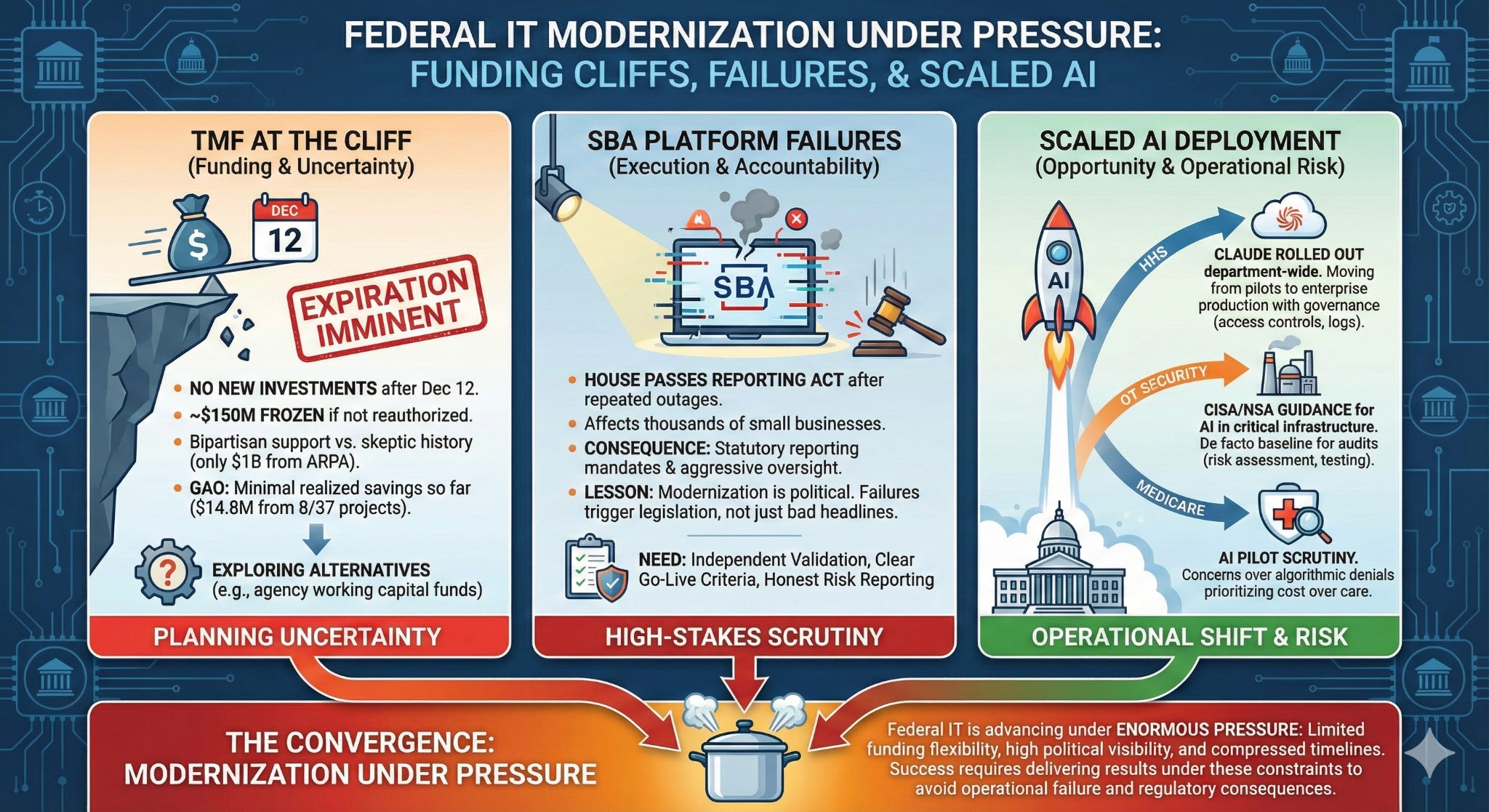
Federal IT modernization faced a series of stress tests this week that exposed both the fragility of current funding mechanisms and the execution risks inherent in large-scale technology transformations. The Technology Modernization Fund is days away from losing its authority to make new investments, the Small Business Administration’s platform failures triggered new statutory reporting requirements, and agencies are attempting to move AI from pilots to enterprise operations under compressed timelines.
Technology Modernization Fund Faces December 12 Expiration
The Technology Modernization Fund will be unable to make any new investments after December 12, freezing more than $150 million in available funding if Congress does not renew the program’s authority (Federal News Network, December 2, 2025). The General Services Administration, which houses the TMF, has been quiet about the fund since the second Trump administration started in January, opting not to publicly announce either of the two new projects it financed this year. But as the authorization cliff nears, political leadership at the Office of Management and Budget and GSA are making their support for the fund known to Congress (Nextgov/FCW, December 4, 2025).
If the TMF is not reauthorized, GSA will be able to continue overseeing existing investments but will not be able to make any new ones, effectively freezing nearly $160 million in funding (Federal News Network, December 2, 2025). GSA called the fund one of the federal government’s most effective tools for rapidly strengthening cybersecurity and improving high-impact systems, and expressed its intent to work with Congress on reauthorization (Federal News Network, December 2, 2025).
Representative Nancy Mace and former Congressman Gerry Connolly introduced the Modernizing Government Technology Reform Act in April, which included extending the fund through December 31, 2031 (Federal News Network, December 2, 2025). The bill has not moved out of the House Oversight and Government Reform Committee, and there is no Senate companion. The House passed a version of this bill in May 2024, but the Senate never moved on it. Senators Jerry Moran and Gary Peters reintroduced legislation on December 4 to reauthorize the TMF through 2032, prioritizing funding for long-term IT and cybersecurity modernization projects (Senate Press Release, December 4, 2025).
Despite bipartisan support, lawmakers have at times been skeptical of the TMF’s funding structure since its 2017 establishment, often deciding not to allocate additional funds beyond the $1 billion provided in the American Rescue Plan Act (Nextgov/FCW, December 4, 2025). Congress later clawed back about $100 million of that funding. The initial premise that the fund would be a self-sustaining mechanism fueled by repayments from agencies that reaped savings from their modernizations has not always panned out. The Biden administration relaxed repayment rules, and the fund now requires a minimum 50 percent repayment rate rather than full repayment within five years (Federal News Network, December 2, 2025).
For federal CIOs, acquisition executives, and systems integrators, the TMF expiration creates immediate planning uncertainty. Projects that depend on TMF funding cannot move forward, and agencies lose access to a flexible capital mechanism that has been particularly valuable for cybersecurity and legacy system modernization. The Alliance for Digital Innovation wrote in a November letter to congressional leaders that by providing flexible capital through a merit-based process overseen by federal technology leaders, the fund enables agencies to undertake complex modernization initiatives that would otherwise remain trapped in multi-year budget cycles (Nextgov/FCW, December 4, 2025).
Larry Bafundo, former executive director of the TMF program office and now president of Mo Studio, pointed to a fundamental disconnect: Congress is incentivized to think in terms of projects instead of services that evolve over time, creating a massive gap between how government works and how IT projects are funded (Federal News Network, December 2, 2025). There is no clear government-wide IT modernization strategy with a clear inventory of systems to align programs like TMF against, resulting in a piecemeal approach rather than a deliberate, coordinated plan. Agencies can lack incentives to modernize effectively, with very few senior executives evaluated based on the value of the services they provide to the public.
SBA Platform Failures Trigger Statutory Reporting Mandates
The House passed the SBA IT Modernization Reporting Act this week, which would require SBA to implement 11 GAO recommendations tied to its troubled Unified Certification Platform and to report regularly to Congress on modernization progress (FedScoop, De43cember 4, 2025). The move comes after repeated outages and platform defects that affected thousands of small businesses seeking federal certifications and contracts.
For CIOs, program executives, and systems integrators, this is a cautionary tale about high-stakes modernization projects that affect citizen or small-business services. When ambitious platforms fail in production, the consequences now include statutory reporting mandates and more aggressive oversight, not just bad headlines. It reinforces the case for independent verification and validation, clear go-live criteria, and honest risk reporting around complex multi-vendor transformations.
The SBA experience demonstrates that modernization is not just a technical challenge but a political one. When systems fail to deliver for constituents, Congress responds with legislation that adds compliance burden and oversight. Agencies planning major platform launches should assume that production failures will trigger regulatory responses and reputational damage that extend well beyond the immediate user base.
HHS Claude Rollout Reflects Scaled AI Execution
The Department of Health and Human Services moved its AI agenda from planning to production this week by rolling out Anthropic’s Claude as a departmentwide tool, building on earlier deployments of ChatGPT through government OneGov contracts (FedScoop, December 4, 2025). Staff across operating divisions will use Claude to draft documents, summarize regulatory text, and support day-to-day analytical tasks within guardrails defined by HHS’s internal AI policies and broader federal guidance.
For technology and security leaders, this is a live case study of what scaled AI adoption looks like inside a cabinet agency. It pairs a written AI strategy with a small set of enterprise platforms and shared services rather than a sprawl of pilots. It also hints at the level of governance needed around access controls, logging, and data residency when generative AI becomes a standard productivity tool for tens of thousands of knowledge workers. Key governance best practices should include regular access reviews, maintenance of audit trails, and strict adherence to state and federal data residency requirements. By upholding these practices, organizations can ensure a robust governance framework that aligns with the growing integration of AI within their operations.
The HHS rollout demonstrates that agencies are willing to move forward with AI deployment even as broader policy questions remain unresolved. This creates both opportunity and risk. Organizations that can demonstrate responsible AI use at scale will have credibility when procurement opportunities expand. Those who wait for perfect clarity will find themselves behind agencies and contractors that built operational muscle through real deployment.
OT Security Guidance and Medicare AI Pilot Highlight Operational Risk
CISA, NSA, and international partners issued joint guidance this week on integrating AI into operational technology environments that run critical infrastructure, such as energy, manufacturing, transportation, and water systems (CISA, December 4, 2025). The document lays out principles for risk assessment, testing, monitoring, and network segmentation to ensure that AI decision-making does not undermine safety, reliability, or regulatory compliance on the plant floor.
Executives with any OT footprint should treat this as a de facto baseline for future audits and regulatory expectations. Suppose your organization plans to use AI for predictive maintenance, anomaly detection, or optimization in industrial systems. In that case, you now have a clear checklist for threat modeling, controls, and vendor due diligence. It is also a reminder that AI in OT is not just another software upgrade but a change in how decisions are made in environments where failure has real physical consequences.
The Medicare prior authorization pilot using AI to review specific requests has drawn sharp criticism from physician groups and lawmakers who worry that financial incentives tied to denials, combined with opaque AI models, could worsen delays and reduce access to medically necessary care (Stateline, December 4, 2025). For CIOs and chief data officers in healthcare and public programs, this pilot underscores that algorithmic decision-making in entitlement programs will face intense scrutiny from clinicians, advocacy groups, and Congress if perceived as prioritizing cost reduction over patient care.
TMF Track Record and Alternatives
Since its creation in 2017, the TMF has received over 100 project submissions from 43 agencies, requesting more than $2.1 billion in funding (FedScoop, December 1, 2025). This demand underscores the urgency and potential for meaningful modernization. Projects funded through TMF have delivered measurable improvements in cybersecurity, citizen services, and operational efficiency. However, a GAO report found that as of February 2023, only 8 of 37 awarded projects had realized cost savings totaling $14.8 million, with five anticipating further savings totaling $2.6 million and an additional 16 projects anticipating $738.6 million in combined savings (GAO, 2024).
Some observers question whether there are alternative ways to accomplish the fund’s objectives. Former congressional staffer Mike Hettinger, who lobbies on behalf of technology companies, thinks the cost-recovery piece has proven too difficult to achieve and suggests taking a step back to assess whether the model has been successful enough to convince Congress (Nextgov/FCW, September 24, 2024). Congressional representatives and GSA have pointed to the potential for IT working capital funds at agencies to help address the need for multi-year funding for IT modernization, as those funds also stem from the law that established TMF (Nextgov/FCW, September 24, 2024).TMF at the tipping point - Nextgov/FCW https://www.nextgov.com/modernization/2024/09/tmf-tipping-point/399776/?oref=ng-next-story
GSA itself noted in its 2025 budget request that it is working with the Office of Management and Budget to explore alternative funding mechanisms for modernization (TMF at the tipping point - Nextgov/FCW https://www.nextgov.com/modernization/2024/09/tmf-tipping-point/399776/?oref=ng-next-story, Nextgov/FCW, September 24, 2024). Whether TMF is reauthorized or replaced with a different model, the underlying need for flexible, multi-year funding for IT modernization remains. Agencies cannot modernize legacy systems within annual appropriations cycles, and the consequences of failing to modernize continue to mount, including cybersecurity risks, operational inefficiencies, and poor service delivery.
The convergence of the TMF expiration, SBA platform failures, and HHS’s scaled AI deployment underscores a broader challenge: federal IT modernization is advancing under enormous pressure, with limited funding flexibility, high political visibility, and compressed timelines that leave little room for error. Organizations that can deliver results under these constraints will thrive. Those who cannot will face both operational failure and regulatory consequences.
Sources:
Federal News Network, “House lawmakers to try again to extend TMF through NDAA,” December 2, 2025, https://federalnewsnetwork.com/congress/2025/12/house-lawmakers-to-try-again-to-extend-tmf-through-ndaa/
Nextgov/FCW, “Technology Modernization Fund nears expiration, despite bipartisan backing,” December 4, 2025, https://www.nextgov.com/modernization/2025/12/technology-modernization-fund-nears-expiration-despite-bipartisan-backing/409948/
Senate Press Release, Senator Jerry Moran, “Moran, Peters Reintroduce Legislation to Reauthorize Technology Modernization Fund,” December 4, 2025, https://www.moran.senate.gov/public/index.cfm/news-releases?id=24712D67-0046-47ED-A1DC-34FAA77B2994
FedScoop, “Why Congress must reauthorize the Technology Modernization Fund,” December 1, 2025, https://fedscoop.com/technology-modernization-fund-reauthorization-congress/
FedScoop, “House passes SBA IT Modernization bill,” December 4, 2025, https://fedscoop.com/house-passes-sba-it-modernization-bill/
FedScoop, “HHS rolls out Claude, Anthropic AI tool,” December 4, 2025, https://fedscoop.com/hhs-rolls-out-claude-anthropic-ai-tool/
CISA, “Principles for Secure Integration of Artificial Intelligence in Operational Technology,” December 4, 2025, https://www.cisa.gov/resources-tools/resources/principles-secure-integration-artificial-intelligence-operational-technology
Stateline, “Medicare’s new AI experiment sparks alarm among doctors, lawmakers,” December 4, 2025, https://stateline.org/2025/12/04/medicares-new-ai-experiment-sparks-alarm-among-doctors-lawmakers/
GAO, “Technology Modernization Fund: Although Planned Amounts Are Substantial, Projects Have Thus Far Achieved Minimal Savings,” 2024, https://www.gao.gov/products/gao-24-106575
Nextgov/FCW, “TMF at the tipping point,” September 24, 2024, https://www.nextgov.com/modernization/2024/09/tmf-tipping-point/399776/
Cybersecurity’s Expanding Attack Surface – OT Vulnerabilities, Nation-State Targeting, and the Identity Crisis
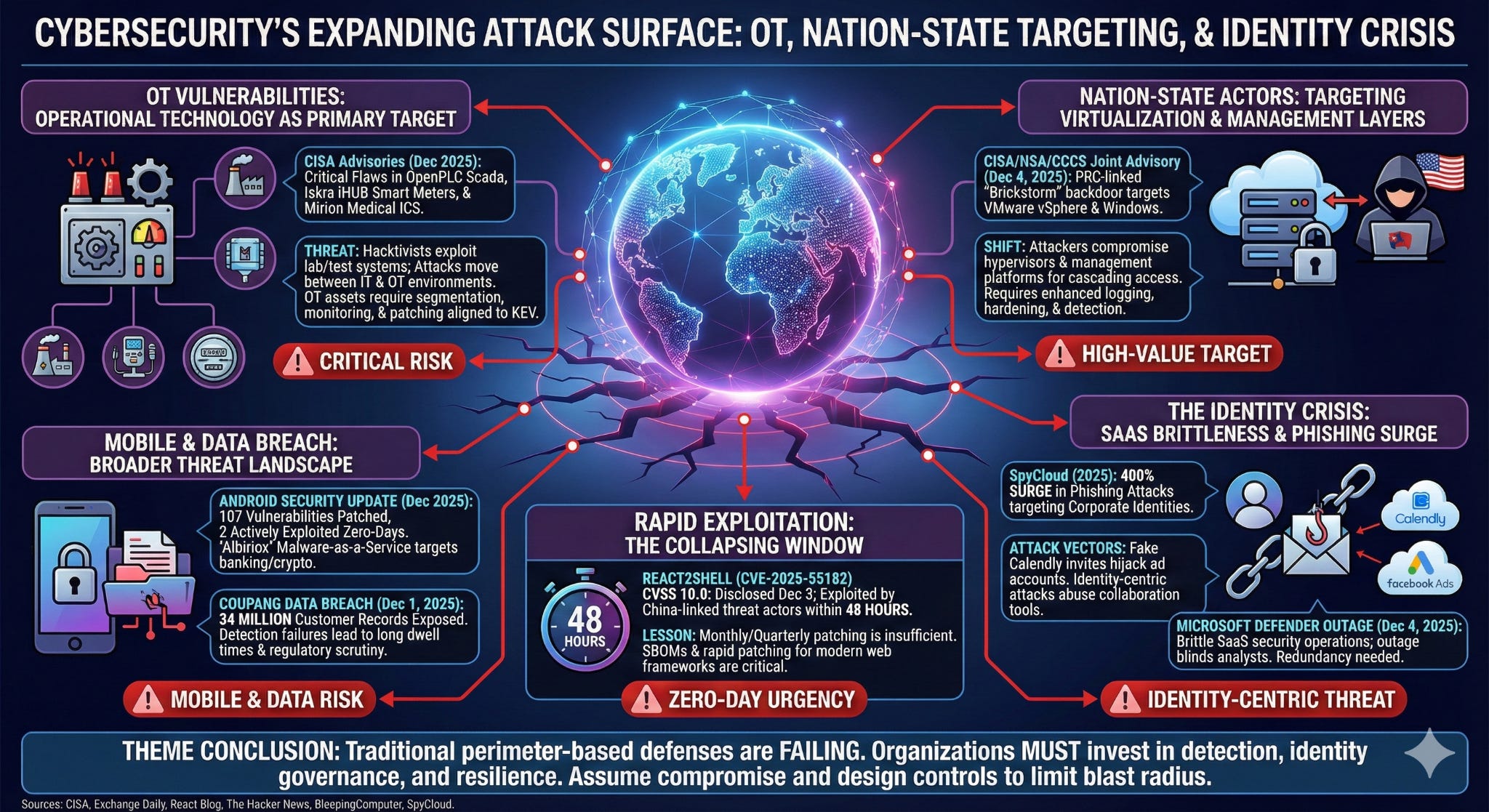
This week’s cybersecurity developments revealed a threat landscape that is both expanding and accelerating. Attackers are systematically targeting operational technology, exploiting maximum-severity flaws in modern web frameworks within hours of disclosure, leveraging brittle SaaS security operations, and shifting to identity-centric attacks that abuse collaboration and marketing tools. The pattern across all these stories is that traditional perimeter-based defenses are failing, and organizations that have not invested in detection, identity governance, and resilience are finding themselves blind to compromise.
Operational Technology Becomes Primary Attack Surface
CISA issued multiple advisories this week highlighting vulnerabilities in critical operational technology systems across sectors. The agency added a vulnerability in the OpenPLC Scada BR stack to its Known Exploited Vulnerabilities catalog (Exchange Daily, December 1, 2025). The flaw, CVE-2021-26829, is a cross-site scripting issue that allows attackers to inject malicious code through a settings page. Hacktivists recently used it to deface what they believed was a live industrial control system, turning off logs and alarms in the process (Prompt Genius
https://promptgenius.net/
). It turned out to be a honeypot, but the lesson is profound. If you run operational technology, you cannot treat lab, demo, or test systems as disposable. They still need segmentation, monitoring, and patching aligned to the KEV list.
CISA also released five ICS advisories on December 2 covering vulnerabilities in Iskra iHUB smart metering platforms and Industrial Video & Control Longwatch software (CISA, December 2, 2025). The vulnerabilities enable remote code execution, denial-of-service attacks, and loss of monitoring visibility. For CISOs and OT security leaders, the message is to treat metering, camera, and support systems as critical OT assets requiring segmentation and patching, not as peripheral IT that can be managed on standard enterprise timelines.
On December 2, CISA issued a medical ICS advisory for Mirion’s EC2 NMIS BioDose software, describing multiple high-severity vulnerabilities (CISA ICS Medical Advisory, December 2, 2025). Successful exploitation could allow attackers to modify executables, access sensitive information, or potentially execute arbitrary code. For healthcare CIOs, CISOs, and clinical engineering leaders, this reinforces that clinical operations software and medical OT must be governed like critical infrastructure, including software bills of materials and vendor patch service-level agreements.
The pattern is clear: operational technology is now a front-line attack surface, and the gap between OT and IT security practices is closing fast. Organizations that continue to manage OT assets on different patching cycles, with other monitoring tools, and without integration into enterprise security operations will find themselves unable to detect or respond to attacks that move between IT and OT environments.
Nation-State Actors Target Virtualization and Management Layers
CISA, NSA, and the Canadian Centre for Cyber Security issued a joint advisory and malware analysis on Brickstorm, a People’s Republic of China-linked backdoor (CISA, December 4, 2025). The campaign targets VMware vSphere and Windows systems, maintaining long-term persistence and enabling credential theft and potential sabotage. The advisory highlights virtualization and management layers as front-line attack surfaces that require enhanced logging, hardening, and detection.
For CIOs, CISOs, and heads of infrastructure, this represents a fundamental shift in threat modeling. Nation-state adversaries are not just targeting application vulnerabilities or end-user devices. They are moving up the stack to compromise the platforms that manage virtualization, storage, and compute resources. A compromised hypervisor or management console provides access to everything running on that infrastructure, making it a high-value target with cascading impact.
The Brickstorm advisory includes specific recommendations for logging, network segmentation, and detection signatures. Organizations should treat these as minimum baselines, not aspirational guidance. If your virtualization infrastructure lacks comprehensive logging, management consoles are accessible from production networks, or security operations teams lack visibility into hypervisor and infrastructure logs, you are operating in the dark about one of the most consequential attack surfaces in your environment.
React2Shell Exploited Within 48 Hours by Chinese Actors
On December 3, the React team disclosed a critical remote code execution vulnerability in React Server Components, tracked as CVE-2025-55182 with a CVSS score of 10.0, the maximum severity (React Blog, December 3, 2025). The flaw, known as React2Shell, allows unauthenticated remote code execution and has been addressed in React versions 19.0.1, 19.1.2, and 19.2.1. Within 48 hours, Amazon Web Services detected two China-linked threat actors, Earth Lamia and Jackpot Panda, attempting to exploit the vulnerability (The Hacker News, December 5, 2025).
AWS analysis of exploitation attempts in its honeypot infrastructure identified infrastructure historically linked to known China state-nexus threat actors (The Hacker News, December 5, 2025). The observed activity involved attempts to run discovery commands, write files, and read files containing sensitive information. AWS noted that threat actors monitor for new vulnerability disclosures, rapidly integrate public exploits into their scanning infrastructure, and conduct broad campaigns across multiple CVEs simultaneously to maximize their chances of finding vulnerable targets.
For security teams, this demonstrates that the window between vulnerability disclosure and active exploitation is collapsing. Organizations that rely on monthly or quarterly patching cycles for web application frameworks are giving adversaries weeks or months of opportunity to compromise systems. React2Shell also highlights the risk in modern front-end stacks. Many organizations have strong patch management for operating systems and databases, but weaker discipline around JavaScript frameworks, npm packages, and front-end dependencies. Software bills of materials and patch pipelines must cover modern front-end stacks like React and Next, not just traditional server-side components.
SaaS Security Operations Prove Brittle
Microsoft’s Defender portal suffered an outage this week that blocked access to some threat hunting alerts (BleepingComputer, December 4, 2025). The outage illustrates that SaaS security operations are brittle when a single console outage blinds analysts to threats. For security operations teams, this is a prompt to revisit outage playbooks for SaaS security tools and ensure that detection and response capabilities can continue when primary consoles are unavailable. Redundancy is not just for infrastructure. It is also needed for security operations platforms.
Attackers have been using fake Calendly invitations to hijack Google and Facebook ad manager accounts (BleepingComputer, December 4, 2025). The campaign abuses marketing and collaboration tools that often have privileged access to advertising platforms and payment information. For CISOs, this reinforces that identity-centric attacks are moving beyond email and now targeting SaaS platforms that employees use daily. Tightening identity and access controls around business platforms, implementing phishing-resistant multifactor authentication, and monitoring for anomalous activity in marketing and collaboration tools are now baseline security requirements, not optional enhancements.
Phishing Surges 400 Percent as Attackers Target Corporate Identities
SpyCloud reported a 400 percent year-over-year surge in successful phishing attacks, with a heavy skew toward corporate identities (SpyCloud, December 2025). The report highlights that attackers are increasingly targeting employees rather than consumers, recognizing that corporate credentials provide access to more valuable data and systems. For security teams, this means employee security awareness training is not sufficient on its own. Organizations need technical controls that reduce the impact of successful phishing, including phishing-resistant multifactor authentication using FIDO2 or WebAuthn, conditional access policies that limit what compromised credentials can access, and behavioral analytics that detect when legitimate credentials are being used in anomalous ways.
The convergence of SaaS brittleness, identity-centric attacks, and rapid exploitation of new vulnerabilities creates an environment where traditional perimeter defenses provide little protection. Assume some percentage of corporate devices and accounts are compromised at any given time. Design controls that limit blast radius, detect anomalies, and enable rapid containment rather than betting on perfect prevention.
Android Security Update and Broader Mobile Threat Landscape
Google released its December 2025 security update for Android, patching 107 vulnerabilities, including two actively exploited zero-days (CISA KEV, 2025). The update addresses CVE-2025-48572 and CVE-2025-48633, both of which were being exploited in the wild before patches were available. For CISOs in financial services and any company that relies on mobile apps for payments and identity, this is a reminder that mobile devices represent a significant attack surface that requires active management.
Earlier in the week, the Exchange Daily highlighted Albiriox, a new Android malware family sold as a malware-as-a-service, targeting banking and crypto applications (Exchange Daily, December 1, 2025). Unlike traditional banking trojans that simply steal credentials or intercept text messages, Albiriox abuses accessibility services to see and control the screen, layers fake interfaces over legitimate apps, and lets attackers perform real-time transactions as if they were the user. This represents whole device fraud, not just credential theft. Organizations should combine device intelligence, behavioral analytics, and step-up verification for risky actions, and update customer security messaging to emphasize keeping Android devices clean and up to date.
Large-Scale Data Breach Underscores Detection and Disclosure Challenges
South Korean e-commerce leader Coupang disclosed that attackers accessed personal data for nearly 34 million customers over several months (Exchange Daily, December 1, 2025). The exposed information includes names, contact details, shipping addresses, and some order history, though payment data and passwords are reportedly unaffected. Authorities are investigating whether a former employee’s authentication key was misused and whether the company complied with its obligations regarding monitoring and disclosure.
For any digital commerce or marketplace operator, the parallels are apparent. Long dwell access in complex cloud environments is hard to spot, but regulators and customers are losing patience with delayed or vague notifications. This is a prompt to retest detection coverage for bulk data access, rehearse incident communication plans, and verify that former employee offboarding processes truly close every technical back door. The Coupang breach demonstrates that detection failures in cloud environments lead to long dwell times, and disclosure delays lead to regulatory scrutiny that can be as damaging as the breach itself.
The week’s cybersecurity stories converge on a single theme: the attack surface is expanding faster than most organizations can secure it. Operational technology, virtualization layers, modern web frameworks, SaaS platforms, mobile devices, and identity systems are all under active exploitation. Organizations that continue to rely on perimeter defenses, annual vulnerability scans, and generic security awareness training will find themselves unable to detect or respond when attackers exploit these expanding surfaces. The path forward requires investment in detection and response capabilities, identity governance that limits blast radius, and a realistic assumption that some level of compromise is always present.
Sources:
Exchange Daily, “OpenPLC Scada vulnerability added to CISA KEV catalog,” December 1, 2025
CISA, “CISA releases five industrial control systems advisories,” December 2, 2025, https://www.cisa.gov/news-events/alerts/2025/12/02/cisa-releases-five-industrial-control-systems-advisories
CISA ICS Medical Advisory, “Mirion EC2 NMIS BioDose,” December 2, 2025, https://www.cisa.gov/news-events/ics-medical-advisories/icsma-25-336-01
CISA, “PRC state-sponsored actors use Brickstorm malware across public sector and information technology,” December 4, 2025, https://www.cisa.gov/news-events/alerts/2025/12/04/prc-state-sponsored-actors-use-brickstorm-malware-across-public-sector-and-information-technology
React Blog, “Critical Security Vulnerability in React Server Components,” December 3, 2025, https://react.dev/blog/2025/12/03/critical-security-vulnerability-in-react-server-components
The Hacker News, “Chinese Hackers Have Started Exploiting the Newly Disclosed React2Shell Vulnerability,” December 5, 2025, https://thehackernews.com/2025/12/chinese-hackers-have-started-exploiting.html
BleepingComputer, “Microsoft Defender portal outage blocks access to security alerts,” December 4, 2025, https://www.bleepingcomputer.com/news/microsoft/microsoft-defender-portal-outage-blocks-access-to-security-alerts/
BleepingComputer, “Fake Calendly invites spoof top brands to hijack ad manager accounts,” December 4, 2025, https://www.bleepingcomputer.com/news/security/fake-calendly-invites-spoof-top-brands-to-hijack-ad-manager-accounts/
SpyCloud, “Phishing has surged 400 percent year-over-year,” 2025, https://spycloud.com/newsroom/phishing-has-surged-400-percent-year-over-year/
Exchange Daily, “Android Albiriox malware targets banking and crypto apps,” December 1, 2025
Exchange Daily, “Coupang data breach affects 34 million customers,” December 1, 2025
CISA Known Exploited Vulnerabilities Catalog, 2025, https://www.cisa.gov/known-exploited-vulnerabilities-catalog
Identity as the New Control Plane
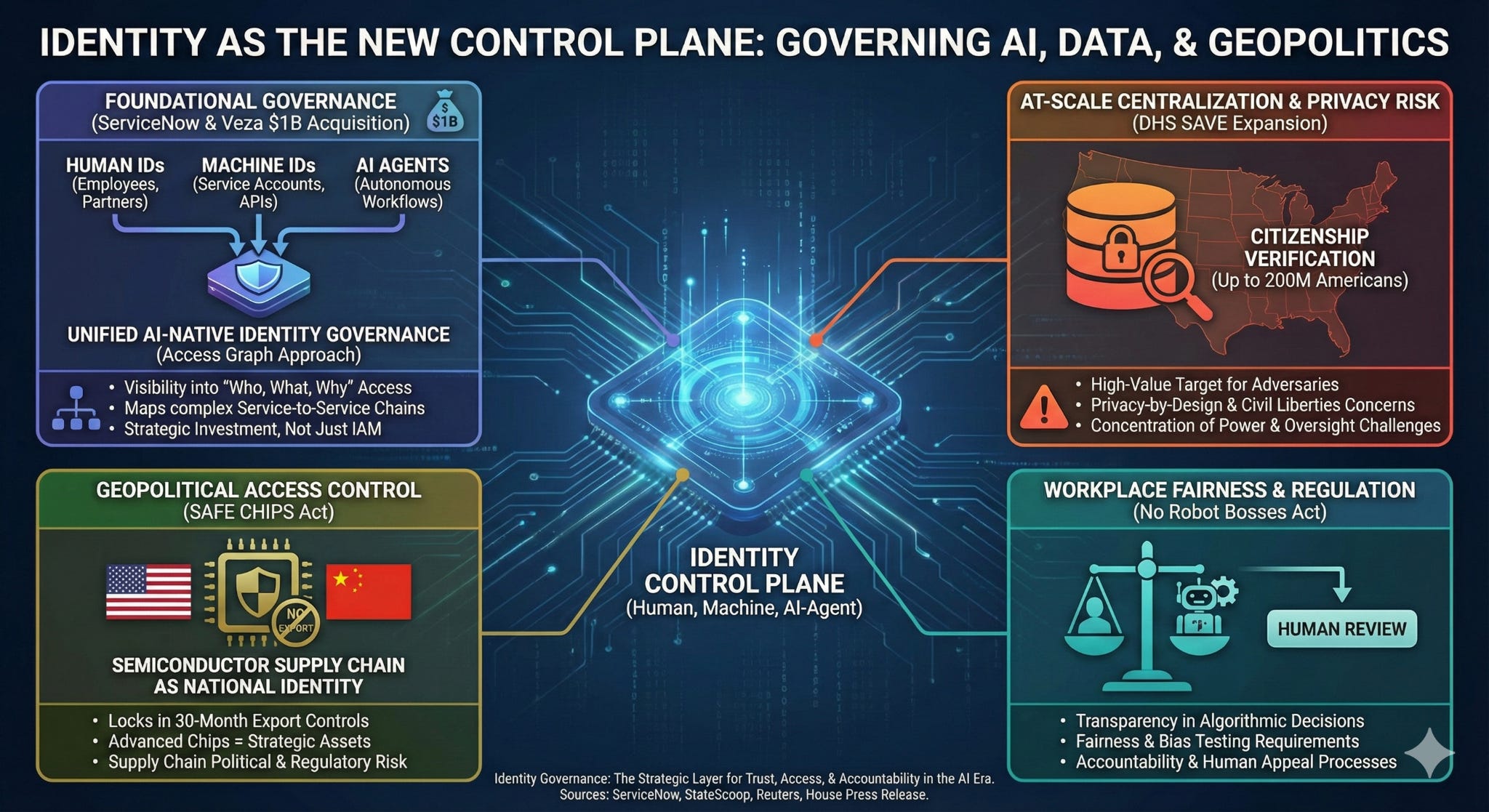
Two significant developments this week framed identity as the essential control layer for AI-native operations and as a battleground for both domestic policy and international competition. ServiceNow’s acquisition of Veza for a reported $1 billion treats identity governance as the foundation for managing human, machine, and AI-agent identities across applications and data stores. At the same time, the Department of Homeland Security’s planned expansion of the SAVE program raised concerns about large-scale aggregation of citizenship and identity data on up to 200 million Americans. Congress also moved forward with legislation to lock in export controls on advanced AI chips to China, framing semiconductor access as a national security and identity question for technology supply chains.
ServiceNow’s Veza Acquisition Signals Market View on AI Identity Governance
ServiceNow signed a definitive agreement this week to acquire Veza, an AI-native identity security platform, in a deal valued at approximately $1 billion (ServiceNow Press Release, December 3, 2025). Veza’s Access Graph approach helps govern human, machine, and AI-agent identities across applications and data stores, providing visibility into who and what has access to which resources and why. The acquisition represents a strong market signal that unified identity governance is becoming the control layer for agentic AI and automation.
For CIOs, CISOs, and identity and access management leaders, the ServiceNow-Veza deal underscores that identity is no longer just about authentication and authorization. It governs how AI agents, service accounts, APIs, and automated workflows access data and take actions. As organizations deploy more AI-driven automation, the number of non-human identities grows exponentially, and traditional identity management tools built for human users struggle to provide visibility and control.
The Access Graph model that Veza pioneered treats identity as a relationship problem rather than just a credential problem. It maps not only who has access but how that access is granted, what permissions are actually used, and what data or actions are at risk if a particular identity is compromised. This approach aligns with the reality that AI-native operations involve complex chains of service-to-service authentication, API keys, temporary credentials, and delegated permissions that are invisible to traditional IAM platforms.
Organizations should interpret the ServiceNow acquisition as validation that identity governance for AI requires new tooling and approaches. Waiting for existing IAM vendors to add AI capabilities may leave organizations without the visibility and control they need as AI agents proliferate. Identity governance is becoming a strategic investment area, not an incremental improvement to existing infrastructure.
DHS SAVE Expansion Raises Privacy and Centralization Concerns
The Department of Homeland Security is planning changes to the Systematic Alien Verification for Entitlements program and a new lookup tool for citizenship verification (Secretary of State Ken Detzner Files Lawsuit Against U.S. Department of Homeland Security, Seeks Access to Database of Non-Citizens to Ensure Accuracy of Florida Voter Rolls - Florida Department of State (https://dos.myflorida.com/communications/press-releases/2012/secretary-of-state-ken-detzner-files-lawsuit-against-us-department-of-homeland-security-seeks-access-to-database-of-non-citizens-to-ensure-accuracy-of-florida-voter-rolls/). The expansion has drawn concerns from secretaries of state and civil rights groups about the large-scale aggregation of identity data on up to 200 million Americans. The planned system would centralize citizenship verification, thereby heightening expectations for privacy-by-design, logging, and access controls in shared identity systems.
For federal and state CIOs, CISOs, and privacy officers, the SAVE expansion highlights the governance challenges that come with large-scale identity infrastructure. When identity data is centralized for efficiency or convenience, it becomes a high-value target for adversaries and a potential source of privacy risk if access controls, audit logging, or data retention policies are inadequate. Any shared identity system that touches millions of Americans requires not just technical security controls but also transparent governance around who can access the data, for what purposes, under what legal authority, and with what oversight.
The concerns raised by secretaries of state and civil rights groups are not just about privacy. They are about the concentration of power that comes with centralized identity infrastructure. When a single system determines eligibility for benefits, employment, or other opportunities, the stakes for accuracy, fairness, and accountability are enormous. Technical leaders involved in identity infrastructure projects should expect that legal, policy, and civil rights stakeholders will scrutinize design decisions around data collection, retention, access, and correction processes.
The DHS SAVE expansion is a reminder that identity infrastructure is inherently political and that technical decisions about architecture, data flows, and access controls have direct implications for civil liberties and public trust. Organizations building or operating identity systems should proactively engage with privacy officers, legal counsel, and external stakeholders rather than treating these systems as purely technical implementations.
SAFE CHIPS Act Frames Semiconductor Access as National Security and Identity
Congress introduced the SAFE CHIPS Act this week to prevent easing of U.S. export controls on advanced AI chips to China and other adversaries for 30 months (Reuters, December 4, 2025). The bipartisan legislation would require the Commerce Department to deny licenses for chips more advanced than those already permitted and to notify Congress before any future rule changes. For CIOs, CTOs, CFOs, and supply chain leaders, this has direct implications for AI infrastructure planning, pricing, and multi-vendor strategies.
The legislation treats semiconductor access as a national security and technological identity question. Advanced AI chips are not commodities that can be freely traded. They are strategic assets that determine which nations and organizations can build and deploy cutting-edge AI capabilities. The SAFE CHIPS Act locks in export controls for at least 30 months, creating a stable policy window but also confirming that geopolitical constraints on chip access are not going away.
For organizations planning AI infrastructure, the practical implication is that supply chains for advanced compute are subject to political and regulatory risk that cannot be hedged through procurement alone. Organizations should maintain relationships with multiple chip vendors and cloud providers, build scenarios in which specific chip architectures become unavailable or more expensive due to export controls or supply constraints, and ensure that AI workloads can migrate across different hardware platforms without complete rewrites.
The intersection of identity governance, citizenship verification, and semiconductor access reveals that identity is not just a technical layer. It is a strategic question about who gets access to what resources, under what conditions, and with what level of trust and verification. Whether the identity in question is a person, a machine, an AI agent, or a nation-state’s access to advanced technology, the underlying governance questions are similar: how do you verify identity, how do you grant and revoke access, how do you audit and monitor use, and how do you ensure that identity systems themselves are trustworthy and resilient.
No Robot Bosses Act and Workplace Identity
The reintroduction of the No Robot Bosses Act on December 4 adds another dimension to identity governance (House Press Release, December 4, 2025). The legislation focuses on transparency, fairness, and accountability in automated decision systems used in hiring and workplace management. This is fundamentally an identity and access question: what can AI systems know about workers and job applicants, what decisions can they make, and how are those decisions reviewed and appealed?
For CIOs, CHROs, and general counsel, this legislation signals that workplace AI will face regulatory scrutiny around how it uses employee and applicant identity data. Hiring algorithms, performance management systems, scheduling tools, and monitoring platforms all rely on identity information and make decisions that affect people’s livelihoods. The No Robot Bosses Act would impose requirements around transparency (what data is used and how decisions are made), fairness (testing for bias and disparate impact), and accountability (human review and appeal processes).
Organizations deploying AI in HR and workforce management should treat these principles as baseline expectations regardless of whether this specific legislation passes. Document what data your AI systems use, test for bias and adverse impact, maintain human oversight and final decision authority, and build appeal processes that are accessible and effective. The alternative is to deploy systems that may face legal challenge, regulatory enforcement, or public backlash when workers or applicants experience outcomes they perceive as unfair or opaque.
The convergence of ServiceNow’s Veza acquisition, DHS SAVE expansion, SAFE CHIPS Act, and No Robot Bosses Act frames identity as the central control plane for AI-era operations. Whether governing AI agents, verifying citizenship, controlling semiconductor access, or managing workplace decisions, the underlying challenge is the same: how do you establish trust, grant appropriate access, monitor use, and ensure accountability? Organizations that invest in identity governance as a strategic capability will be better positioned to navigate regulatory requirements, manage risk, and operate AI systems responsibly.
Sources:
ServiceNow Press Release, “ServiceNow to Expand Security Portfolio With Acquisition of Veza’s Leading AI-native Identity Security Platform,” December 3, 2025, https://newsroom.servicenow.com/press-releases/details/2025/ServiceNow-to-Expand-Security-Portfolio-With-Acquisition-of-Vezas-Leading-AI-native-Identity-Security-Platform/default.aspx
SecurityWeek, “ServiceNow to acquire AI-native identity security firm Veza,” December 3, 2025
StateScoop, “DHS SAVE elections secretaries of state letter,” December 2, 2025, https://statescoop.com/dhs-save-elections-secretaries-state-letter/
Reuters, “Senators unveil bill to keep Trump from easing curbs on AI chip sales to China,” December 4, 2025, https://www.reuters.com/world/us/senators-unveil-bill-keep-trump-easing-curbs-ai-chip-sales-china-2025-12-04/
House Press Release, Representative Chris Deluzio, “Deluzio, Bonamici, Moylan restart push to protect workers from AI and robot bosses,” December 4, 2025, https://deluzio.house.gov/media/press-releases/deluzio-bonamici-moylan-restart-push-protect-workers-ai-and-robot-bosses
The Week Ahead
This coming week will bring clarity on at least one central open question: whether the Technology Modernization Fund receives congressional reauthorization before its December 12 expiration. House and Senate lawmakers are exploring pathways to extend the fund, potentially through the National Defense Authorization Act, but the outcome remains uncertain. If the fund expires, federal agencies lose access to flexible capital for modernization projects, and nearly $160 million in available funding is effectively frozen.
The December 29 deadline for federal agencies to finalize detailed AI use and procurement policies is also approaching rapidly. Agencies have three weeks to translate strategic AI plans into operational mandates around AI inventories, data governance, human oversight, testing requirements, and contractor expectations. For federal contractors and systems integrators, the period between now and the end of the month will determine what AI compliance looks like in practice for the next several years.
State legislatures are preparing for 2026 sessions, and AI legislation will be a significant focus. Virginia’s framework for clinical AI, Utah’s pro-human AI initiative, and the broader push for state-level AI civil rights protections suggest that even if federal preemption efforts succeed, states will continue to shape AI governance through sector-specific rules, workforce programs, and enforcement actions. Executives should monitor not just federal legislation but also state-level activity in jurisdictions where they operate or plan to expand.
Data center developers and hyperscalers face ongoing negotiations with local governments, utilities, and community groups over permits, power access, and environmental impact. The Pennsylvania opposition and BlackRock’s warnings about physical constraints suggest that not all announced projects will move forward on schedule. Organizations betting on specific data center locations or capacity timelines should build contingency plans that account for delays or cancellations.
Cybersecurity teams should prioritize patching for React Server Components vulnerabilities, given the active exploitation by nation-state actors. Organizations that use React in production applications need to verify that patches have been applied and that detection coverage exists for indicators of compromise associated with React2Shell. The gap between disclosure and exploitation is now measured in hours, not weeks, making rapid patching a competitive advantage.
The ServiceNow-Veza acquisition will likely trigger activity among other identity and security vendors looking to build or acquire AI-native identity governance capabilities. Organizations evaluating identity platforms should ask vendors how they plan to address non-human identities, AI agents, and service-to-service access, ensuring visibility and control rather than just authentication. The market is signaling that traditional IAM approaches are insufficient for AI-era operations.
Finally, the intersection of AI policy, infrastructure constraints, modernization pressure, cybersecurity threats, and identity governance suggests that the next several weeks will be a period of consolidation and clarification. Organizations that use this time to assess their readiness across all these dimensions, identify gaps, and build plans that account for realistic constraints will enter 2026 in a stronger position than those waiting for perfect clarity before taking action.
Closing Perspective
December 1-5, 2025, will be remembered as the week when the gap between AI ambition and operational reality became impossible to ignore. Federal and state governments are locked in a fight over who sets AI rules at the exact moment when agencies must finalize procurement policies. Data centers intended to address compute constraints are facing organized local opposition, physical infrastructure bottlenecks, and financial institutions quietly reducing exposure. A federal modernization fund that enables cybersecurity and legacy system upgrades is days away from expiring without reauthorization. Adversaries are exploiting maximum-severity vulnerabilities within 48 hours of disclosure while targeting operational technology, virtualization platforms, and identity systems that organizations assumed were secure.
The organizations that will succeed in this environment are not those with the most ambitious AI roadmaps or the most significant infrastructure budgets. They are the ones who recognize constraints as the defining feature of the landscape and build adaptive strategies around them. They map AI compliance to both current state rules and potential federal preemption scenarios. They diversify infrastructure across regions and maintain relationships with multiple providers rather than betting on a single hyperscaler or a specific data center project. They treat the December 29 federal AI policy deadline as the start of a new compliance regime, not an administrative formality. They invest in detection and identity governance rather than perimeter defenses that adversaries routinely bypass.
The week’s developments make one thing clear: AI is no longer a technology experiment. It is a governance, infrastructure, security, and political challenge that requires executive attention, cross-functional coordination, and realistic planning. The promise of AI remains transformative, but the path to delivering on that promise runs through constraints that cannot be wished away or solved with more capital alone. Organizations that face these constraints directly and build resilience into their strategies will be the ones still standing when the dust settles.
This update was assembled using a mix of human editorial judgment, public records, and reputable national and sector-specific news sources, with help from artificial intelligence tools to summarize and organize information. All images in this newsletter were created using Google Gemini. All information is drawn from publicly available sources listed above. Every effort is made to keep details accurate as of publication time, but readers should always confirm time-sensitive items such as policy changes, budget figures, and timelines with official documents and briefings.
All original content, formatting, and presentation are copyright 2025 Metora Solutions LLC, all rights reserved. For more information about our work and other projects, drop us a note at info@metorasolutions.com