Your federal clients are asking about agentic AI. Your commercial clients are piloting it. Your compliance team is scrambling to catch up. And you don’t have a playbook yet.
This is the moment where System Integrators and Service Providers either lead the conversation or get trapped in reactive delivery mode. The difference is governance. The window to shape how your clients think about it is closing fast.
This week’s news isn’t about features. It’s about the infrastructure, guardrails, and timelines that will define how your clients deploy agentic AI safely, compliantly, and profitably.
The Real Question Your Clients Are Asking (But Maybe Not Out Loud)
“We want to move fast with agentic AI, but we can’t afford the compliance debt. How do we do both?”
If you don’t have a credible answer to that question by Q1 2026, you’re leaving money on the table and ceding advisory authority to competitors who do.
What you’ll find behind the paywall: Three governance failure modes we’re already seeing in early 2026 pilots, how to prevent each one before it hits audit, and a platform-specific playbook for federal and commercial clients.
What Happened This Week: The Convergence
Platform Vendors Are Making Agentic AI Operational
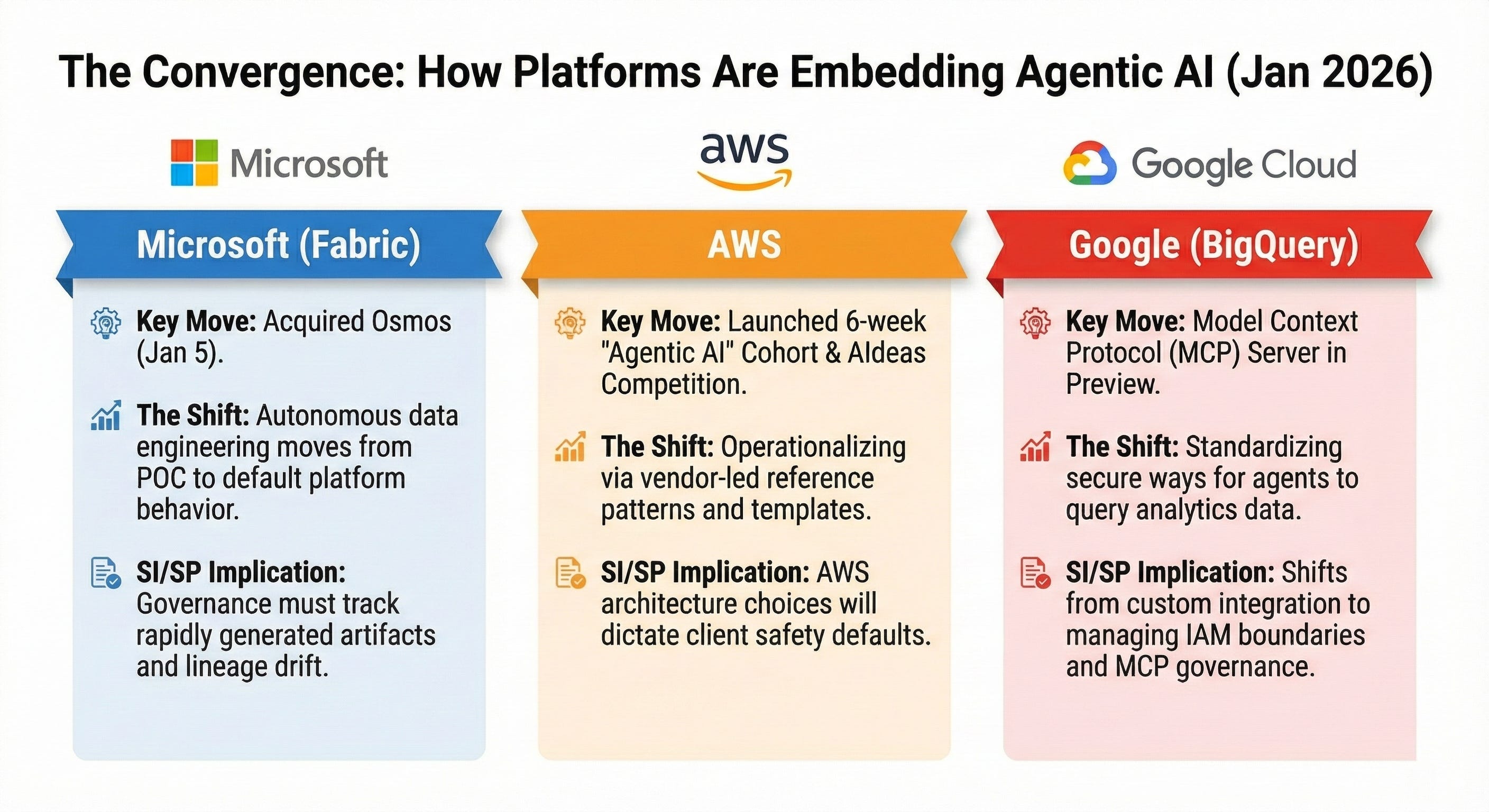
Microsoft’s acquisition of Osmos (announced January 5, 2026) signals that autonomous data engineering is moving from proof-of-concept into default platform behavior inside Microsoft Fabric.
The promise is straightforward. Agents can automate pipeline creation, transformation, and optimization at scale. The governance problem is equally clear. When agents generate artifacts faster than your controls can track them, cost, access, and lineage drift fast.
AWS is operationalizing agentic AI through enablement and competition. The company announced a six-week “Agentic AI on AWS” cohort starting February 21, 2026, and promoted the Global 10,000 AIdeas Competition with a January 21 deadline.
This isn’t marketing noise. It’s a signal that vendor-led reference patterns are becoming the templates your clients will copy. The architecture choices, safety defaults, and governance assumptions in those examples will influence how your clients think about agent deployment.
Google is standardizing how agents connect to analytics data. BigQuery’s fully managed, remote Model Context Protocol (MCP) server (in preview as of January 2026) gives agents a secure, standardized way to query data without weeks of custom integration work.
The operational takeaway for your practice is clear. This becomes a platform decision, not a one-off integration. Your data and analytics teams need to understand MCP governance, IAM boundaries, and audit logging implications before pilots become production.
Federal Governance Is Catching Up
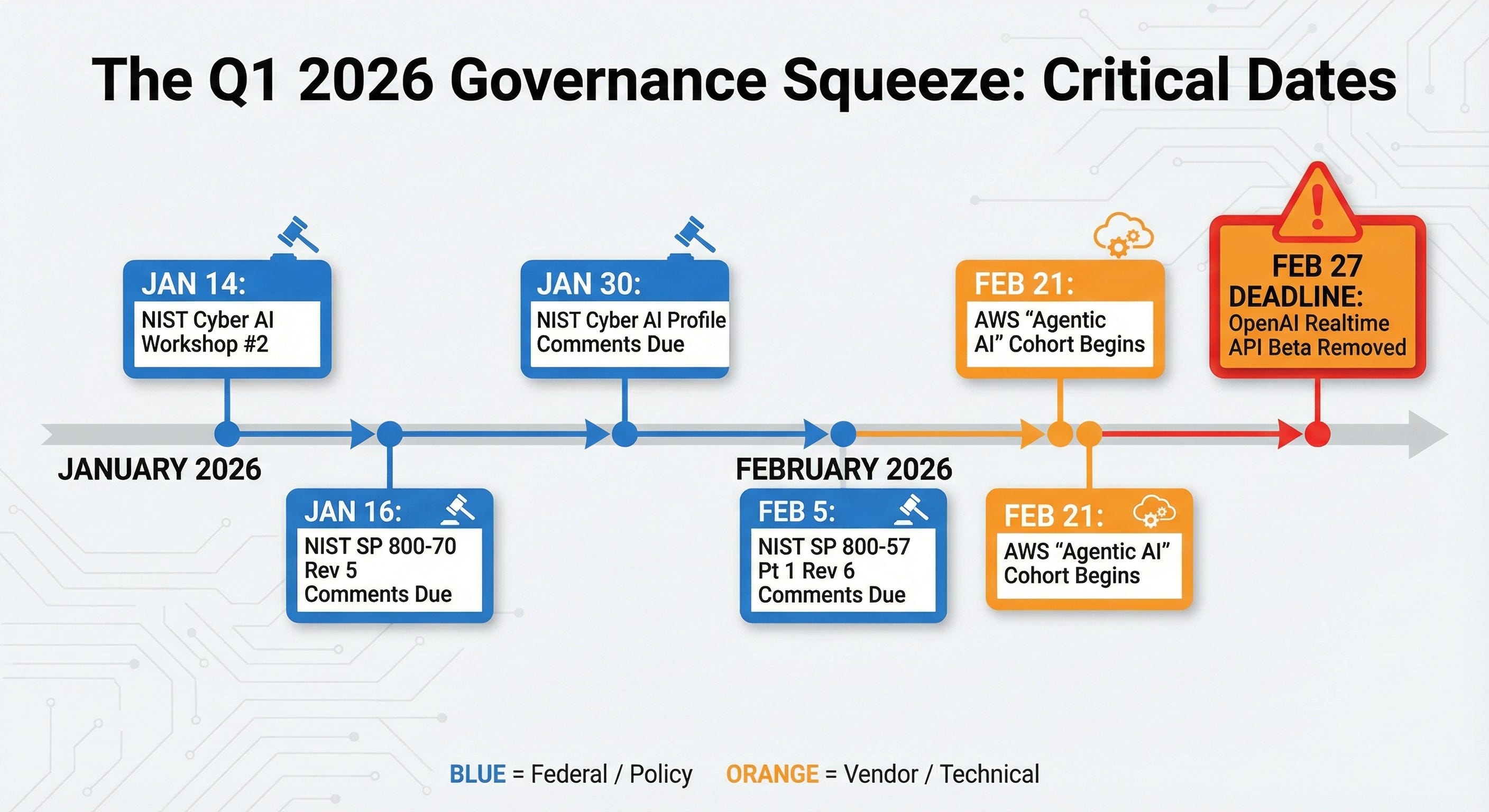
NIST is building the reference framework for AI cybersecurity. The Cyber AI Profile workshop is scheduled for January 14, 2026, with comments due January 30.
This effort maps AI cybersecurity outcomes to Cybersecurity Framework 2.0, so teams can manage AI risk using a structure executives and auditors already understand.
For your federal practice, this is where you shape what becomes default procurement language and assessment criteria.
FedRAMP modernization is accelerating with hard dates. Phase 2 of FedRAMP 20x runs January 5–9, 2026 (Cohort 2 application window is closed), with broader Phase 2 milestones through March 2026.
This isn’t a gentle transition. It’s a competitive pipeline event with limited slots. If your federal cloud offerings aren’t positioned for modernized authorization approaches, you’re already behind.
NIST guidance on key management, compliance, and cyber risk is reshaping policy language. SP 1308 comments close January 7 (tonight), SP 800-57 Part 1 Rev 6 comments are due February 5, and SP 800-70 Rev 5 comments close January 16.
These aren’t academic exercises. They’re the documents that will drive how your clients define governance requirements, procurement language, and compliance workflows for the next 3–5 years.
Why This Matters for Your SI/SP Practice
Your Clients Are Moving Faster Than Their Governance
Agentic AI is no longer a 2027 problem. It’s a 2026 delivery reality. Your federal clients have budget authority and modernization mandates. Your commercial clients are running pilots. And none of them have a credible governance playbook yet.
That’s your advisory opportunity. It’s also your liability if you don’t get ahead of it.
The governance gap is where SIs and SPs create value. Not by slowing clients down, but by helping them move fast without creating audit nightmares, cost overruns, or compliance violations. That’s a premium service, and it’s in high demand right now.
Three Governance Failure Modes We’re Already Seeing
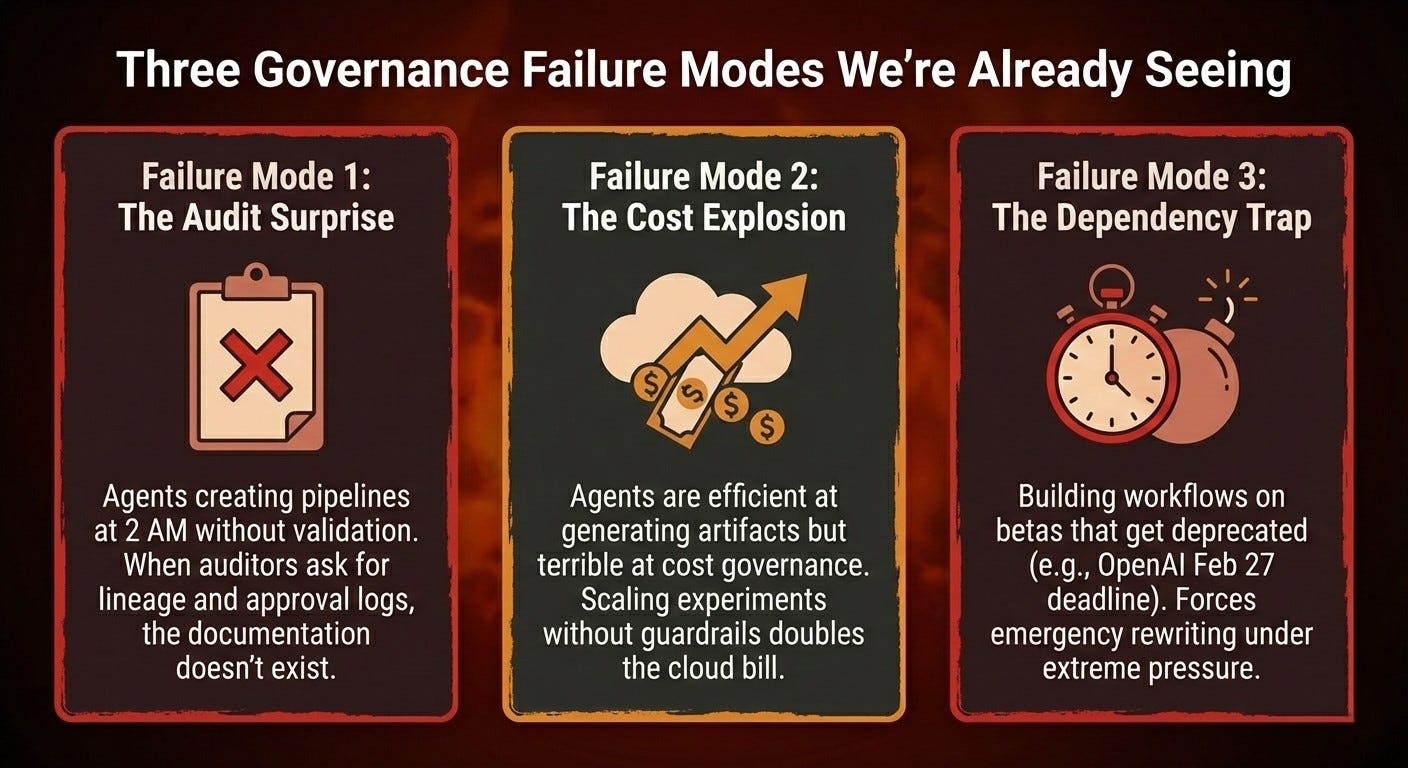
Failure Mode 1: The Audit Surprise. An agent creates a data pipeline at 2 AM to solve a business problem. The transformation logic is correct. The data quality is fine. But nobody approved the data sources, nobody validated the lineage, and nobody documented why the pipeline was created. When audit arrives, you have a compliance gap that looks like negligence.
Failure Mode 2: The Cost Explosion. Agents are efficient at generating artifacts. They’re terrible at cost governance. An agent spins up compute resources, runs experiments, and scales without guardrails. Your cloud bill doubles. Your finance team demands answers. You have no visibility into what the agent was doing or why.
Failure Mode 3: The Dependency Trap. Your clients build agent workflows on OpenAI’s Realtime API Beta. It works great. Then OpenAI announces the beta is being removed February 27, 2026. Your client has 45 days to migrate or lose the capability. You’re now in emergency mode, scrambling to rewrite integrations under deadline pressure.
These aren’t hypothetical. We’re seeing all three in early 2026 pilots.
Platform Consolidation Is Real
Microsoft, AWS, and Google are all pushing agentic AI as a default platform feature. That means your clients won’t be choosing whether to adopt agentic AI. They’ll be choosing how to govern it within the platforms they already use.
Your practice needs to understand:
How Fabric’s Osmos integration changes data governance workflows
What “agentic AI on AWS” means for your cloud architecture practice
How BigQuery’s MCP server affects your data analytics delivery model
If you’re still positioning agentic AI as a separate capability, you’re already behind the market.
Federal Compliance Is Becoming a Competitive Advantage
Your federal clients are watching FedRAMP 20x, NIST guidance updates, and policy shifts. The ones who understand what’s coming will move faster and win more deals. The ones who don’t will get surprised by compliance requirements mid-project.
Your compliance and federal practice can position itself as the team that translates policy into architecture. Before it becomes a crisis.
How to Advise Your Clients (This Week)
For Federal Clients
Action 1: Map FedRAMP 20x implications now. If you’re a cloud service provider or federal buyer, understand whether Phase 2 modernization affects your authorization timeline. The dates are real, the competition is real, and the window is narrow. Schedule a readiness review with your 3PAO and sponsoring agency.
Action 2: Assign an owner to track NIST guidance updates. SP 1308, SP 800-57 Part 1 Rev 6, and SP 800-70 Rev 5 are all in comment windows or about to be finalized. These documents will drive compliance language for the next 3–5 years. Your GRC and compliance teams should be reviewing drafts and considering comment submissions.
Action 3: Define agentic AI guardrails before pilots become production. If your federal clients are experimenting with agentic AI (data engineering, analytics, security automation), now is the time to define approval workflows, audit logging, and lineage requirements. Don’t wait until an agent generates a pipeline that violates compliance requirements.
For Commercial Clients
Action 1: Standardize agent governance across your platforms. Whether your clients are using Microsoft Fabric, AWS, or Google BigQuery, they need consistent governance. What tools agents can call. What data they can touch. How actions are logged and reviewed. This is a platform decision, not a feature decision.
Action 2: Build a kill switch into every agent workflow. Your clients need the ability to stop an agent flow without taking down the whole service. This sounds simple, but it’s often missing from early pilots. Make it a requirement.
Action 3: Inventory agent dependencies and deprecation risk. OpenAI’s Realtime API Beta is being removed February 27, 2026. If your clients have anything in production tied to deprecated interfaces, they need a migration plan now. This is a governance problem masquerading as a technical one.
For Your Practice
Action 1: Build an agentic AI governance reference architecture. Your clients will ask for it. Have a playbook that covers identity, logging, approval workflows, cost controls, and audit trails. Make it platform-agnostic enough to apply to Fabric, AWS, and Google, but specific enough to be actionable.
Action 2: Staff up your compliance and federal practice. This is where the advisory value lives. Your technical teams can build agents. Your compliance teams can help clients deploy them safely. That’s a premium service.
Action 3: Position yourself as the translator between platform vendors and policy. Your clients don’t have time to read NIST drafts or track FedRAMP timelines. You do. That’s your competitive advantage.
What’s Coming Next (Your Calendar)
January 14, 2026: NIST Cyber AI Workshop #2 (register now if you haven’t)
January 15, 2026: OpenAI retires Voice in ChatGPT macOS app
January 16, 2026: NIST SP 800-70 Rev 5 comment deadline
January 21, 2026: AWS 10,000 AIdeas Competition deadline
January 30, 2026: NIST Cyber AI Profile comments due
February 5, 2026: NIST SP 800-57 Part 1 Rev 6 comment deadline
February 21, 2026: AWS Agentic AI on AWS cohort begins
February 27, 2026: OpenAI Realtime API Beta removed
Our Recommendation
This is your moment to lead, not follow.
Your clients are moving into agentic AI whether you’re ready or not. The ones who have a governance playbook will move faster, win more deals, and avoid compliance disasters. The ones who don’t will get trapped in reactive delivery mode.
Sources
Microsoft Osmos acquisition: https://blogs.microsoft.com/blog/2026/01/05/microsoft-announces-acquisition-of-osmos-to-accelerate-autonomous-data-engineering-in-fabric/
AWS Agentic AI cohort and 10,000 AIdeas: https://aws.amazon.com/blogs/aws/happy-new-year-aws-weekly-roundup-10000-aideas-competition-amazon-ec2-amazon-ecs-managed-instances-and-more-january-5-2026/
Google BigQuery MCP server: https://cloud.google.com/blog/products/data-analytics/using-the-fully-managed-remote-bigquery-mcp-server-to-build-data-ai-agents/
FedRAMP 20x Phase 2: https://www.fedramp.gov/20x/phase-two/
NIST Cyber AI Profile workshop: https://www.nccoe.nist.gov/get-involved/attend-events/cyber-ai-workshop-2
NIST SP 1308: https://csrc.nist.gov/News/2025/nist-sp-1308-second-public-draft-qsg
NIST SP 800-57 Part 1 Rev 6: https://csrc.nist.gov/News/2025/comment-on-sp-800-57pt1r6-initial-public-draft
NIST SP 800-70 Rev 5: https://csrc.nist.gov/News/2025/draft-sp-800-70-rev-5-is-available-for-comment
OpenAI Realtime API Beta deprecation: https://platform.openai.com/docs/deprecations
The Exchange Weekly: SI/SP Edition is a production of Metora Solutions. All original content, formatting, and presentation are copyright 2026 Metora Solutions LLC, all rights reserved.
For more information about our SI/SP strategy services, contact us at info@metorasolutions.com or schedule a consultation at metora.solutions.