
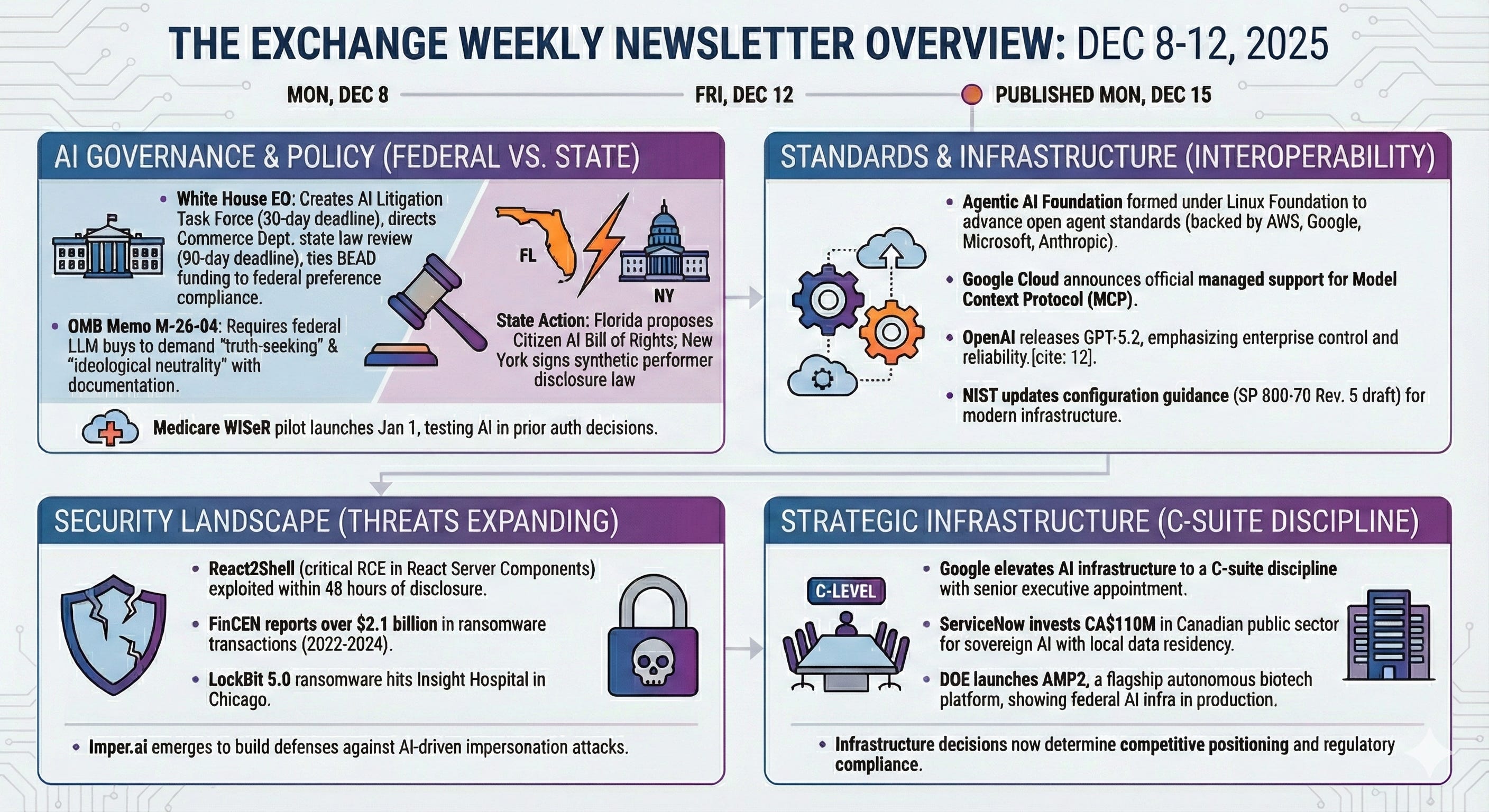
This past week marked the moment when abstract AI policy debates crystallized into concrete executive action, procurement mandates, and compliance deadlines that technology and security leaders can no longer treat as theoretical. The White House signed an executive order explicitly challenging state AI laws, created an AI Litigation Task Force with a 30-day formation deadline, and tied remaining Broadband Equity Access and Development funds to state compliance with federal AI preferences. In parallel, the Office of Management and Budget issued Memorandum M-26-04 requiring federal agencies to demand “truth-seeking” and “ideological neutrality” from large language model vendors, complete with documentation requirements and contractual language that will reshape how government buys AI.
For all the details, subscribe to the Exchange Newsletter - free through the end of 2025.
We are so confident you’ll find value in your Exchange Subscription in just 30 days, we will refund your subscription if you’re not satisfied.
The infrastructure picture shifted from aspiration to execution. The Linux Foundation launched the Agentic AI Foundation with backing from AWS, Google Cloud, Microsoft, and Anthropic, signaling that agent interoperability standards are moving from a competitive advantage to a baseline expectation. Google elevated AI infrastructure to a C-suite discipline, acknowledging that data center buildouts, custom chips, and backbone networking are now strategic decisions with tens of billions of dollars at stake. ServiceNow committed CA$110 million to Canadian public-sector AI infrastructure, demonstrating that sovereign AI deployments require not just technology but also local presence, dedicated teams, and explicit commitments to data residency. Google Cloud made Model Context Protocol an official integration layer through managed remote servers, reducing the connector maintenance burden and positioning Apigee as the policy and identity control plane for agent tool access.
Healthcare governance moved from pilot to production with the launch of Medicare’s WISeR model in six states on January 1, allowing selected Medicare Advantage and Part D plans to use AI and algorithmic tools in prior authorization decisions. Physicians and lawmakers are raising concerns about opaque algorithms driving denials and complicating appeals, making WISeR a live test of whether logging, explainability, and human oversight requirements can actually protect patients when AI enters high-stakes care decisions.
The security landscape remained under pressure from multiple directions. React2Shell, a maximum-severity remote code execution vulnerability in React Server Components, joined CISA’s Known Exploited Vulnerabilities catalog as adversaries raced to exploit modern web frameworks. LockBit 5.0 hit Insight Hospital in Chicago, adding another healthcare ransomware victim to the list. FinCEN reported more than $2.1 billion in ransomware payments between 2022 and 2024, quantifying what had been anecdotal evidence of ransomware as a multi-billion-dollar systemic risk. Imper.ai emerged from stealth with $28 million to build real-time defenses against AI-driven impersonation, from deepfake video calls to synthetic voice attacks.
State-level action accelerated even as federal preemption efforts intensified. Florida proposed a Citizen AI Bill of Rights that would give residents new protections around personal data and image use while explicitly limiting utilities from passing AI data center costs through to ratepayers. New York signed legislation requiring advertisements to disclose when AI-generated synthetic performers are used and mandating consent for the use of post-mortem likenesses. These moves demonstrate that states are not waiting for federal clarity and are willing to impose conditions on AI infrastructure and creative pipelines that affect how enterprises operate.
The convergence of executive action, procurement mandates, infrastructure standardization, and state-level legislation has made the compliance environment significantly more complex. Organizations can no longer plan for a single regulatory future. They must build strategies that account for federal preemption efforts that may or may not succeed, state laws that may or may not survive legal challenge, and procurement requirements that are already binding on federal contractors. The winners will be those who treat regulatory volatility as a design constraint and build adaptive compliance capabilities rather than waiting for clarity that may never arrive.
Federal Authority Collides with State Experimentation - The Week AI Governance Got Real
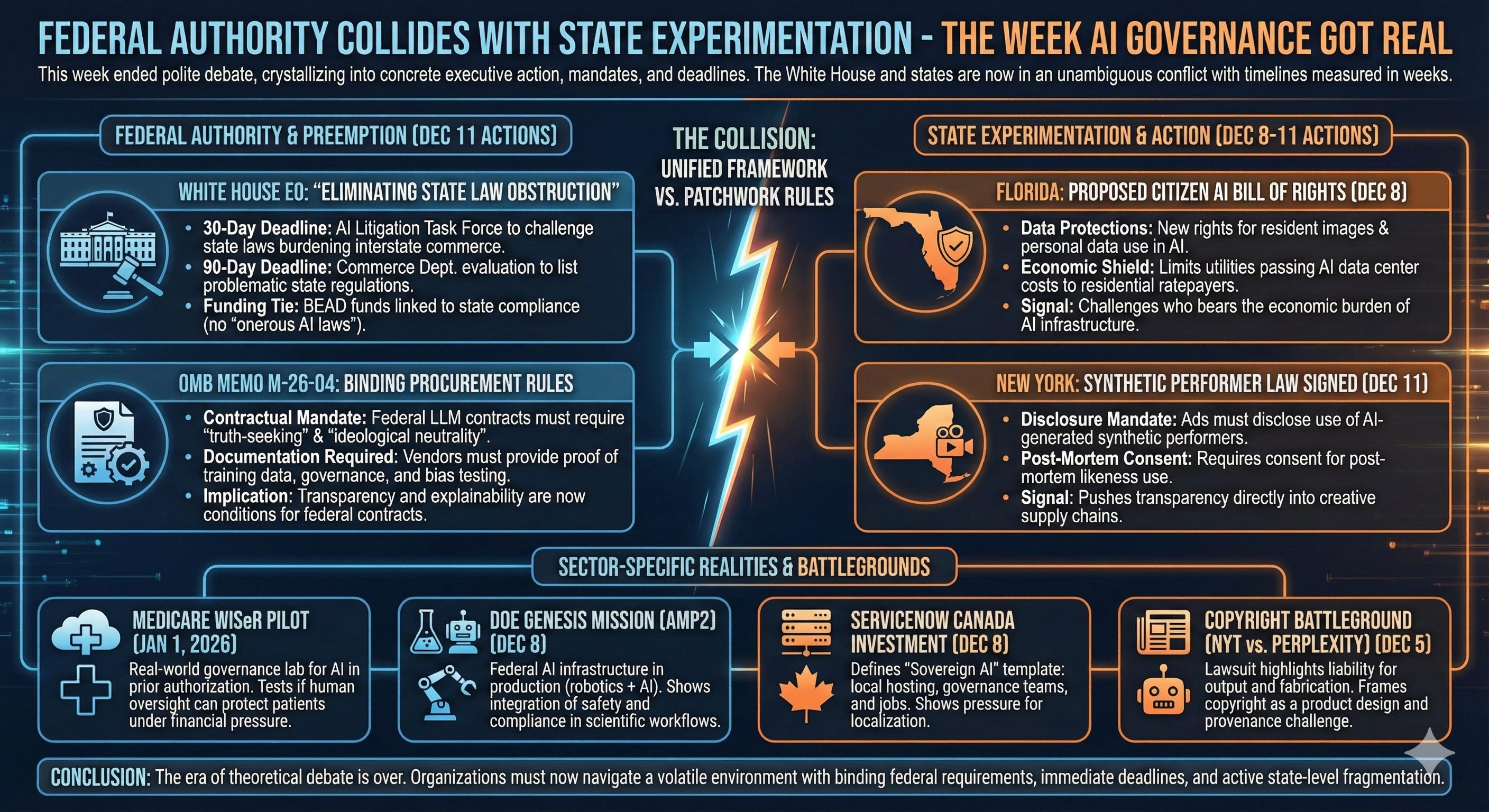
This week ended the era of polite debate about whether the United States will operate under a unified federal AI framework or a patchwork of state-level rules. The White House made its position unambiguous, states doubled down on their authority to protect residents, and the legal and political machinery to resolve this fight kicked into gear with timelines measured in weeks, not years.
The Federal Preemption Order and What It Actually Does
On December 11, the White House signed an executive order titled “Eliminating State Law Obstruction of National Artificial Intelligence Policy” that does three specific things with immediate operational implications (White House, December 11, 2025). First, it directs the Attorney General to establish an AI Litigation Task Force within 30 days to identify state AI laws that may be challenged in court as burdens on interstate commerce or conflicts with federal authority. Second, it directs the Commerce Department to publish an evaluation of existing state AI laws within 90 days, creating a formal list of regulations the administration considers problematic. Third, it ties eligibility for certain remaining Broadband Equity Access and Development non-deployment funds to whether a state has what the order calls “onerous AI laws,” to the maximum extent allowed by federal law.
For technology and policy leaders, this is not rhetoric. It is a binding directive to federal agencies with explicit deadlines and funding consequences. The 30-day timeline for the task force means that by mid-January, the Department of Justice will have a formal structure for evaluating which state laws to challenge. The 90-day Commerce evaluation means that by mid-March, there will be a published assessment that effectively becomes a roadmap for where the administration sees legal vulnerabilities. The BEAD funding provision creates immediate financial pressure on states that might otherwise ignore federal preferences.
This matters because AI compliance strategies built around stable state frameworks just became obsolete. If you have mapped AI systems to California’s transparency requirements, Colorado’s algorithmic impact assessments, or any other state-specific rule, you now need to plan for scenarios where those requirements are frozen by litigation, overturned by courts, or abandoned by states that decide federal funding is more valuable than regulatory autonomy. That does not mean state laws will disappear overnight, but it does mean they carry execution risk that must be factored into compliance roadmaps and vendor contracts.
OMB Procurement Memo Adds Binding Requirements for Federal LLM Buyers
While the executive order challenged state authority, the Office of Management and Budget issued Memorandum M-26-04 on the same day, requiring federal agencies to add contractual language when procuring large language models (OMB, December 11, 2025). The memo operationalizes the July 2025 executive order on “Unbiased AI Principles” by directing agencies to ensure that solicitations include requirements for “truth-seeking” and “ideological neutrality” and to obtain sufficient vendor documentation to determine compliance.
For federal contractors and systems integrators, this is a hard compliance requirement, not guidance. If you sell or integrate LLM capabilities into federal systems, you will face questions about how your models are trained, what data sources are used, how outputs are validated for accuracy, and what controls exist to prevent ideological bias. You will need documentation ready to provide during procurement evaluations, and you will need contract language that commits to ongoing compliance with these principles.
The practical implication is that winning federal AI contracts now requires not just technical capability but also transparency into training data, model governance, and output validation. Organizations that treat LLMs as black boxes or that cannot provide clear lineage for training data will struggle to meet the documentation requirements. Those that have invested in explainability, data provenance, and bias testing will have a competitive advantage in federal procurement.
The combination of the preemption order and the procurement memo creates a two-track compliance challenge. On one track, organizations must navigate the uncertainty created by federal challenges to state laws. On the other track, they must meet new federal procurement requirements that are already binding. The result is that compliance teams need to plan for parallel futures where state and federal rules may diverge, converge, or remain in conflict for extended periods.
Florida and New York Demonstrate States Are Not Waiting
Even as the White House moved to preempt state authority, Florida and New York advanced their own AI frameworks this week, signaling that states view AI governance as a core responsibility regardless of federal pressure. Florida Governor Ron DeSantis announced a proposed Citizen AI Bill of Rights that would establish new protections around how residents’ images and personal data can be used in AI systems (Florida Governor’s Office, December 8, 2025). The proposal also includes provisions explicitly limiting utilities from passing the costs of AI data centers through to residential ratepayers, addressing community concerns about who bears the economic burden of AI infrastructure.
The Florida proposal is significant because it mixes civil rights protections with infrastructure economics. It is not just about algorithmic transparency or bias testing. It is about whether local communities will subsidize data center power consumption through higher electric bills. For hyperscalers and enterprises planning AI data center investments, this is a warning that state and local governments will impose conditions on infrastructure projects if they perceive that benefits flow elsewhere while costs stay local.
New York signed legislation requiring advertisements to disclose when AI-generated synthetic performers are used and mandating consent for post-mortem likeness use (New York Governor’s Office, December 11, 2025). The law pushes transparency requirements into the creative supply chain and raises the bar for rights management in generative media. For marketing and communications teams using AI-generated video, voice, or images, this creates concrete compliance obligations around disclosure and consent that must be built into creative workflows, not bolted on afterward.
The timing of these state actions, coming in the same week as the federal preemption order, underscores the intensity of the conflict. States are not pausing their legislative agendas to wait for federal clarity. They are moving forward with rules tailored to local priorities, creating the very fragmentation that federal preemption is designed to prevent.
Medicare WISeR Pilot Becomes Real-World AI Governance Laboratory
The Centers for Medicare and Medicaid Services WISeR model launches January 1, 2026, allowing selected Medicare Advantage and Part D plans in Arizona, Florida, Ohio, Pennsylvania, Tennessee, and Texas to use AI and algorithmic tools in prior authorization decisions (CMS, December 4, 2025). The pilot is designed to test whether AI can reduce wasteful and inappropriate services while maintaining access to medically necessary care, but physician groups and some lawmakers are expressing concerns that financial incentives tied to denials, combined with opaque algorithms, could worsen delays and reduce patient access.
For healthcare technology and compliance leaders, WISeR is not an abstract policy experiment. It is a live test of whether AI governance frameworks centered on logging, explainability, and human oversight can actually protect patients when AI enters high-stakes decisions about care access. The pilot explicitly preserves requirements for human review and documentation, but critics worry that these guardrails will prove insufficient when plans face financial pressure to deny claims and patients struggle to understand or appeal algorithmic decisions.
The WISeR pilot matters beyond healthcare because it demonstrates the operational challenges of deploying AI in regulated decision-making. Every industry facing similar pressures (financial services making credit decisions, employers using AI in hiring, housing providers screening applicants) will face questions about how to balance efficiency gains with fairness, transparency, and accountability. The lessons from WISeR, both positive and negative, will shape expectations for AI governance across sectors.
DOE Genesis Mission Shows Federal AI Infrastructure in Production
While policy debates raged, the Department of Energy demonstrated what federal AI infrastructure looks like in production by launching the Anaerobic Microbial Phenotyping Platform, or AMP2, at Pacific Northwest National Laboratory (DOE, December 8, 2025). The largely autonomous biotech system combines robotics and AI to accelerate microbial research and serves as a flagship project under the Genesis Mission national AI science agenda.
For CIOs and CTOs working in regulated research and production environments, AMP2 is a reference design for connecting AI models to physical systems, data acquisition, and compliance workflows in ways that regulators and boards can accept. It demonstrates that AI infrastructure is not just software and cloud models but also the integration layer between AI decision-making and physical operations where safety and regulatory compliance are non-negotiable.
The DOE investment in AMP2 underscores that federal AI strategy extends beyond policy and procurement to direct investment in infrastructure that advances scientific capabilities. For organizations working with federal research agencies, this signals opportunities to partner on AI-enabled research platforms, but it also sets expectations around safety controls, human oversight, and validation that will apply to any AI system touching federally funded research.
ServiceNow Canada Investment Defines Sovereign AI Expectations
ServiceNow announced a CA$110 million investment to support AI adoption across Canada’s public sector, including Canadian-hosted AI-ready infrastructure, a new national Center of Excellence, and approximately 100 new high-skill jobs (ServiceNow, December 8, 2025). The commitment is designed to allow government agencies to run AI workloads on the Now platform while maintaining data residency and sovereignty requirements.
For public sector and highly regulated enterprises, the ServiceNow Canada investment is a template for the kinds of commitments large platforms will need to make as governments demand more control over where AI runs and how data is handled. It demonstrates that sovereign AI is not just about technology but about local presence, dedicated governance teams, and shared responsibility models that reach beyond traditional SaaS boundaries.
The investment also signals competitive pressure among major platforms to secure long-term relationships with governments willing to commit to multi-year AI deployments. Organizations planning AI contracts with government agencies should expect to negotiate similar terms around data residency, local job creation, governance structures, and shared responsibility for security and compliance.
Copyright as AI Governance Battleground
The New York Times sued Perplexity AI for allegedly copying and republishing millions of articles without permission, including paywalled content, and for fabricating stories while displaying Times branding (Reuters, December 5, 2025). The lawsuit moves beyond traditional copyright scraping claims to address product design and output liability, raising questions about how AI companies are liable when their systems generate false information attributed to reputable sources.
For technology and security leaders, the Times lawsuit is a rehearsal for exposure when mixing internal, licensed, and public data into AI systems that generate answers instead of links. It creates pressure to document training data provenance, respect robots.txt and paywalls, govern retrieval augmented generation carefully, and handle takedown or correction requests when AI systems produce false or misleading output.
The lawsuit matters because it frames copyright not just as a legal compliance issue but as a product design challenge. If your AI system can generate content that appears to come from third-party sources, you face liability risk not just for copying but also for misattribution and false information. Organizations deploying retrieval-augmented generation or answer engines need clear policies around citation, attribution, and validation of generated content, along with processes for handling disputes when sources claim misuse.
The convergence of the preemption order, procurement memo, state legislative action, Medicare pilot, federal research infrastructure, sovereign AI commitments, and copyright litigation demonstrates that AI governance is no longer a theoretical discussion. It is a rapidly evolving legal, procurement, and operational environment where organizations must plan for multiple regulatory futures simultaneously while meeting immediate compliance deadlines.
Theme Sources:
White House, “Executive Order on Eliminating State Law Obstruction of National Artificial Intelligence Policy,” December 11, 2025, https://www.whitehouse.gov/presidential-actions/2025/12/eliminating-state-law-obstruction-of-national-artificial-intelligence-policy/
Office of Management and Budget, “Memorandum M-26-04: Increasing Public Trust in Artificial Intelligence Through Unbiased AI Principles,” December 11, 2025, https://www.whitehouse.gov/wp-content/uploads/2025/12/M-26-04-Increasing-Public-Trust-in-Artificial-Intelligence-Through-Unbiased-AI-Principles-1.pdf
Florida Governor’s Office, “Governor Ron DeSantis Announces Proposal ‘Citizen Bill of Rights for Artificial Intelligence,’” December 8, 2025, https://www.flgov.com/eog/news/press/2025/governor-ron-desantis-announces-proposal-citizen-bill-rights-artificial
New York Governor’s Office, “Governor Hochul Signs Legislation to Protect Consumers and Boost AI Transparency in Film Industry,” December 11, 2025, https://www.governor.ny.gov/news/governor-hochul-signs-legislation-protect-consumers-and-boost-ai-transparency-film-industry
Centers for Medicare and Medicaid Services, “WISeR Model,” December 4, 2025, https://www.cms.gov/priorities/innovation/innovation-models/wiser
Department of Energy, “Energy Department Launches Breakthrough AI-Driven Biotechnology Platform at PNNL,” December 8, 2025, https://www.energy.gov/articles/energy-department-launches-breakthrough-ai-driven-biotechnology-platform-pnnl
ServiceNow, “ServiceNow Makes Major Multi-Year Investment to Enable AI Adoption at Scale Across Canada’s Public Sector,” December 8, 2025, https://www.businesswire.com/news/home/20251208982450/en/ServiceNow-Makes-Major-Multi-Year-Investment-to-Enable-AI-Adoption-at-Scale-Across-Canadas-Public-Sector
Reuters, “New York Times sues Perplexity AI for infringing copyright works,” December 5, 2025, https://www.reuters.com/legal/litigation/new-york-times-sues-perplexity-ai-infringing-copyright-works-2025-12-05/
TechCrunch, “The New York Times is suing Perplexity for copyright infringement,” December 5, 2025, https://techcrunch.com/2025/12/05/the-new-york-times-is-suing-perplexity-for-copyright-infringement/
The Standards War Heats Up - Agent Interoperability Moves from Competitive Edge to Table Stakes
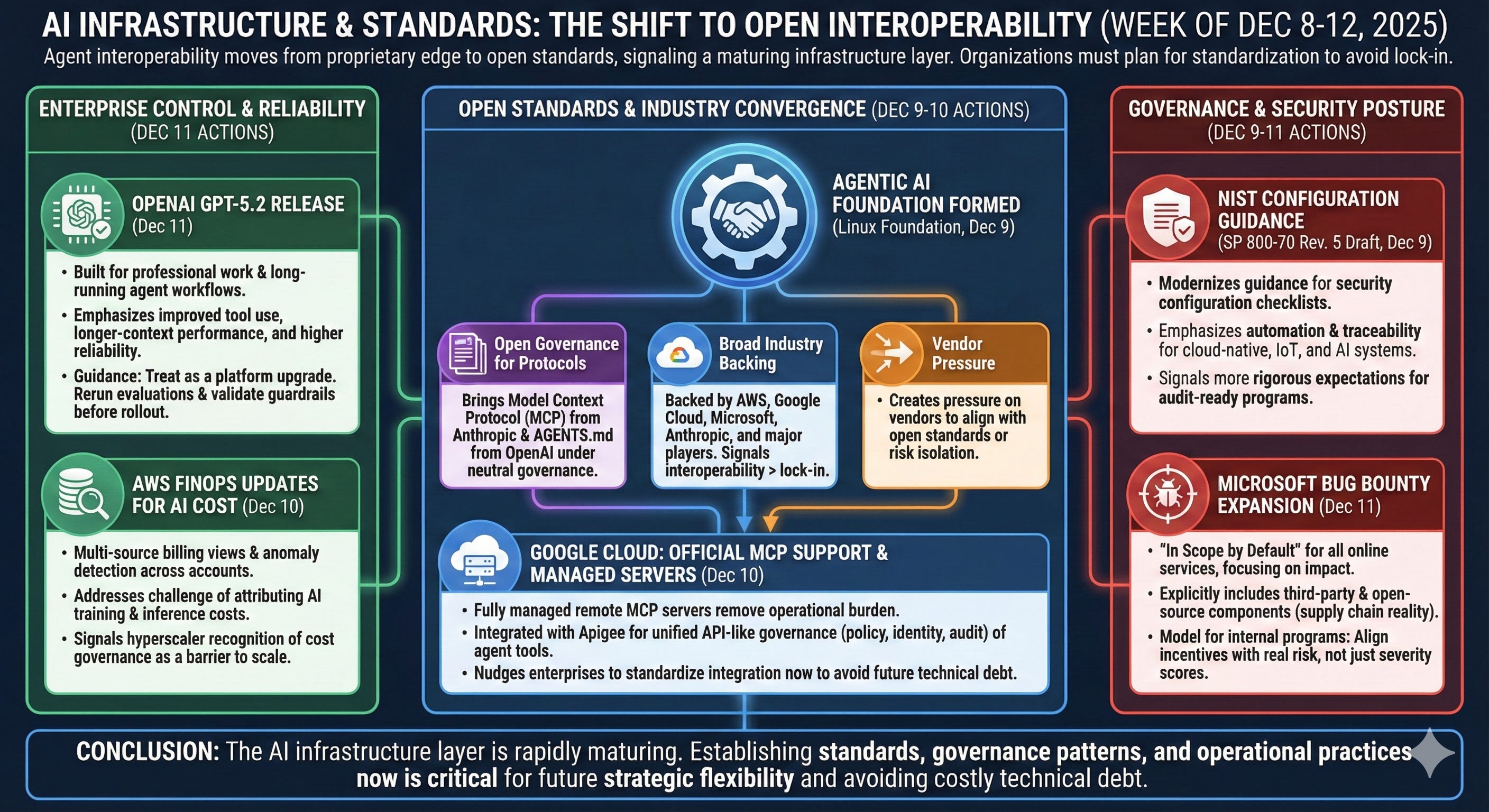
This week marked a turning point in how the industry approaches AI agent infrastructure. The formation of the Agentic AI Foundation under the Linux Foundation, Google Cloud’s official support for Model Context Protocol, and OpenAI’s GPT-5.2 release converge to demonstrate that agent interoperability is moving from proprietary competitive advantage to open standards with broad industry backing. The organizations that recognize this shift and plan accordingly will avoid costly lock-in. Those who bet on proprietary agent frameworks may find themselves on the wrong side of a standardization wave.
The Agentic AI Foundation Signals Industry Convergence
The Linux Foundation announced the formation of the Agentic AI Foundation on December 9, bringing together Model Context Protocol from Anthropic, AGENTS.md from OpenAI, and related efforts under open governance with backing from AWS, Google Cloud, Microsoft, Anthropic, and other major players (Linux Foundation, December 9, 2025). The foundation is designed to advance open, interoperable standards and tooling for agentic AI systems, moving key protocols out of single-vendor control and into neutral governance structures.
For technology leaders, this represents a fundamental shift in how agent infrastructure will evolve. When major cloud providers and AI companies agree to collaborate on open standards rather than compete through proprietary stacks, it signals that the market believes interoperability is more valuable than lock-in. The formation of the foundation creates pressure on every AI vendor to align with these emerging standards or risk building isolated platforms that cannot easily integrate with the broader ecosystem.
The practical implication is that organizations deploying AI agents should prioritize vendors that commit to open standards and demonstrate interoperability with MCP and related protocols. Contracts should include provisions requiring alignment with foundation standards and protecting against lock-in if vendors fail to deliver on interoperability promises. The time to negotiate these terms is now, before agents proliferate across the enterprise and migration becomes prohibitively expensive.
The foundation also creates a governance structure that allows competing vendors to collaborate on core infrastructure while still differentiating on application-layer capabilities. This is the same pattern that succeeded with container orchestration through Kubernetes and cloud-native infrastructure through CNCF. Organizations that learned from those transitions understand that betting on open standards early provides more strategic flexibility than optimizing for any single vendor’s proprietary features.
Google Cloud Makes MCP Official with Managed Remote Servers
Google Cloud announced official support for Model Context Protocol through fully managed remote MCP servers, allowing AI agents to access Google and Google Cloud services through standardized interfaces (Google Cloud, December 10, 2025). The announcement is significant not just because it validates MCP as a standard but because it reduces the operational burden of maintaining local MCP servers or fragile open-source connectors.
Google also integrated MCP support with Apigee, its API management platform, signaling that agent tool access will be governed the same way APIs are governed today, with unified policy, identity, and audit controls. This is exactly the governance model that enterprise architects have been asking for, one that treats agent capabilities as manageable, auditable resources rather than as uncontrolled integrations scattered across business units.
For CTOs and platform teams, the Google Cloud MCP announcement is a nudge to standardize agent tool integration now, before every business unit invents its own connector stack. Organizations that establish clear policies for how agents access enterprise services, with centralized governance and monitoring, will avoid the technical debt and security risk that comes from unmanaged agent proliferation.
The managed remote server model also addresses a practical challenge that has slowed MCP adoption. Running local MCP servers requires infrastructure, maintenance, and expertise that many organizations lack. By offering managed endpoints, Google Cloud removes friction and makes it easier for enterprises to adopt MCP without building specialized infrastructure teams. This pattern will likely be replicated by other cloud providers, further accelerating standardization.
OpenAI GPT-5.2 Emphasizes Enterprise Control and Reliability
OpenAI released GPT-5.2 on December 11, positioning it as a model series built for professional work and long-running agent workflows (OpenAI, December 11, 2025). The release emphasizes improved tool use, longer-context performance, and higher reliability on complex multi-step tasks. For enterprises with production agents, the announcement represents both opportunity and risk, as new pricing, model naming, and capability tiers can change unit economics and governance defaults overnight.
The practical guidance for technology leaders is to treat GPT-5.2 like a platform upgrade rather than a drop-in replacement. Organizations should rerun evaluation suites, validate tool-call guardrails, verify that monitoring and logging capture new model behaviors, and only then broaden rollout. The temptation to immediately switch to the latest model can introduce unintended changes in output quality, cost, or behavior that affect production systems.
OpenAI’s emphasis on reliability and tool use addresses two of the most significant enterprise concerns about AI agents. Reliability matters because agents often operate with limited human oversight, and failures can cascade through workflows in ways that are difficult to detect and correct. Tool use matters because agents derive value from their ability to interact with enterprise systems, and poor tool integration creates security and operational risk.
The combination of new capabilities, pricing changes, and governance requirements means that GPT-5.2 adoption should be treated as a deliberate migration project, not an automatic upgrade. Organizations need to assess which use cases benefit most from new capabilities, what the cost implications are at scale, and how to ensure that existing safety and monitoring controls remain effective with the new model.
AWS FinOps Updates Address AI Cost Governance
AWS announced updates to its Cloud Financial Management capabilities at re:Invent, including multi-source billing views that can aggregate shared billing information from up to 20 payer accounts, new dashboards, billing transfer capabilities, and expanded anomaly detection (AWS, December 10, 2025). The updates are designed to make spend attribution and operating controls easier for large multi-account organizations, reducing friction between finance and engineering teams.
For organizations running AI workloads on AWS, these FinOps updates address a chronic pain point. AI training and inference costs can be difficult to attribute accurately when workloads span multiple accounts, teams, and projects. Improved visibility and allocation capabilities allow organizations to understand true AI costs, implement chargebacks that drive accountability, and detect anomalies before they result in surprise invoices.
The practical implication is that organizations should revisit their cloud cost management practices in light of these new capabilities. If cloud cost governance is a board-level concern, or if finance and engineering teams struggle to agree on cost attribution, the AWS updates provide tools that can reduce friction and improve transparency. Organizations should work with their FinOps leads to evaluate which features can simplify showback and chargeback in the next quarter.
The FinOps updates also matter because they signal that hyperscalers recognize cost management is a barrier to AI adoption at scale. When organizations cannot predict or control AI costs, they limit experimentation and deployment. By improving cost visibility and control, AWS is trying to reduce one of the structural barriers to broader AI adoption.
NIST Configuration Guidance Reflects Modern Reality
NIST published an initial public draft of Special Publication 800-70 Revision 5, updating guidance for the National Checklist Program and how security configuration checklists are developed, tested, and maintained (NIST, December 9, 2025). The draft emphasizes improved usability, modernized automation approaches, and stronger alignment with widely used cybersecurity frameworks and control catalogs.
For audit-ready hardening programs, the NIST update matters because configuration baselines remain one of the highest-leverage security controls. Updated federal guidance shapes what good looks like across vendors, regulated industries, and any organization that needs evidence-driven security reporting. The revision acknowledges that modern infrastructure includes cloud services, IoT devices, and AI systems, expanding coverage beyond traditional servers and network devices.
Organizations should treat the NIST draft as an opportunity to modernize their configuration management programs. The guidance emphasizes automation and traceability, reflecting the reality that manual configuration management does not scale in cloud-native and AI-enabled environments. Organizations that invest in automated configuration validation, continuous compliance monitoring, and clear audit trails will find it easier to meet both the updated NIST guidance and related requirements from other frameworks.
The NIST update also signals that federal agencies and contractors should expect more rigorous configuration management expectations, particularly for systems handling controlled unclassified information or operating in sensitive environments. Organizations that have treated configuration management as a check-the-box compliance activity will need to upgrade their capabilities to meet evolving standards.
Microsoft Bug Bounty Expansion Aligns Incentives with Real Risk
Microsoft Security Response Center announced a new “In Scope by Default” approach that expands bug bounty eligibility to include all online services by default, focusing incentives on vulnerabilities with direct and demonstrable impact (Microsoft, December 11, 2025). The policy also explicitly includes third-party and open-source components when they affect online service security, acknowledging supply chain realities.
For security leaders, the Microsoft approach offers a useful pattern for internal disclosure programs. Scope definitions should reflect real risk at the seams between dependencies, services, and operational environments. Bounty programs can be governance instruments when aligned with what threat models indicate matters most. By defaulting to a broad scope rather than requiring services to opt in, Microsoft reduces the risk that new services launch without a security review.
The inclusion of third-party and open-source components in scope is particularly significant. Modern applications depend on complex supply chains, and vulnerabilities in dependencies often have as much impact as flaws in first-party code. By explicitly including these components, Microsoft creates incentives for researchers to examine the full attack surface rather than just the parts Microsoft directly controls.
Organizations building or refining internal bug bounty programs should consider adopting similar principles. Default to a broad scope rather than narrow exclusions. Align incentives with business impact rather than technical severity scores. Include supply chain components that affect production security. These design choices can make bounty programs more effective governance tools rather than just cost centers for paying researchers.
The convergence of the Agentic AI Foundation, Google Cloud MCP support, OpenAI GPT-5.2, AWS FinOps updates, NIST configuration guidance, and Microsoft bug bounty expansion demonstrates that the infrastructure layer for AI is maturing rapidly. The standards, governance patterns, and operational practices that will define the next several years of AI deployment are being established now. Organizations that engage with these developments and shape their strategies accordingly will be better positioned than those that wait for clarity or assume that current patterns will persist.
Theme Sources:
Linux Foundation, “Linux Foundation Announces the Formation of the Agentic AI Foundation,” December 9, 2025, https://www.linuxfoundation.org/press/linux-foundation-announces-the-formation-of-the-agentic-ai-foundation
Google Cloud, “Announcing official MCP support for Google services,” December 10, 2025, https://cloud.google.com/blog/products/ai-machine-learning/announcing-official-mcp-support-for-google-services
OpenAI, “Introducing GPT-5.2,” December 11, 2025, https://openai.com/index/introducing-gpt-5-2/
AWS, “AWS Cloud Financial Management: Key re:Invent 2025 launches to transform your FinOps practice,” December 10, 2025, https://aws.amazon.com/blogs/aws-cloud-financial-management/aws-cloud-financial-management-key-reinvent-2025-launches-to-transform-your-finops-practice/
NIST, “SP 800-70 Rev. 5 (Initial Public Draft),” December 9, 2025, https://csrc.nist.gov/pubs/sp/800/70/r5/ipd
Microsoft Security Response Center, “In Scope by Default,” December 11, 2025, https://www.microsoft.com/en-us/msrc/blog/2025/12/in-scope-by-default
Security Under Siege - From React2Shell to Hospital Ransomware, No Safe Harbor Remains
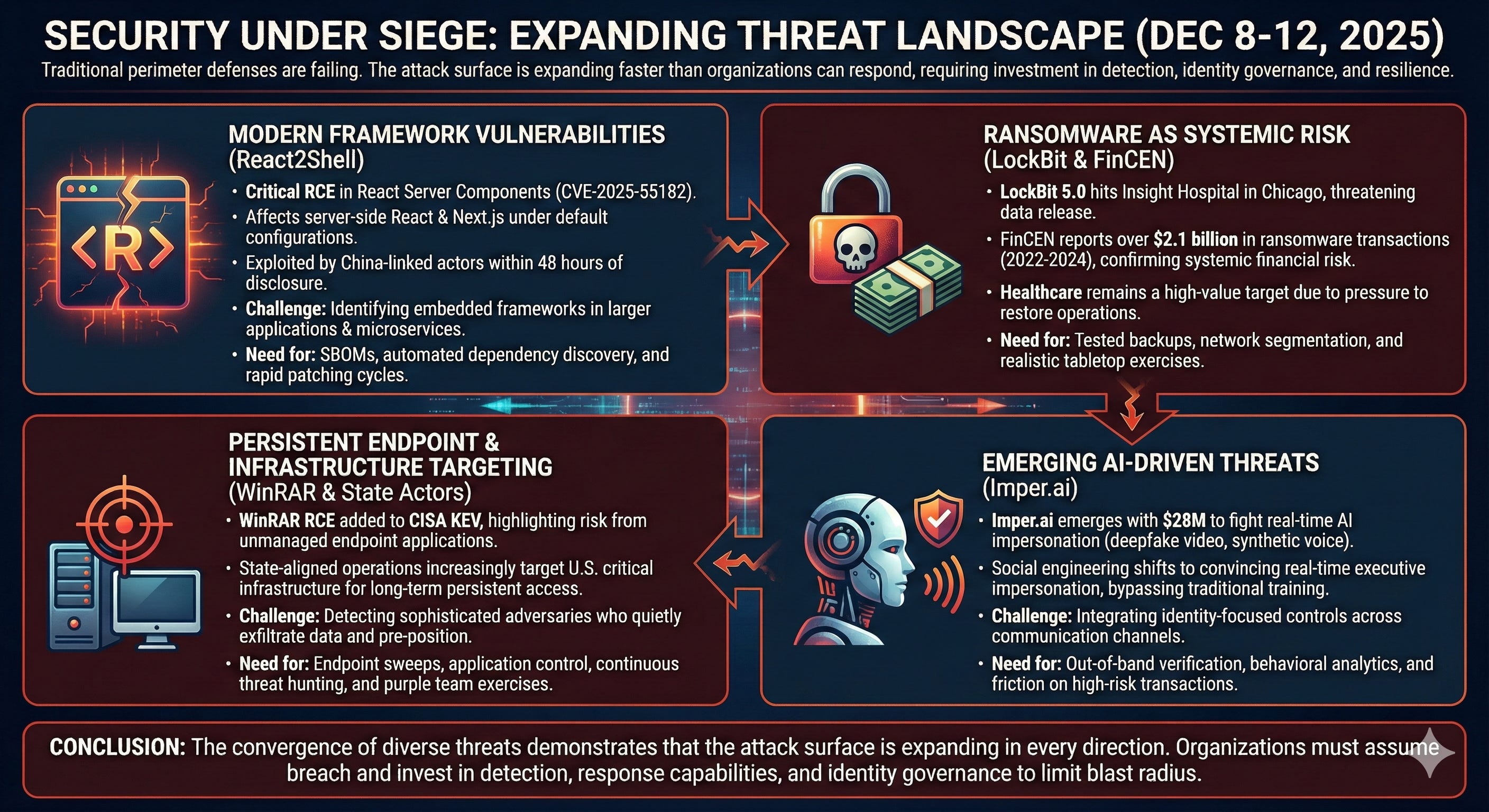
This week reinforced that the cybersecurity threat landscape is expanding faster than most organizations can respond. A maximum-severity vulnerability in React Server Components was added to CISA’s Known Exploited Vulnerabilities catalog. A major hospital fell victim to LockBit 5.0 ransomware. FinCEN quantified ransomware as a $2.1 billion problem between 2022 and 2024. A startup raised $28 million to defend against AI-driven impersonation. WinRAR joined the KEV catalog as an actively exploited flaw on high-value endpoints. The pattern across all these developments is clear: traditional perimeter defenses are failing, and organizations that have not invested in detection, identity governance, and resilience are operating in the dark about ongoing compromise.
React2Shell Exposes Modern Web Framework Risk
The React team disclosed CVE-2025-55182, a critical remote code execution vulnerability in React Server Components with a CVSS score of 10.0, on December 3 (React Blog, December 3, 2025). Known as React2Shell, the flaw affects server-side React and popular frameworks like Next.js under default configurations, putting many modern web and AI front ends in scope even when teams do not consider themselves to be running React on the server.
For enterprise architects and security teams, React2Shell is exactly the kind of issue CISA’s Known Exploited Vulnerabilities catalog was designed to address. The vulnerability tests how quickly organizations can identify where a framework is in use, push patches, and verify that third-party providers have done the same. It reinforces the value of software bills of materials, automated dependency discovery, and clear ownership for shared frameworks that can otherwise fall through the cracks.
The practical challenge is that React and Next.js are often embedded in larger applications, microservices, and internal tools that may not be formally tracked as React deployments. Organizations need to conduct sweeps of their application portfolios to identify where React Server Components are in use, prioritize patching based on exposure and data sensitivity, and verify that cloud-hosted applications and SaaS platforms have also applied updates.
AWS detected China-linked threat actors Earth Lamia and Jackpot Panda attempting to exploit React2Shell within 48 hours of disclosure (AWS, December 5, 2025). The rapid exploitation demonstrates that adversaries monitor vulnerability disclosures, integrate public exploits into scanning infrastructure, and conduct broad campaigns across multiple CVEs to maximize their chances of finding vulnerable targets. Organizations that rely on monthly or quarterly patching cycles for web application frameworks are giving adversaries weeks or months of opportunity.
React2Shell also highlights risk in modern front-end stacks. Many organizations have strong patch management for operating systems and databases, but weaker discipline around JavaScript frameworks, npm packages, and front-end dependencies. Software bills of materials and patch pipelines must cover the full application stack, including front-end frameworks that may be managed by different teams or buried in containerized microservices.
LockBit 5.0 Hospital Ransomware Underscores Healthcare Vulnerability
LockBit 5.0 listed Insight Hospital and Medical Center in Chicago on its leak site, threatening to release stolen data (Dexpose, December 2025). The incident follows a familiar pattern of data theft, extortion, and potential disruption of hospital operations, adding another name to the growing list of healthcare organizations under ransomware pressure.
For healthcare executives and leaders handling regulated data, the Insight Hospital incident is a reminder that ransomware is a long-tail operational risk, not just a weekend headline. It reinforces the need for realistic tabletop exercises that test response capabilities under pressure, segmented clinical networks that limit lateral movement, well-practiced backup and recovery plans that can restore operations quickly, and frank conversations with boards about how much downtime and data loss the current architecture would actually tolerate.
The healthcare sector remains a high-value target for ransomware groups because hospitals face intense pressure to restore operations quickly to avoid patient harm, thereby increasing the likelihood of ransom payments. Electronic health records, medical devices, and clinical systems often run on older software with known vulnerabilities, creating an abundant attack surface. The regulatory environment around patient data creates additional pressure, as breaches trigger notification requirements and potential enforcement actions.
Healthcare CIOs and CISOs should treat ransomware as an ongoing operational risk that requires continuous investment in detection, segmentation, backup, and recovery capabilities. Waiting until after an incident to test backup restoration or rehearse crisis communications means the first real test occurs under maximum pressure, with patients at risk. Organizations that invest in regular exercises, maintain current backups with offline copies, and have pre-negotiated relationships with incident response firms will fare better when ransomware inevitably arrives.
FinCEN Data Quantifies Ransomware as Multi-Billion Dollar Systemic Risk
The Financial Crimes Enforcement Network reported that ransomware-related transactions totaled more than $2.1 billion between 2022 and 2024, with thousands of suspicious activity reports identifying ransomware as the suspected underlying crime (FinCEN, 2025). The data quantifies what had previously been anecdotal evidence of ransomware as a systemic financial risk affecting critical infrastructure, healthcare, state and local governments, and private enterprises.
For boards, CFOs, and risk committees, the FinCEN data provides concrete evidence that ransomware is not an isolated cybersecurity problem but a financial crime challenge with measurable economic impact. The $2.1 billion figure represents only reported transactions and likely understates total ransomware payments, as many incidents go unreported or are settled through cryptocurrency transactions designed to evade detection.
The FinCEN analysis also highlights that ransomware operations function as organized criminal enterprises with specialized roles, infrastructure, and financial networks. Disrupting these operations requires coordination between law enforcement, financial institutions, and victim organizations. The data underscores that preventing ransomware payments through better security controls and resilience is more effective than trying to recover funds after payments are made.
Organizations should interpret the FinCEN data as validation that investment in ransomware prevention, detection, and recovery is justified by measurable financial risk. Boards that question cybersecurity budgets or resist tabletop exercises should be presented with evidence that ransomware is a multi-billion-dollar threat with direct impact on operations, reputation, and financial performance.
Imper.ai Raises $28 Million to Fight AI-Driven Impersonation
Imper.ai emerged from stealth with $28 million in funding to build real-time defense against AI-driven impersonation, including deepfake video calls, synthetic voice, and chat (Imper.ai, December 2025). The company’s pitch is to sit across collaboration and communication channels, fusing signals from identity, devices, behavior, and content to flag high-risk interactions before someone approves a payment or shares sensitive data.
For CISOs and fraud leaders, Imper.ai offers an early view of what an identity-focused control plane for AI-era social engineering might look like. The challenge is determining where to place these controls, how they integrate with existing identity and access management stacks, and how to measure success when the primary value is preventing one catastrophic mistake rather than logging millions of clean transactions.
The rise of AI-driven impersonation attacks reflects a fundamental shift in social engineering. Attackers no longer need to find insiders willing to help or spend months studying targets. They can use deepfake video and synthetic voice to impersonate executives in real time, creating convincing interactions that bypass traditional security awareness training. The pace and scale of these attacks will increase as tools become more accessible and sophisticated.
Organizations should evaluate whether existing fraud controls and identity verification processes are adequate for AI-driven impersonation. Multi-factor authentication helps, but does not prevent scenarios where attackers impersonate legitimate users in real-time communications. Behavioral analytics can detect anomalies but may not catch one-off attacks. Out-of-band verification, challenge questions, and delays on high-risk transactions all add friction but provide protection against impersonation at the moment of decision.
WinRAR KEV Addition Highlights Endpoint Security Gaps
CISA added a WinRAR remote code execution vulnerability to its Known Exploited Vulnerabilities catalog and set a remediation deadline for federal agencies (CISA, December 9, 2025). The addition underscores that attackers continue to exploit older, widely deployed software on high-value endpoints and administrative workstations where users regularly handle compressed files.
For security teams, the WinRAR KEV addition is a reminder that endpoint security must extend beyond operating system patches to include third-party applications that may not be centrally managed or regularly updated. WinRAR is commonly installed on administrative workstations, engineering systems, and other high-value endpoints where users need to work with compressed files. These systems often have elevated privileges or access to sensitive data, making them attractive targets.
The practical response is to conduct endpoint inventory sweeps to identify where WinRAR and similar utilities are installed, prioritize updates based on user privilege and data exposure, and consider whether alternative tools with stronger security track records might reduce risk. Organizations should also evaluate whether application control or least privilege policies can limit the impact if compression utilities are exploited.
The WinRAR KEV entry also highlights that CISA is expanding the catalog to include not just infrastructure and server vulnerabilities but also client-side applications that affect federal agencies. This broader scope reflects the reality that modern attacks target endpoints as much as servers, and that unpatched client applications can be entry points for broader compromise.
State-Aligned Cyber Operations Target Critical Infrastructure
Reporting from Check Point via Industrial Cyber identified a sharp increase in state-aligned cyber operations targeting U.S. government agencies and critical infrastructure providers, with emphasis on establishing long-term persistent access as a strategic asset (Industrial Cyber, December 2025). The operations demonstrate that nation-state adversaries are not just conducting espionage but are positioning themselves for potential disruption or sabotage in future conflicts.
For critical infrastructure operators and government agencies, the Check Point analysis underscores that detecting and evicting sophisticated adversaries requires sustained investment in threat hunting, network segmentation, and continuous monitoring. Attackers who achieve persistent access can maintain footholds for years, quietly exfiltrating data, mapping networks, and pre-positioning for future operations.
The practical implication is that organizations in government and critical infrastructure sectors cannot treat cybersecurity as a point-in-time compliance exercise. They must assume that sophisticated adversaries may already be present and that detection requires active hunting rather than waiting for alerts. This means investing in security operations centers with threat-hunting capabilities, deploying network detection and response tools to identify anomalous behavior, and conducting regular purple-team exercises to test detection effectiveness.
The convergence of React2Shell exploitation, hospital ransomware, FinCEN ransomware data, AI impersonation threats, WinRAR KEV addition, and state-aligned infrastructure targeting demonstrates that the attack surface is expanding in every direction. Organizations that continue to rely on perimeter defenses, annual vulnerability scans, and generic security awareness training will find themselves unable to detect or respond when these diverse threats converge. The path forward requires investment in detection and response capabilities, identity governance that limits blast radius, continuous monitoring that assumes breach, and realistic exercises that test whether response plans work under pressure.
Theme Sources:
React Blog, “Critical Security Vulnerability in React Server Components,” December 3, 2025,
https://react2shell.com/
National Vulnerability Database, “CVE-2025-55182,” https://nvd.nist.gov/vuln/detail/CVE-2025-55182
AWS Security Blog, “China-nexus cyber threat groups rapidly exploit React2Shell vulnerability (CVE-2025-55182),” December 5, 2025, https://aws.amazon.com/blogs/security/china-nexus-cyber-threat-groups-rapidly-exploit-react2shell-vulnerability-cve-2025-55182/
Dynatrace, “CVE-2025-55182 (React2Shell) Critical Vulnerability: What It Is and What to Do,” https://www.dynatrace.com/news/blog/cve-2025-55182-react2shell-critical-vulnerability-what-it-is-and-what-to-do/
Dexpose, “LockBit 5.0 Breaches Insight Hospital and Medical Center,” 2025, https://www.dexpose.io/lockbit-5-0-breaches-insight-hospital-and-medical-center/
Ransomware.live, “LockBit5 Group Profile,” https://www.ransomware.live/group/lockbit5
Financial Crimes Enforcement Network, “Ransomware Financial Trend Analysis,” 2025
Imper.ai, “Imper.ai Launches with $28 Million in Funding,” 2025, https://imper.ai/press/imper-ai-launches-with-28-million-in-funding/
CISA, “Known Exploited Vulnerabilities Catalog,” December 9, 2025, https://www.cisa.gov/known-exploited-vulnerabilities-catalog
Industrial Cyber, “Check Point: State-Aligned Operations Target US Critical Infrastructure,” December 2025
Infrastructure Leadership Becomes C-Suite Discipline - Capital Allocation Meets Strategic Advantage
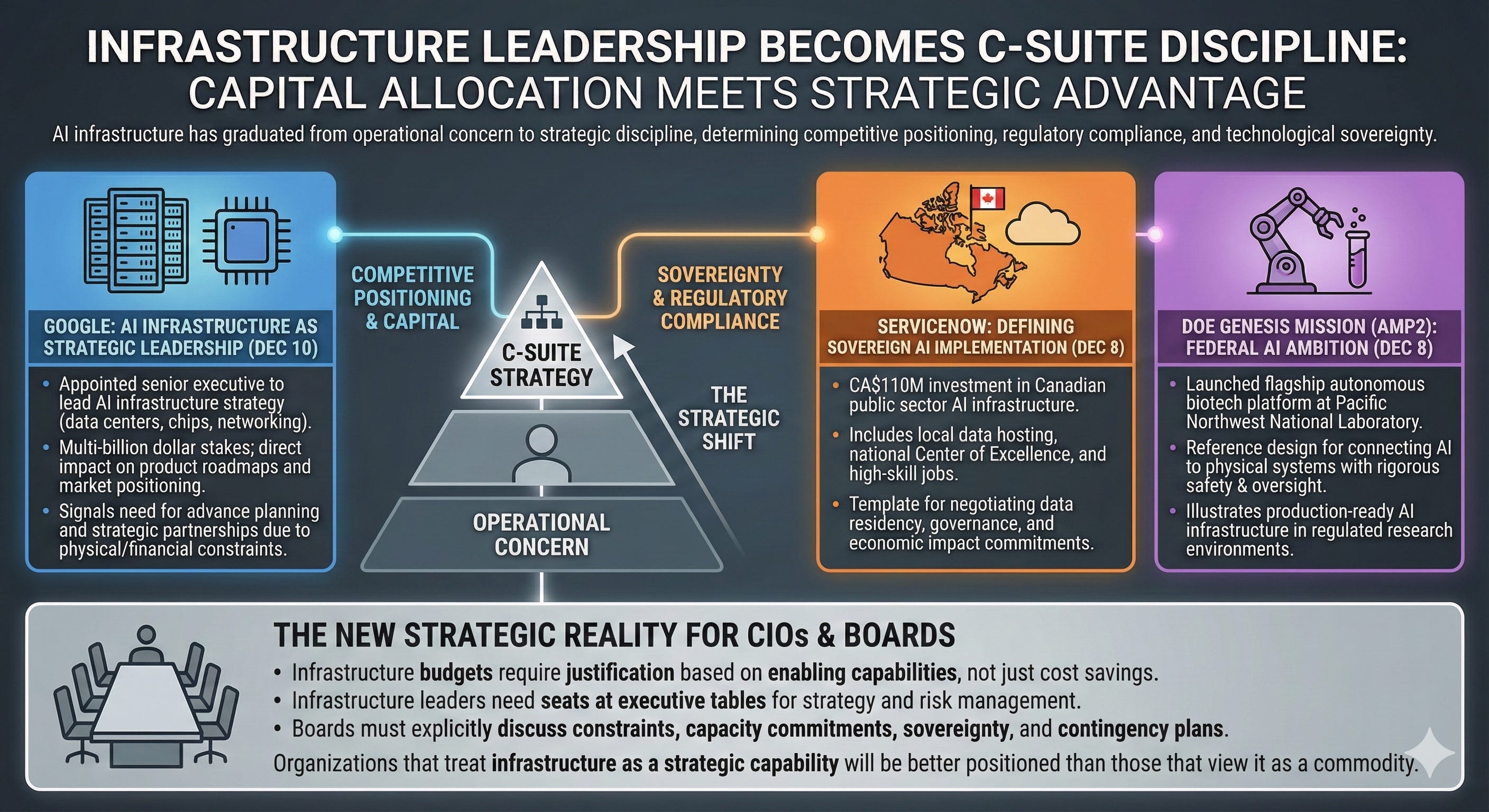
This week demonstrated that AI infrastructure has graduated from operational concern to strategic discipline requiring C-suite attention and multi-billion-dollar capital commitments. Google appointed a senior executive to lead the AI infrastructure buildout, ServiceNow invested CA$110 million in Canadian public-sector AI capabilities, and the Department of Energy launched a flagship autonomous biotech platform. These moves signal that infrastructure decisions now determine competitive positioning, regulatory compliance, and technological sovereignty rather than just operational efficiency.
Google Elevates AI Infrastructure to Named Leadership Role
Google appointed a senior executive to oversee the company’s AI infrastructure strategy, including data centers, custom chips, and backbone networking to support Gemini and cloud AI services (Reuters, December 10, 2025). The move acknowledges that the compute race is now strategic, not just operational, with tens of billions of dollars at stake and direct impact on product roadmaps and market positioning.
For cloud customers and enterprise technology leaders, Google’s organizational change signals that cloud roadmaps and capacity planning decisions will increasingly be driven by how infrastructure leaders allocate scarce GPUs, design new regions, and balance internal products like Gemini with external customer demand. Organizations should factor this into multi-cloud and contract strategies by asking hard questions about where AI workloads will physically run, how resilient those regions are, and what happens when demand exceeds available compute.
The elevation of AI infrastructure to a C-level discipline reflects the reality that hyperscalers face physical and financial constraints that limit how quickly they can scale capacity. Land acquisition, power contracts, permitting, construction timelines, chip supply chains, and sustainability commitments all create bottlenecks that cannot be solved simply by allocating more capital. Organizations betting on unlimited cloud capacity need to recognize that access to AI infrastructure is becoming a competitive differentiator that requires advanced planning and strategic partnerships.
The Google announcement also suggests that enterprise AI strategies should include infrastructure diversification rather than dependence on any single cloud provider. When hyperscalers make explicit tradeoffs between internal product needs and customer demand, organizations without committed capacity or strategic relationships may find themselves unable to scale AI workloads at critical moments. Multi-cloud strategies, hybrid deployments, and advanced capacity commitments all become more important in a supply-constrained environment.
ServiceNow Canada Investment Defines Sovereign AI Implementation
ServiceNow’s CA$110 million investment in Canadian public sector AI infrastructure goes beyond traditional cloud contracts to include local data center hosting, a national Center of Excellence, and approximately 100 new high-skill jobs (ServiceNow, December 8, 2025). The commitment demonstrates that sovereign AI requires not just technology but also local presence, dedicated governance teams, and explicit commitments around data residency and economic impact.
For public-sector and regulated-enterprise leaders, the ServiceNow Canada model is a template for negotiating AI contracts with major platform providers. Organizations can ask for commitments around where workloads run, where data is stored, how governance decisions are made, what happens during disputes or service disruptions, and how economic benefits flow to local communities. The ServiceNow investment shows that large vendors are willing to make these commitments when government customers demand them as contract requirements.
The investment also reflects competitive pressure among major platforms to secure long-term relationships with governments planning multi-year AI deployments. Organizations that clearly articulate sovereignty requirements, data residency expectations, and governance preferences can negotiate more favorable terms than those that accept standard cloud contracts without modification. The time to negotiate these terms is during initial procurement, not after workloads are deployed, and migration becomes expensive.
Sovereign AI extends beyond technical requirements to include workforce development, local economic impact, and control over strategic technology capabilities. The ServiceNow investment includes job creation and skills development, acknowledging that governments view AI adoption as an economic development opportunity, not just a technology procurement decision. Organizations working with government agencies should recognize that proposals that address workforce and economic impacts have a competitive advantage over purely technical offerings.
DOE Genesis Mission Demonstrates Federal AI Infrastructure Ambition
The Department of Energy’s launch of the Anaerobic Microbial Phenotyping Platform at Pacific Northwest National Laboratory serves as a flagship project under the Genesis Mission national AI science agenda (DOE, December 8, 2025). The largely autonomous biotech system combines robotics and AI to accelerate microbial research. It provides a reference design for how federal agencies plan to deploy AI in research and production environments.
For organizations working with federal research agencies, AMP2 demonstrates expectations around safety controls, human oversight, validation processes, and integration between AI decision-making and physical systems. The platform is not just software running in the cloud, but a complex system that connects AI models to laboratory robotics, data acquisition, and sample handling, all of which must meet rigorous safety and quality standards.
The Genesis Mission framework signals that federal AI strategy extends beyond policy and procurement to direct investment in infrastructure that advances scientific capabilities. Organizations interested in partnering with federal agencies on AI-enabled research should understand that proposals must address not just technical capability but also safety, validation, regulatory compliance, and operational integration in mission-critical environments.
AMP2 also illustrates the difference between AI deployed in consumer applications and AI deployed in regulated research environments. The platform requires extensive validation, documented decision-making processes, human oversight at critical points, and audit trails that can reconstruct how results were generated. Organizations building AI systems for regulated environments should study AMP2 as an example of what production-ready AI infrastructure looks like when safety and compliance are non-negotiable.
Infrastructure Investment Reflects Strategic Rather Than Operational Logic
The convergence of Google’s infrastructure leadership appointment, ServiceNow’s sovereign AI investment, and DOE’s AMP2 deployment demonstrates that AI infrastructure decisions now reflect strategic logic about competitive positioning, regulatory compliance, and technological sovereignty rather than purely operational considerations about cost and efficiency.
For CIOs, CTOs, and CFOs, this shift means that infrastructure budgets require different justification and governance than traditional IT spending. AI infrastructure investments are not just about reducing costs or improving efficiency but about enabling capabilities that differentiate organizations, meet regulatory requirements, and maintain strategic optionality. Financial models that evaluate infrastructure purely on direct cost savings miss the strategic value of capacity availability, regulatory compliance, and platform flexibility.
The elevation of infrastructure to strategic importance also means that infrastructure leaders need seats at executive tables where business strategy, risk management, and capital allocation decisions are made. Infrastructure constraints can limit business opportunities, regulatory non-compliance can create existential risk, and vendor lock-in can restrict strategic options. Organizations that treat infrastructure as a back-office function rather than a strategic capability will struggle to compete in AI-enabled markets.
Board-level conversations about AI strategy should include explicit discussion of infrastructure constraints, capacity commitments, vendor relationships, data sovereignty requirements, and contingency plans for when primary infrastructure providers cannot deliver. The questions boards should ask include: Where will AI workloads actually run? What happens if capacity is unavailable? How quickly can we migrate if our primary provider fails to deliver? What regulatory requirements constrain our infrastructure choices? What level of capital commitment is required to secure the necessary capacity?
The pattern across this week’s infrastructure developments is clear: AI infrastructure has graduated from operational concern to strategic discipline. Organizations that recognize this shift and plan accordingly will be better positioned than those that continue to treat infrastructure as a commodity that can be purchased on demand.
Theme Sources:
Reuters, “Google names Amin Vahdat as new chief of AI infrastructure buildout, Semafor reports,” December 10, 2025, https://www.reuters.com/business/google-names-amin-vahdat-new-chief-ai-infrastructure-buildout-semafor-reports-2025-12-10/
ServiceNow, “ServiceNow Makes Major Multi-Year Investment to Enable AI Adoption at Scale Across Canada’s Public Sector,” December 8, 2025, https://www.businesswire.com/news/home/20251208982450/en/ServiceNow-Makes-Major-Multi-Year-Investment-to-Enable-AI-Adoption-at-Scale-Across-Canadas-Public-Sector
Department of Energy, “Energy Department Launches Breakthrough AI-Driven Biotechnology Platform at PNNL,” December 8, 2025, https://www.energy.gov/articles/energy-department-launches-breakthrough-ai-driven-biotechnology-platform-pnnl
The Week Ahead
The immediate focus for federal agencies and contractors is the White House AI preemption order’s 30-day deadline for establishing the AI Litigation Task Force and the 90-day deadline for the Commerce Department’s evaluation of state AI laws. By mid-January, the Department of Justice will have a formal structure for evaluating which state laws to challenge, and by mid-March, there will be a published list of regulations the administration considers problematic. Organizations with compliance strategies built around stable state frameworks need to begin scenario planning for what happens if those frameworks are frozen by litigation or abandoned by states.
The Medicare WISeR model launches January 1 in six states, making it the first large-scale test of AI in Medicare prior authorization decisions. Healthcare technology and compliance leaders should monitor early implementations for signals on logging requirements, expectations for human oversight, and appeal processes that will shape broader AI governance expectations in healthcare. Physician groups, patient advocates, and lawmakers will scrutinize the pilot closely, and any problems with access, transparency, or appeals will trigger regulatory and legislative responses.
Federal procurement teams will begin implementing the requirements of OMB Memorandum M-26-04 for large language model contracts, including documentation of truth-seeking and ideological neutrality. Contractors and systems integrators should expect procurement officers to request vendor documentation about training data, model governance, bias testing, and output validation. Organizations that cannot provide clear answers will struggle to compete for federal AI contracts.
The Agentic AI Foundation will begin operationalizing open governance for Model Context Protocol and related standards. Organizations deploying AI agents should engage with the foundation’s working groups to understand emerging standards and ensure their platforms can interoperate with open protocols. Vendor roadmap discussions should include specific questions about MCP alignment and commitment to avoid proprietary lock-in.
Google Cloud’s official MCP support and the managed remote server model will likely trigger similar announcements from AWS and Microsoft Azure. Organizations should evaluate whether managed MCP endpoints reduce operational burden enough to accelerate agent deployment and whether centralized governance through API management platforms like Apigee provides adequate control over agent tool access.
OpenAI GPT-5.2 adoption will accelerate as organizations complete evaluation and testing. Security and compliance teams should verify that logging, monitoring, and guardrails capture new model behaviors and that cost controls remain effective as usage scales. Organizations should also assess whether GPT-5.2 capabilities enable new use cases that require additional governance or risk review.
State legislatures will convene in January, and AI legislation will be a major focus despite federal preemption efforts. Florida’s Citizen AI Bill of Rights and New York’s synthetic performer disclosure law demonstrate that states are not waiting for federal clarity. Organizations operating in multiple states should monitor legislative activity and prepare for divergent compliance requirements even if federal preemption ultimately succeeds.
Critical infrastructure operators and healthcare organizations should prioritize patching for React2Shell and WinRAR vulnerabilities, given active exploitation. Security operations teams should verify that detection coverage exists for indicators of compromise associated with these flaws and that third-party applications and cloud-hosted services have applied updates.
Financial institutions and organizations handling payment processing should evaluate defenses against AI-driven impersonation following Imper.ai’s funding announcement and market entry. Out-of-band verification, behavioral analytics, and delayed settlement for high-risk transactions all provide protection against deepfake and synthetic voice attacks that bypass traditional authentication.
The convergence of policy deadlines, pilot launches, procurement requirements, standards development, and security threats creates a compressed timeline where organizations must make consequential decisions about AI strategy, infrastructure investments, governance frameworks, and risk management. Waiting for clarity means ceding advantage to organizations that treat uncertainty as a design constraint and build adaptive strategies that work across multiple regulatory futures.
Closing Perspective
December 8-12, 2025, will be remembered as the week when AI governance transitioned from policy discussion to enforceable action with clear timelines, financial consequences, and legal machinery. The White House did not just express preference for federal AI authority. It created a litigation task force with a 30-day formation deadline, directed Commerce to publish an evaluation of problematic state laws within 90 days, and tied federal funding to state compliance. At the same time, OMB issued binding procurement requirements that specify exactly what federal agencies must demand from LLM vendors, including documentation expectations and contractual language.
The infrastructure layer matured with the formation of the Agentic AI Foundation under neutral governance, Google Cloud’s official MCP support through managed endpoints, and Google’s elevation of AI infrastructure to a C-level discipline. These developments signal that agent interoperability is moving from a competitive advantage to a baseline expectation, and that infrastructure decisions now require executive attention and multi-billion-dollar capital commitments.
Security teams faced yet another week where the attack surface expanded faster than defenses could adapt. React2Shell demonstrated that modern web frameworks pose the highest-severity risks that adversaries exploit within 48 hours. LockBit 5.0 hit another hospital. FinCEN quantified ransomware as a $2.1 billion systemic problem. AI-driven impersonation threats justified $28 million in venture funding. The pattern is clear: perimeter defenses are obsolete, and organizations must assume some level of ongoing compromise.
The organizations that will succeed in this environment are not those with the most aggressive AI roadmaps or the largest infrastructure budgets. They are the ones that recognize volatility as the defining feature of the landscape and build strategies that work across multiple regulatory futures simultaneously. They map compliance to both current state rules and potential federal preemption outcomes. They negotiate infrastructure contracts that preserve flexibility and avoid lock-in. They invest in detection and identity governance rather than perimeter defenses that adversaries routinely bypass. They treat procurement as a strategic capability that requires clear documentation of training data, model governance, and bias testing rather than as an administrative function that can be delegated to junior staff.
The week’s developments make one thing unambiguous: AI is no longer a technology experiment. It is a governance challenge with enforceable deadlines, a procurement discipline with binding requirements, an infrastructure race with C-suite implications, and a security problem that requires continuous investment in detection and response. The promise of AI remains transformative, but the path to delivering on that promise now runs through explicit compliance deadlines, standardized agent protocols, strategic infrastructure partnerships, and realistic security assumptions. Organizations that face these requirements directly and build capabilities that work under uncertainty will be the ones still standing when the next wave of change arrives.
This update was assembled using a mix of human editorial judgment, public records, and reputable national and sector-specific news sources, with help from artificial intelligence tools to summarize and organize information. All information is drawn from publicly available sources listed above. Every effort is made to keep details accurate as of publication time, but readers should always confirm time-sensitive items such as policy changes, budget figures, and timelines with official documents and briefings. Graphics with the Google Gemini Star in the lower right-hand corner were produced with Google Nano-Banana-Pro.
All original content, formatting, and presentation are copyright 2025 Metora Solutions LLC, all rights reserved. For more information about our work and other projects, drop us a note at info@metorasolutions.com