
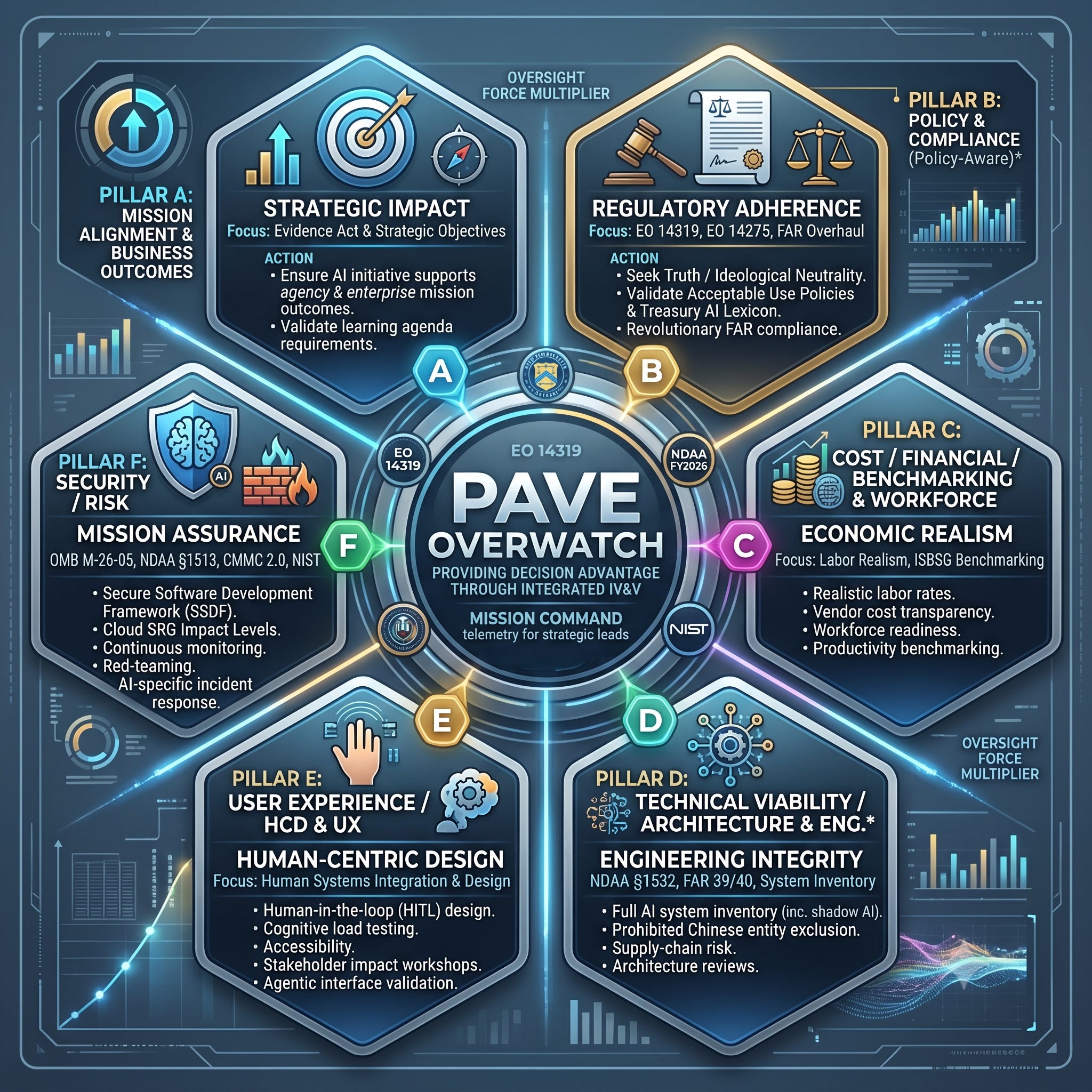
Starting this week, The Exchange Daily is adopting a new structure aligned with Metora Solutions’ PAVE (Policy Aware Validation and Estimation) framework. Each day from Monday through Saturday, we focus on one of the six PAVE pillars. Today’s Friday edition centers on Pillar E: User Experience & Human Systems Integration, examining how Section 1801 and emerging practices ensure capabilities are validated by real end users and are ready for operational impact.
Section 1801 Requires End-User Validated Acquisition Through Iteration
Section 1801 of the FY 2026 NDAA mandates that defense acquisition guidance prioritize end-user needs and be validated by direct engagement, experimentation, and iteration. This statutory requirement shifts programs toward rapid prototyping, continuous feedback, and the ability to terminate capabilities that fail to deliver results.
Action for program teams: Embed structured end-user engagement and iterative design checkpoints into every major software and system acquisition.
NEW Guidance on Governing Agentic AI Systems
A June 9, 2026 FedScoop analysis emphasizes that as federal agencies move from individual AI models to dynamic multi-agent (agentic) systems, the focus must shift to orchestration, human oversight, identity, accountability, and safety-critical workflows. Experts stress that agentic AI must deliver efficiency in a traceable manner while preserving meaningful human judgment in high-stakes environments.
Executive implication: Governance frameworks for agentic AI must include clear intervention points and accountability chains before large-scale deployment.
MVP to MVCR Through Human-Centered Design
The distinction between Minimum Viable Product (MVP) and Minimum Viable Capability Release (MVCR) is central to delivering operational value. An MVP gathers feedback to shape scope. When it lacks sufficient capability for fielding, programs use an iterative human-centered design process to define an MVCR — the initial set of features suitable for operational deployment that enhances mission outcomes. Software programs are expected to deliver an MVCR within one year of initial funding obligation.
Best practice: Treat the transition from MVP to MVCR as a deliberate, user-validated step rather than an afterthought.
Cognitive Load Management in AI-Enabled Systems
Human Systems Integration frameworks for AI emphasize measuring workload in both normal and stressed conditions. High cognitive load can cause task shedding and performance loss, while low load risks inattention. AI intended to reduce burden has sometimes increased “invisible work.” Rigorous testing of human-AI teaming under realistic mission conditions is essential.
Recommended step: Require workload measurement and human performance testing as part of AI capability evaluation criteria.
Agentic Interfaces Require Deliberate Human Oversight Design
Agentic systems capable of autonomous planning and execution offer powerful capabilities but demand explicit design for human judgment, intervention, and accountability. Without these safeguards, agencies risk eroding critical warfighter skills and losing meaningful control over high-consequence decisions.
Compliance note: Build human oversight mechanisms and transparent decision trails into agentic AI architectures from the start.
PAVE alignment: These practices directly support Pillar E objectives of ensuring software delivery moves beyond MVP to field-ready MVCR through validated human-centered design and effective human systems integration.
Topics We’re Tracking (But Didn’t Make the Cut)
Specific implementation timelines and metrics for cognitive load testing in AI-enabled systems (guidance still maturing).
Detailed case studies of successful MVCR transitions in major DoD software programs (limited public data available).
Sources
FY 2026 National Defense Authorization Act (P.L. 119-60), Section 1801 | Official text:
https://www.congress.gov/
FedScoop: “Why governing agentic AI is the next mission for federal agencies” (June 9, 2026) — NEW
DAU Adaptive Acquisition Framework: MVP / MVCR Guidance (updated references 2026)
Recent Human Systems Integration frameworks for AI-enabled capabilities (2025–2026)
The Exchange Daily and Weekly deliver verified public-source intelligence for executive decision-makers. All information is from reputable, publicly available sources. Every effort is made to keep details accurate as of publication time, but readers should always confirm time-sensitive items such as policy changes, budget figures, and timelines with official documents and briefings. Always validate with primary sources before action.
The Exchange Daily and the Exchange Weekly do not constitute legal, investment, procurement, security, compliance, or technical advice. Content is for informational purposes only.
The Exchange Daily and Weekly are a production of Metora Solutions LLC, a HUBZone and Service Disabled Veteran Owned Small Business. All rights reserved. Copyright Metora Solutions LLC 2026.


